
x


 Expressionism
 11.0 x 9.0 cm
Hand-painted oil on canvas in your size and frame, made to order by our artists. ( Buy Print Buy Image)
Pick from our preset sizes that match the artwork's original proportions.

You may enter your own dimensions to fit a specific frame or space. If your selected size does not match the original image's proportions, we will either crop the artwork or extend the painting with additional hand-painted elements. A digital mockup will be sent for your approval before production begins.
Please note that the on-screen preview does not reflect the actual cropping or extension. Only the mockup will accurately show the final composition.
While custom sizes are available, we recommend selecting a dimension from the predefined list to preserve the original proportions.
Worldwide Delivery () in 3/4 weeks instead of standard 5 weeks. (29 August). No compromise on quality.


Only Gradually Did Kuan uin
Reproduction Size

The American artist Harry Cimino (1898-1969) remains a captivating figure in the realm of early 20th-century art, particularly renowned for his evocative wood engravings and paintings that masterfully capture the essence of nature and the human experience. Born in Marion, Indiana, and later residing primarily in Falls Village, Connecticut, Cimino’s work is characterized by a distinctive atmospheric quality—a sense of quiet contemplation, subtle emotion, and an almost dreamlike realism. His art wasn't merely representation; it was a carefully constructed mood, achieved through meticulous detail and a deep understanding of light and shadow.
Cimino’s artistic journey began with formal training at the Art Institute of Chicago and further honed his skills at the prestigious Art Students League in New York. These formative experiences exposed him to diverse artistic styles and techniques, ultimately shaping his unique approach. He quickly established himself as a sought-after illustrator and engraver, contributing significantly to publications like “Sutter’s Gold” and “The Perilous Isle,” works that cemented his reputation for capturing the rugged beauty of the American West. His work wasn't confined to landscapes; he also explored themes of human interaction with nature, often depicting solitary figures within expansive natural settings.
Cimino’s most celebrated medium was undoubtedly wood engraving. This painstaking process demanded immense patience and technical skill, requiring him to carve intricate designs into a block of wood, then ink the raised surfaces and press them onto paper. The result was prints imbued with remarkable depth, texture, and tonal variation—qualities that perfectly suited his atmospheric style. His engravings for “The Print Connoisseur,” a leading publication dedicated to fine printmaking, are particularly noteworthy, showcasing his mastery of line and shading. These weren't simply illustrations; they were miniature works of art in themselves, often featuring intricate details and subtle color palettes achieved through the use of multiple blocks.
The artist’s process was deeply rooted in observation and a profound connection to the natural world. He spent considerable time studying landscapes, meticulously capturing their forms, textures, and light conditions. This dedication translated directly into his artwork, imbuing each piece with a palpable sense of authenticity and immediacy. His work reflects an appreciation for the quiet beauty of everyday life—a celebration of the simple pleasures found in nature’s embrace.
Cimino's art is often described as belonging to the broader category of American Impressionism, though he possessed a distinctly individual style. He was influenced by the works of artists like Albert Bierstadt and Thomas Moran, both renowned for their romanticized depictions of the American West. However, Cimino’s work moved beyond mere imitation, imbuing these influences with his own unique sensibility—a sensitivity to light, color, and mood that set him apart. His subjects frequently included landscapes, portraits, and scenes of rural life, often imbued with a sense of melancholy or nostalgia.
Furthermore, Cimino’s artistic vision was shaped by his personal experiences and philosophical leanings. He was a member of the Unitarian Church, a progressive religious movement that emphasized reason, social justice, and individual conscience. These values are subtly reflected in his artwork—a quiet reverence for nature, a concern for human dignity, and a rejection of superficiality.
Despite not achieving widespread fame during his lifetime, Harry Cimino’s work has gained increasing recognition in recent decades. His evocative landscapes and masterful engravings are now included in the collections of major museums, including the Smithsonian American Art Museum, testament to the enduring quality and artistic merit of his creations. His prints continue to be appreciated for their atmospheric beauty, technical skill, and profound emotional resonance.
Cimino’s legacy extends beyond his individual artworks—he represents a pivotal moment in American art history, bridging the gap between traditional illustration and modern painting. His dedication to craftsmanship, his deep connection to nature, and his subtle yet powerful artistic vision ensure that Harry Cimino's work will continue to captivate and inspire audiences for generations to come.

1898 - 1969

Master the nuances of Giclée printing with our expert guide. Discover how pigment-based inks and museum-grade substrates create fade-resistant, high-fidelity art reproductions designed for discerning collectors seeking unparalleled quality and longevity.
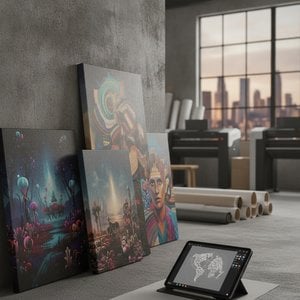
Transform your digital artistry into a prestigious global brand with WahooArt’s premium Giclée prints. Experience museum-quality archival excellence and seamless on-demand fulfillment designed for the modern creative entrepreneur seeking to build a lasting artistic legacy.


Stay updated with the latest art news, exclusive offers, and decoration ideas.
Tell us about your project and our art experts will provide you with 3 personalized art suggestions.
Let Us Curate 3 Options Just for You - Free!

 Preview
 Send
Send Share
Share
 Details

 Download
 Similars
 X-Ray
X-Ray Diaporama
 Read More




































 Glass option is only available in size under 110 CM


