A Life Bridging Worlds: The Art of Chiura Obata
Chiura Obata’s journey was one of remarkable resilience and artistic synthesis, a testament to the power of cultural exchange and the enduring spirit of creativity even in the face of adversity. Born Zoroku Sato in 1885 in Okayama Prefecture, Japan, his early life was steeped in tradition. At the age of seven, he was adopted by his older brother, Rokuichi, an artist himself, initiating a formal artistic education in the delicate art of sumi-e – Japanese ink painting. This foundational training instilled within him not just technical skill but also a deep reverence for nature and a philosophical approach to art that would permeate his entire career. Though initially steered towards a military path by his brother, Obata’s spirit yearned for artistic freedom, leading him at fourteen to leave home and pursue studies in Tokyo under masters like Tanryo Murata, Kogyo Terasaki, and Gaho Hashimoto. These years were crucial, exposing him not only to the nuances of Japanese aesthetics but also to burgeoning Western influences that would later shape his unique style. In 1903, a young Obata embarked on a new chapter, immigrating to the United States with aspirations of studying American art before continuing his journey in Europe – a path that ultimately led him to settle and flourish in San Francisco.From Illustration to Landscape: Finding a Californian Voice
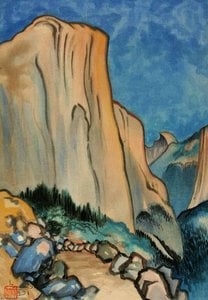
Obata’s early years in America were marked by practical necessity. He initially supported himself through illustration work for Japanese newspapers like *The New World* and *The Japanese American*, even documenting the devastation of the 1906 San Francisco earthquake through his sketches. Simultaneously, he honed his design skills working with prominent department stores such as Gump's and the Emporium. However, it was a pivotal sketching tour of Yosemite and the Sierra Nevada in 1927 that truly ignited his artistic passion and defined his trajectory. The majestic landscapes of California captivated him, inspiring a lifelong dedication to capturing their grandeur on canvas and woodblock. This period also saw the founding of the East West Art Society in San Francisco, an organization he co-founded to foster cross-cultural dialogue among artists – a reflection of his own position as a bridge between two worlds. His return trip to Japan in 1928 resulted in the creation of his celebrated “World Landscape Series,” a collection of thirty-five exquisitely detailed colored woodblock prints depicting Californian vistas, particularly those of Yosemite National Park. These prints, produced with meticulous craftsmanship at the Takamizawa Print Works, garnered recognition in Tokyo and established Obata as an artist capable of seamlessly blending Japanese techniques with Western subject matter.Teaching and Internment: Art as Resistance
From 1932 to 1954, Chiura Obata dedicated himself to education, serving as an instructor at the University of California, Berkeley. He profoundly impacted generations of students, imparting not only technical skills but also a philosophy of art rooted in observation, discipline, and a deep connection to nature. This period of stability was tragically disrupted by World War II and the forced internment of Japanese Americans. Following the attack on Pearl Harbor, Obata and his family were unjustly incarcerated first at Tanforan Detention Center and later at Topaz Relocation Center in Utah. Yet, even within the confines of these camps, Obata’s spirit remained unbroken. Demonstrating extraordinary resilience, he established an art school within Topaz, offering a creative outlet for fellow detainees and providing instruction in over twenty-five subjects to as many as 95 students weekly. This act was not merely a gesture of hope; it was an act of resistance – a powerful assertion of cultural identity and the enduring human need for self-expression in the face of oppression. Support from organizations like UC Berkeley helped sustain this remarkable initiative, highlighting the importance placed on art even during times of national crisis.Legacy and Enduring Influence
After his release from internment, Obata resumed his artistic career with renewed vigor. His work gained wider recognition through exhibitions and publications, solidifying his reputation as a significant figure in California art. He became a naturalized U.S. citizen in 1954 and continued to paint, teach, and lead tours to Japan, sharing his knowledge and passion for both cultures. Chiura Obata’s historical significance lies not only in the beauty of his artwork but also in his role as a cultural ambassador and advocate for artistic expression. His art uniquely blends Japanese traditions with Western influences, reflecting his personal experiences and bridging divides. He documented the splendor of California's wilderness, providing a valuable visual record of its natural beauty. His establishment of an art school within the internment camp stands as a powerful symbol of hope and resilience, demonstrating the transformative power of art in times of adversity. Obata’s contributions to American art, his dedication to teaching, and his unwavering commitment to artistic expression have left an enduring legacy, inspiring artists and audiences alike for generations to come. His work continues to resonate today, reminding us of the importance of cultural understanding, the power of creativity, and the indomitable spirit of the human heart.Questions & Answers
Where is Chiura Obata from?
Chiura Obata was born in Japan.
Where can I see Chiura Obata's artworks in chronological order?
A timeline of Chiura Obata's works exists: the artist's Artwork Timeline page orders the artworks by creation date.
What are the birth city and country of Chiura Obata?
Chiura Obata was born in Okayama, in Japan.