Purchase a high-resolution, enhanced digital image, far superior to the online preview.
Each file is meticulously prepared by our in-house specialists using advanced tools and expert manual retouching. We ensure every image has exceptional clarity, precise color accuracy, and fine detail.
The final file is delivered via email within 72 hours, optimized for immediate use in professional, editorial, and print environments. This is the same quality trusted by top-tier design studios, publishers, and galleries.
Download a high-resolution file for personal display, printing, and creative projects. ( Switch to Print Buy Hand Made Painting)
When you choose WahooArt.com, you're not just getting an image - you're receiving a professionally enhanced digital artwork, crafted with precision and backed by a satisfaction guarantee. Here's everything that comes with your order, automatically:
Your high-resolution digital image file will be emailed to you within 72 hours of ordering - ready for immediate use.
Your artwork is professionally optimized using advanced AI tools and manual editing, ensuring maximum detail, clarity, and color accuracy.
Accidentally deleted or lost your file? No worries - we'll resend it to you anytime, free of charge.
Enjoy your artwork instantly with zero customs, duties, or delivery fees - digital downloads are always tax-free.
We ensure your digital image reflects the original colors as closely as possible using professional tools and color management.
If you're not satisfied with your digital image, we'll revise it or refund 100% within 100 days - no questions asked.
Not satisfied? Get a full refund within 100 days of receiving your digital file - no questions asked.
Buy 3 images, save 10% - Buy 5, save 15% - Buy 10+, save 20%. Great for creative projects, galleries, and agencies.
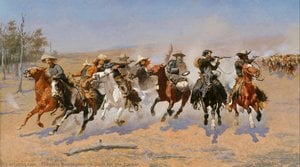
Frederic Remington's "A Study," painted in 1908, isn’t merely a depiction of a horse; it’s a profound meditation on the relationship between man and beast, a snapshot of the American West rendered with an almost palpable sense of movement and observation. The painting captures a sorrel stallion – its coat a rich, burnished copper – in a moment of quiet contemplation as it grazes within a sun-drenched field. Remington, a master of capturing the rugged spirit of the frontier, eschews romanticized grandeur for a more intimate, almost scientific approach to his subject. He wasn’t interested in heroic battles or sweeping landscapes; instead, he sought to understand and portray the subtle nuances of animal behavior, particularly the horse – an integral part of Western life.
Remington's technique is characterized by a remarkable sensitivity to light and shadow. The painting is dominated by a warm, golden glow that washes over the horse’s coat, highlighting its musculature and creating a sense of warmth and vitality. Notice how he uses short, broken brushstrokes – a hallmark of his style – to suggest movement and texture. These quick, decisive marks capture not just the physical form of the animal but also the feeling of it shifting slightly with each breath, each subtle shift in weight. The background is rendered with a looser, more atmospheric approach, suggesting distance and depth without sacrificing the overall clarity of the composition.
For Remington, the horse represented far more than just transportation or labor; it embodied the very essence of the American West. It was a symbol of independence, resilience, and the enduring connection between humans and nature. The sorrel stallion in “A Study” embodies these qualities perfectly – strong, proud, and deeply rooted in its environment. Remington’s fascination with horses stemmed from his own childhood experiences on the ranch, where he spent countless hours observing their behavior and learning to ride them. This intimate knowledge is evident in the painting's remarkable accuracy and emotional resonance.
Furthermore, the horse held a complex significance within Native American culture, often viewed as a sacred animal. Remington’s work, while sometimes criticized for its romanticized portrayal of the West, also acknowledged this deeper connection to the land and its inhabitants. The painting subtly hints at this duality – the powerful, independent spirit of the horse mirrored in the vastness of the Western landscape.
“A Study” offers a rare glimpse into Remington's working method. He began with numerous preliminary sketches and studies, meticulously observing the horse’s anatomy, posture, and expression. These preparatory drawings reveal his deep understanding of equine movement and his commitment to capturing the animal’s true character. The painting itself is believed to be based on a live model – likely one of Remington's own horses – which allowed him to accurately render its form and capture its unique personality.
Remington was known for his dedication to realism, but he also possessed a remarkable ability to infuse his paintings with emotion. “A Study” is not simply a portrait; it’s an evocation of the spirit of the West – a testament to the enduring beauty and power of nature, and the profound connection between humans and animals.
Reproductions of "A Study" offer a wonderful opportunity to bring this iconic image into your home or office. The quality of these reproductions varies greatly; seek out prints created using giclée technology, which ensures exceptional color accuracy and detail. The original’s subtle tonal variations are faithfully reproduced, capturing the painting's atmospheric depth and luminous quality. Consider framing the print in a natural wood frame to complement the painting’s rustic charm.
Beyond its aesthetic appeal, “A Study” serves as a powerful reminder of Frederic Remington’s enduring legacy as one of America’s greatest Western artists. It is a timeless masterpiece that continues to captivate viewers with its evocative imagery and profound insights into the human spirit.
The recommended space for "A Study" by Frederic Remington is a living room. The suggestion can of course be adapted to your interior.
"A Study" has a calm atmosphere.
The medium of "A Study" by Frederic Remington is acrylic on canvas, and the work is dated 1908.
In terms of perceived brightness, "A Study" by Frederic Remington is balanced.
"A Study" is classified as recognized.
"A Study" by Frederic Remington has a calm atmosphere and is recommended for a living room. The mood is what the work brings to the space around it.
The color harmony of "A Study" is recorded as balanced harmony.
"A Study" depicts horse, western, remington, landscape, cowboy, plains, study, painting, while Frederic Remington's recorded themes are western frontier life, native american subjects, cowboy culture imagery, realistic depictions”, “remington’s signature style”. Comparing the two shows how the work relates to the artist's usual subjects.


1861 - 1909 , United States of America

 Preview
 Send
Send Share
Share
 Details
 Guide
Guide

 Download
 Similars
 X-Ray
X-Ray Diaporama
 Stats
Stats


 Read More