Hand-painted oil on canvas in your size and frame, made to order by our artists. ( Switch to Print Switch to Digital Image)





























Pick from our preset sizes that match the artwork's original proportions.

You may enter your own dimensions to fit a specific frame or space. If your selected size does not match the original image's proportions, we will either crop the artwork or extend the painting with additional hand-painted elements. A digital mockup will be sent for your approval before production begins.
Please note that the on-screen preview does not reflect the actual cropping or extension. Only the mockup will accurately show the final composition.
While custom sizes are available, we recommend selecting a dimension from the predefined list to preserve the original proportions.
Worldwide Delivery () in 3/4 weeks instead of standard 5 weeks. (13 October). No compromise on quality.
Ridden Down
Reproduction Size
Frederic Remington's "Ridden Down," painted in 1905, isn’t merely a depiction of cowboys and horses; it’s a profound meditation on solitude, resilience, and the enduring spirit of the American West. This oil-on-canvas masterpiece, currently residing within the Amon Carter Museum of American Art in Fort Worth, Texas, captures a pivotal moment – a lone Native American rider silhouetted against an expansive, undulating sand dune landscape under a brilliant, cloudless sky. Remington, a master of portraying the frontier, expertly blends realism with an impressionistic sensibility, creating an image that simultaneously feels immediate and deeply symbolic.
The painting’s composition immediately draws the eye to the central figures: a man, clad in a simple green shirt, riding a powerful mustang. The horse is positioned behind him, its head lowered as if acknowledging the immensity of the terrain. Remington skillfully employs horizontal lines created by the towering sand dunes, which dominate the scene and establish a sense of overwhelming scale. These sweeping forms contrast sharply with the verticality of the rider and horse, emphasizing their vulnerability against the backdrop of nature’s grandeur. Two birds soar high above, adding a touch of fleeting beauty to this otherwise stark landscape – perhaps representing freedom or a distant hope.
Remington’s technique is immediately recognizable—bold, expressive brushstrokes that convey both the physicality of the scene and an underlying sense of movement. He doesn’t shy away from visible texture; the sand dunes are rendered with a rough, grainy quality, while the horse’s coat appears almost sculpted by the artist's hand. The color palette is dominated by warm yellows and ochres, reflecting the sun-baked earth and creating a feeling of intense heat. Cool blues in the sky provide a striking contrast, highlighting the vastness of the space and adding depth to the composition. Remington masterfully uses light and shadow to sculpt the forms, lending them a remarkable three-dimensionality.
The painting’s dynamic energy is further enhanced by his use of color—a vibrant, almost feverish application that captures the intensity of the desert environment. Notice how he subtly shifts tones within the sand dunes, suggesting variations in texture and depth. This attention to detail, combined with his confident brushwork, elevates “Ridden Down” beyond a simple landscape painting; it becomes a visceral experience for the viewer.
"Ridden Down" is more than just a visual record of the American West; it’s imbued with layers of symbolic meaning. The lone rider, often interpreted as a Native American figure, embodies themes of survival, adaptation, and resilience in the face of an increasingly encroaching civilization. The posture of the horse—lowered head, steady gait—suggests both respect for the land and a quiet determination to endure. Considering Remington’s own career, which coincided with a period of significant change and displacement for Native American communities, the painting can be viewed as a poignant commentary on this historical context.
Painted in 1905, “Ridden Down” reflects the waning days of the frontier era. Remington’s work often depicted scenes of cowboys, Indians, and the wild west—a romanticized vision that captured the imagination of a nation eager to define its identity. However, it's important to note that Remington’s portrayal was not without its complexities; he sometimes perpetuated stereotypes while simultaneously capturing the raw beauty and inherent drama of the West. The painting stands as a testament to his skill as an artist and a valuable window into a transformative period in American history.
To delve deeper into Frederic Remington’s artistic legacy, consider examining "The Wounded Buffalo," another iconic work showcasing his mastery of capturing the spirit of the West. You can explore more of his paintings and writings at WahooArt.com, where you'll find a curated selection of his most celebrated works. For further insights into Remington’s life and career, visit the Amon Carter Museum of American Art (here) or explore his biography on Wikipedia (here). And for a visual journey through the world of Frederic Remington, be sure to visit this page.
Among Frederic Remington's recorded themes - western expansion influence, native american culture", frontier life depiction, military & exploration, remington's iconic style, american identity theme, landscapes & human scale, key work in artist corpus - "Ridden Down" brings its own focus on american west, native american, horseback riding, desert landscape, remington art, western theme, lone figure, dynamic scene”.
"Ridden Down" was created by Frederic Remington, born in United States of America, within the American Regionalism” movement. The artist's origin links the work to American Regionalism” as practiced by artists from United States of America.
"Ridden Down" was created by Frederic Remington in 1905.
"Ridden Down" by Frederic Remington is recommended for a living room. This suggestion is based on the work's subject, colors and mood.
The colors of "Ridden Down" show a luminous luminance.
Behind "Ridden Down" stand Frederic Remington and the American Regionalism” movement.
"Ridden Down" was created in 1905 as a work of the American Regionalism” movement. Date and movement anchor the artwork in art history.
The copyright answer for "Ridden Down" by Frederic Remington: the work is in the public domain - its copyright has expired. This determines whether reproductions of the image may be freely made.


1861 - 1909 , United States of America

Explore the life & legacy of Benjamin West, pioneering American artist and Royal Academy president. Discover his Neoclassical masterpieces, transatlantic influence, and lasting impact on art history. Learn more at WahooArt.
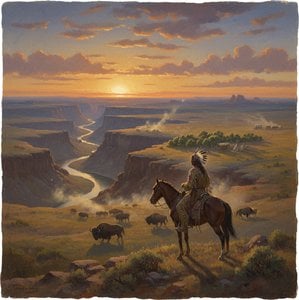
Explore the evocative paintings of Henry Farny, renowned for his romantic realism & depictions of Native American life in the 19th-century West. Discover his legacy and key artworks at WahooArt.

Explore the world of Grant Wood & American Regionalism with WahooArt. Discover the symbolism behind 'American Gothic', recurring themes, and the movement's lasting impact on art history. High-quality reproductions available.

Explore the captivating world of Charles Marion Russell, 'the cowboy artist.' Discover his life, iconic paintings, advocacy for Native Americans, and investment potential. A guide for discerning art collectors.

Explore the captivating art of Alfred Jacob Miller, chronicler of the American West. Discover his iconic paintings, techniques & lasting legacy – a valuable addition to any serious collection. Learn more at WahooArt.

 Preview
 Send
Send Share
Share
 Details
 Guide
Guide

 Download
 Similars
 X-Ray
X-Ray Diaporama
 Stats
Stats


 Read More









 Glass option is only available in size under 110 CM