

 Oil On CanvasWallArtRococo
 1755
1755 36.0 x 35.0 cm
 Royal Collection
Museum-quality giclée or canvas print with fast production and flexible finish options. ( Buy Hand Made Painting Switch to Digital Image)





























Pick from our preset sizes that match the artwork's original proportions.

Type the width and the height you need, to fit your frame or your wall. A print can only be cut, never made bigger than the picture, so a size with a different shape loses a part of the image. We send you a digital mockup to approve before we print anything. The picture shown on this page does not show the real cut — only the mockup does.
Worldwide Delivery () in 2 weeks instead of standard 4/5 weeks. (18 October)
Longcase equation clock
Reproduction Size
The French longcase equation clock presented here is more than a mere timekeeper; it’s a miniature universe, a testament to 18th-century scientific ambition and exquisite craftsmanship. Crafted in 1755 by Ferdinand Berthoud, a name synonymous with precision and innovation in horology, this remarkable piece transcends the functional, becoming a captivating work of art that speaks volumes about the intellectual currents of its time.
Berthoud’s genius lay not just in assembling gears and springs, but in understanding the complex relationship between time and the cosmos. He sought to reconcile the imperfect measurements of local sundials with the steady march of the solar year, creating a clock that displayed both the standard hours and the true, astronomical time – a feat considered revolutionary for its day. This ambition is immediately apparent in the clock’s dual faces: one meticulously marking the familiar twelve-hour cycle, the other presenting a more sophisticated representation of the solar day, complete with indications of leap years and the solstices and equinoxes.
The clock’s case is a masterpiece in itself, a lavish display of marquetry and gilded ornamentation executed by Charles Cressent, a renowned cabinet-maker and sculptor. The intricate inlay work depicts a vibrant scene – cherubs playfully scattering fruit amongst lions’ heads, all set against a backdrop of stylized foliage and floral motifs. This opulent design reflects the prevailing Rococo style, characterized by its exuberance, asymmetry, and playful use of ornamentation. The claw feet, rising gracefully upwards, add to the piece's aristocratic charm.
Beyond the decorative elements, the case’s construction reveals a remarkable level of skill. The shaped upright form is not merely aesthetic; it was designed to maximize space for the intricate movement within. Cressent’s mastery is evident in the seamless integration of the marquetry with the surrounding wood, creating a harmonious and visually stunning whole.
At the heart of this clock lies Berthoud’s groundbreaking equation movement. This ingenious mechanism, meticulously crafted by B.L. Vulliamy in 1821, calculates the true solar time and displays it alongside the standard hours. The complexity is astounding – a network of gears, wheels, and levers working in perfect synchronicity to achieve this feat of engineering. The clock’s dial itself is a testament to Berthoud's scientific mind, incorporating astronomical indicators that reveal the positions of the sun and moon at any given time.
It’s important to note that Berthoud’s work extended far beyond this single clock. He was instrumental in developing marine chronometers – essential instruments for navigation at sea – and authored numerous scientific treatises on horology, solidifying his reputation as a leading figure in the field. His contributions were recognized by the Royal Society of London, where he was elected a Fellow in 1764.
The Longcase Equation Clock is more than just an antique; it’s a tangible link to a pivotal moment in scientific history. It embodies the Enlightenment spirit of inquiry, combining artistic beauty with intellectual rigor. Its intricate design, masterful craftsmanship, and revolutionary mechanics make it a truly exceptional piece – a captivating reminder of the ingenuity and artistry that flourished during the 18th century. Reproductions capture some of this magic, offering a way to bring this remarkable clock into any home or collection.
A print of "Longcase equation clock" by Ferdinand Berthoud can be ordered directly on its Fine Art Print page: a fine art print on cotton canvas or archival canvas paper.
The original "Longcase equation clock" by Ferdinand Berthoud is an oil on canvas work measuring 36 x 35 cm. Technique and size describe the original object.
"Longcase equation clock" by Ferdinand Berthoud has a gentle luminance luminance. Luminance describes how much light the colors appear to reflect.


1727 - 1807 , Switzerland
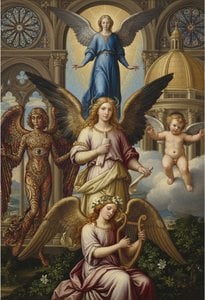
Explore the profound beauty of angelic figures in art history. From Renaissance masterpieces to celestial symbolism, our expert guide offers a sophisticated journey through the divine imagery of the Old Masters for discerning collectors and art enthusiasts.

 Preview
 Send
Send Share
Share
 Details
 Guide
Guide

 Download
 Similars
 X-Ray
X-Ray Diaporama
 Stats
Stats Read More









 Glass option is only available in size under 110 CM


