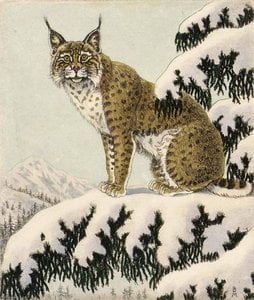
Naturalistic Prints
 1932
1932 9.0 x 11.0 cm
The artwork displayed on this page is protected by copyright law, which means we cannot legally create or sell an identical reproduction. This protection is enforced under international agreements such as the Berne Convention and by national laws, including those outlined by the U.S. Copyright Law - Title 17.
As a respectful and legal alternative, we offer custom, hand-painted artworks inspired by the original. Our skilled and professional artists carefully study the original's style, mood, and artistic essence to create a new, unique piece that evokes the same feeling - while remaining an original creation in its own right.
This method fully complies with copyright regulations because it does not involve copying or duplicating the protected artwork. Instead, it is a creative reinterpretation - a new painting that is influenced by the original but not identical to it.
Hand-painted oil on canvas in your size and frame, made to order by our artists. ( Switch to Print Switch to Digital Image)
Pick from our preset sizes that match the artwork's original proportions.

Type the width and the height you need, to fit your frame or your wall. This is hand-painted, so for a size with a different shape the artist can paint a bit more around the picture, or cut a bit — you choose. We send you a digital mockup to approve before the painting starts. The picture shown on this page does not show the real result — only the mockup does.
Worldwide Delivery () in 3/4 weeks instead of standard 5 weeks. (22 October). No compromise on quality.
Deer
Reproduction Size
The colors of "Deer" show a bright balance luminance.
The colors of "Deer" by Benson B Moore have a muted saturation. Saturation describes how vivid or muted the colors are.
"Deer" represents the Early 20th Century of Benson B Moore.

Benson Bond Moore, a name perhaps less familiar than some of his contemporaries, nevertheless holds a significant place within the pantheon of American wildlife artists of the early to mid-20th century. Born in Washington D.C. in 1882, Moore’s artistic journey was deeply intertwined with the city's cultural landscape and a surprisingly diverse range of experiences – from assisting in the restoration of iconic paintings at the Capitol Building to meticulously documenting the animal kingdom for newspapers. His work, characterized by an almost obsessive attention to detail and a profound respect for the natural world, offers a captivating glimpse into a bygone era of American art and conservation.
Moore’s early life provided him with an unusual foundation for his future career. Rather than formal artistic training initially, he learned the craft of painting restoration from his father, a respected professional who worked on numerous pieces within the White House. This apprenticeship instilled in him a deep understanding of materials, techniques, and the inherent value of preserving artistic heritage. Later, he studied at the Corcoran School of Art, absorbing influences from prominent landscape painters like Edmund Messer and Richard Brooke – figures associated with the Barbizon School movement, known for its emphasis on plein air painting and capturing the essence of nature. However, Moore’s style quickly evolved beyond a simple imitation of these traditions, developing into a distinctly personal and evocative approach.
Moore's artistic trajectory took an unexpected turn when he began working for the Maurice Joyce Photo-Engraving Company in Washington D.C., assisting Dr. Alexander Graham Bell in developing hearing aids for the deaf. This experience honed his observational skills and attention to detail, qualities that would later prove invaluable in his wildlife paintings. Simultaneously, he contributed illustrations to “The Evening Star,” a prominent newspaper, producing over 3700 drawings of animals – a remarkable undertaking that showcased his ability to capture the nuances of animal behavior and form. This period cemented his reputation as a skilled naturalist-artist, blending scientific observation with artistic expression.
His work for the Smithsonian Institution further solidified his standing within the art world. He created numerous illustrations for their “Scientific Series,” demonstrating his commitment to both artistic excellence and scientific accuracy. The influence of this period is evident in his later paintings – a meticulous rendering of animal anatomy combined with an intuitive understanding of light, shadow, and texture. Moore’s dedication to portraying animals in their natural habitats was not merely aesthetic; it reflected a growing awareness of the importance of conservation during a time when America's wilderness was rapidly being transformed.
Moore’s paintings are immediately recognizable for their extraordinary level of detail. He employed a combination of techniques – including drypoint etching, watercolor, and oil painting – to achieve this remarkable realism. His use of light was particularly masterful, creating a sense of atmosphere and depth that brought his subjects to life. He wasn't simply copying what he saw; he was striving to capture the *feeling* of being immersed in nature.
His subjects – deer, owls, yellow perch, and other wildlife – were rendered with an almost photographic precision, yet imbued with a palpable sense of life and movement. Moore’s work stands as a testament to his dedication to observation, skill, and artistic vision.
Benson Bond Moore continued to paint until his death in 1974, leaving behind a substantial body of work that is now recognized for its exceptional quality and historical significance. His paintings are held in prominent collections across the United States, including the Smithsonian American Art Museum, the Maryland Center for History and Culture, and the Washington County Museum of Fine Arts. His legacy extends beyond his individual artistic achievements; he represents a pivotal moment in American art history – a time when artists were increasingly engaged with the natural world and committed to documenting its beauty and fragility.
Moore’s work serves as a reminder that true artistry lies not only in technical skill but also in a deep connection to the subject matter. He was, in essence, an artist of observation, translating his profound respect for nature into paintings that continue to captivate and inspire viewers today.

1882 - 1974

Master the nuances of Giclée printing with our expert guide. Discover how pigment-based inks and museum-grade substrates create fade-resistant, high-fidelity art reproductions designed for discerning collectors seeking unparalleled quality and longevity.
Explore the intricate world of etching and intaglio printmaking. Discover how masters use acid and metal to create profound textures and lines, from Romanticism to modern era, through an expert lens of art history and technical mastery.

Transform your digital artistry into a prestigious global brand with WahooArt’s premium Giclée prints. Experience museum-quality archival excellence and seamless on-demand fulfillment designed for the modern creative entrepreneur seeking to build a lasting artistic legacy.

 Preview
 Send
Send Share
Share
 Details
 Guide
Guide

 Download
 Similars
 X-Ray
X-Ray Diaporama
 Stats
Stats Read More






































 Glass option is only available in size under 110 CM