The Intersection of Thought and Form
Born in the French town of Pessac in 1978, Benoît Maire has emerged as a profound voice in contemporary visual arts, a creator whose work functions as a bridge between the tangible world and the abstract realms of philosophical inquiry. His artistic identity is inextricably linked to his intellectual pursuits; having studied philosophy at Sorbonne Université Paris I and visual arts at Villa Arson in Nice, Maire does not merely create objects, but rather translates complex theoretical concepts into visceral, sensory experiences. This unique duality allows him to treat theory itself as an art form, transforming the silent weight of a sculpture or the vibrant depth of a painting into a medium for profound discourse.
Maire’s early life and education provided the fertile ground necessary for such a multidisciplinary approach. Growing up in Pont-de-Vivaux, Marseille, he developed an acute sensitivity to observation and reflection, qualities that would later define his meticulous engagement with materiality. His Italian heritage further enriched this perspective, instilling a cosmopolitan openness to diverse cultural narratives. As his career progressed through prestigious residencies at the Palais de Tokyo and the Villa Medici in Rome, Maire expanded his repertoire far beyond the canvas, mastering film, sculpture, photography, collage, and performance art to create a holistic language of expression.
Materiality and the Language of Symbolism
The essence of Maire’s practice lies in his ability to manipulate physical matter to evoke metaphysical truths. He is particularly noted for his nuanced approach to materiality, often utilizing wood as a primary medium to explore texture, form, and organic decay. In his sculptural works, the grain and weight of the material serve as anchors for symbolic exploration, while his paintings utilize evocative color palettes to capture fleeting atmospheres and deep-seated emotions. His work frequently navigates the tension between geometry and chaos, using structured forms to probe the complexities of sociology, mythology, and psychoanalysis.
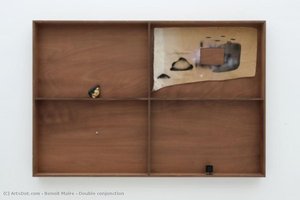
Central to his conceptual framework is the influence of Jean-François Lyotard’s concept of the ‘differend’—the idea that meaning can exist in the gaps where language fails. Maire utilizes the canvas and the sculptural space as arenas for confronting these very contradictions, challenging established paradigms through visual metaphors. Whether through the cinematic narratives of his films or the intricate textures of his photographic still lifes, such as Double conjonction, he invites the viewer to look beyond the surface and engage with the underlying structures of reality.
A Legacy of Global Recognition
The significance of Benoît Maire’s contribution to contemporary art is reflected in the widespread acclaim and the prestigious institutions that house his work. His career is marked by a series of landmark solo exhibitions across the globe, from Soon the metal between us will turn into gold at Kunsthalle Mulhouse to Pierrots in Brussels. These exhibitions have served as vital platforms for presenting his evolving dialogue between art and intellect to an international audience.
His enduring impact is perhaps most clearly seen in the permanence of his presence within major public collections, ensuring that his philosophical explorations continue to resonate with future generations. Notable collections include:
- Centre Georges Pompidou – Musée National d’Art Moderne, Paris
- FRAC Aquitaine, Bordeaux
- Kadist Art Fondation, Paris
- David Roberts Art Foundation, London
- New National Museum of Monaco, Monaco
- Vancouver Art Gallery, Canada
Through this vast and varied body of work, Maire remains a vital figure in the contemporary landscape, reminding us that art is not merely a window to the world, but a profound tool for questioning the very nature of existence.



 Preview
 Buy Hand Made Painting
 Send
Send Share
Share
 Details

 Download
 Similars
 X-Ray
X-Ray Diaporama


 Read More






































 Glass option is only available in size under 110 CM