The Quiet Genius of Baroque Still Life
Sebastian Stoskopff (July 13, 1597 – February 10, 1657) stands as a pivotal figure in German Baroque art, yet his name remains relatively obscure compared to contemporaries like Rembrandt or Rubens. Rediscovered after decades of neglect following World War II, Stoskopff’s oeuvre—primarily consisting of meticulously rendered still lifes featuring goblets, glasses, and occasionally fruit—offers a unique glimpse into the artistic sensibilities of his era and possesses an understated elegance that continues to captivate scholars and collectors alike. His work is characterized by a profound stillness, a quality that invites the viewer into a meditative state, contemplating the fragile beauty of the objects he so lovingly rendered.
Born in Strasbourg, Alsace, at a time when the region was part of the Holy Roman Empire, Stoskopff descended from a family steeped in Huguenot tradition. His father, a civil servant employed by the city council, instilled in him a strong sense of civic duty alongside an appreciation for intellectual pursuits. Recognizing Sebastian’s innate talent for drawing and painting at a young age—around fifteen—his father proactively sought assistance from the Strasbourg art community. He specifically recommended Daniel Soreau, a respected painter and engraver based in Hanav. While Soreau initially hesitated to accept apprentices from his own family, he ultimately agreed to nurture Stoskopff’s artistic ambitions, sending him to Hanau for formal training. Though Soreau's methods were somewhat traditional, favoring familial connections, he recognized Stoskopff’s potential and ensured he gained foundational skills in drawing, mirroring the techniques championed by masters like Albrecht Dürer.
Mastery of Light and Materiality
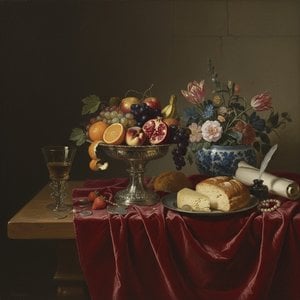
Soreau’s workshop served as a crucible for Stoskopff's artistic evolution. Despite Soreau's reluctance to introduce him to painting directly—a common practice at the time—Stoskopff diligently honed his observational skills and mastered the subtleties of chiaroscuro, employing dramatic lighting to breathe life into inanimate objects. This mastery is perhaps most evident in his celebrated works from the 1640s, such as his Still-Life of Glasses in a Basket (1644). In these compositions, the artist demonstrates an almost supernatural ability to capture the translucency of glass, the glint of light on a silver rim, and the heavy, tactile presence of ceramic or metal. His technique allowed him to navigate the delicate boundary between reality and illusion, creating textures so convincing they seem to vibrate with life.
His development was marked by an increasing sophistication in his use of symbolism, often leaning into the vanitas tradition. Through the depiction of luxury glassware and fine bottles, Stoskopff did not merely showcase wealth; he whispered of the ephemeral nature of existence. In works like Still-Life with Glasses and Bottles (1641), the serene arrangement serves as a silent memento mori, reminding the viewer of the fleeting beauty of the material world. This ability to blend technical virtuosity with deep, philosophical undertones is what elevates his work from mere decoration to profound artistic expression.
Legacy and Historical Significance
The historical significance of Sebastian Stoskopff lies in his unique position as a bridge between the Northern Renaissance traditions of his training and the burgeoning Baroque sensibilities of the 17th century. While much of the art of this period moved toward grand, sweeping narratives, Stoskopff found greatness in the minute and the overlooked. His contribution to the genre of still life is characterized by:
- Precision and Realism: An unparalleled ability to render the physical properties of glass, liquid, and metal with scientific accuracy.
- Atmospheric Depth: The use of light and shadow to create a sense of space and quietude that distinguishes him from the more boisterous Dutch masters.
- Symbolic Complexity: The integration of subtle vanitas themes that invite intellectual engagement beyond simple aesthetic appreciation.
Though his fame was eclipsed for centuries, the modern rediscovery of his talent has restored him to his rightful place in the canon of European art. Today, collectors and historians look to Stoskopff not just as a skilled craftsman, but as a master of atmosphere, whose quiet, luminous compositions continue to resonate with the timeless human fascination with light, shadow, and the beauty of the ephemeral.
Questions & Answers
Where are Sébastien Stoskopff's artworks mapped by subject?
The Subject Atlas of Sébastien Stoskopff is a page that maps the artist's artworks by their subjects.
How can I see every artwork made by Sébastien Stoskopff?
Every work by Sébastien Stoskopff on this website can be browsed from the artist's All Artworks page.
Where is Sébastien Stoskopff from?
Sébastien Stoskopff was born in France.
What moods do Sébastien Stoskopff's artworks express?
The Mood Room of Sébastien Stoskopff is a page that arranges the artist's artworks by mood.
What are the birth city and country of Sébastien Stoskopff?
Sébastien Stoskopff was born in Strasbourg, in France.
Which artworks by Sébastien Stoskopff are the most viewed?
A Stats page exists for Sébastien Stoskopff, presenting statistics about the artist's artworks on this website.
How is Sébastien Stoskopff's career divided into periods?
The Chronicle of Sébastien Stoskopff is a scroll-driven timeline that presents the artist's works in chronological order, grouped into career-period chapters.
Can I explore Sébastien Stoskopff's works by color spectrum?
The Spectral Index of Sébastien Stoskopff is a page that organizes the artist's artworks by their colors.