Museum-quality giclée or canvas print with fast production and flexible finish options. ( Buy Hand Made Painting Switch to Digital Image)





























Pick from our preset sizes that match the artwork's original proportions.

Type the width and the height you need, to fit your frame or your wall. A print can only be cut, never made bigger than the picture, so a size with a different shape loses a part of the image. We send you a digital mockup to approve before we print anything. The picture shown on this page does not show the real cut — only the mockup does.
Worldwide Delivery () in 2 weeks instead of standard 4/5 weeks. (16 November)
Flora, Scattering Flowers
Reproduction Size
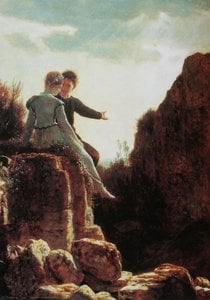
To gaze upon this scene is to step through a veil into a moment suspended between dream and reality. The painting, Flora, Scattering Flowers, presents us with an idyllic tableau where the human spirit seems perfectly attuned to the gentle rhythms of nature. At its heart stands a woman, clad in flowing blue garments that echo the tranquility of a distant river. She is not merely posing; she is participating in a quiet communion with the bounty surrounding her, holding forth blossoms as if offering secrets whispered only to the breeze. The composition guides the eye effortlessly across this pastoral setting, suggesting a leisurely stroll through an overgrown garden or meadow.
The very title speaks to themes of ephemerality and abundance. The scattering flowers are more than mere decoration; they are potent symbols of life's fleeting beauty—the perfect bloom that must eventually fade, yet in its passing, it creates a breathtaking moment of perfection. This sense of delicate transience is echoed by the two birds visible in the azure expanse above. They seem to be messengers, carrying away moments of pure freedom across the sky. Furthermore, the inclusion of the potted plant anchors the scene, suggesting that even cultivated beauty finds its counterpart in wild, untamed growth. The overall atmosphere achieved is one of profound serenity, a visual balm for the modern soul.
While the specific context places this work within an unknown period, the sensibility resonates deeply with the Symbolist movements that captivated artists like Arnold Böcklin. Though perhaps not directly by him, the painting shares a kinship with the Romantic fascination for allegory and the merging of mythic narrative with natural settings. The gentle melancholy inherent in such scenes—the beauty tinged with the knowledge of its passing—is a hallmark of art that seeks to explore deeper truths beyond mere depiction. It invites contemplation on cycles: birth, bloom, scattering, and rest.
For the collector or designer seeking to infuse a space with an aura of peaceful sophistication, this reproduction offers unparalleled depth. Imagine this piece gracing a sunlit drawing-room or a tranquil bedroom retreat. The soft blues and vibrant bursts of floral color provide natural focal points, while the overall pastoral calm acts as a visual anchor for any room's decor scheme. It is art that does not shout but rather whispers its beauty into your daily life, transforming a mere wall into a portal to an idealized, blooming afternoon.
The Stats page of "Flora, Scattering Flowers" by Arnold Böcklin presents public visit statistics: monthly visits of this artwork, a comparison with the artist's most viewed works, and where its visitors come from.
"Flora, Scattering Flowers" by Arnold Böcklin conveys a tranquil emotional tone.
The recommended space for "Flora, Scattering Flowers" by Arnold Böcklin is a living room. The suggestion can of course be adapted to your interior.

Basel, Switzerland, provides the starting point for a life defined by the tension between the tangible and the spectral. Born on October 16, 1827, to Christian Frederick Böcklin and Ursula Lippe, the young man would eventually move beyond the silk trade of his father to the rigorous halls of the Düsseldorf Academy. Under the guidance of Schirmer, he began to absorb the language of landscape, a skill that would later be used to map the geography of the human soul. He did not merely paint scenery; he constructed realms where the classical and the macabre collide.
The movement from the academic discipline of Düsseldorf to the light of Paris and the ancient weight of Rome marks a fundamental shift in his vision. In the Louvre, he absorbed the history of the masters, but it was the atmosphere of Italy that truly shaped his hand. He returned to Rome between 1862 and 1866, a period where his palette began to favor more violent, expressive colors. This was not the bright, sun-drenched Italy of the Renaissance, but a place of deep shadows and mythological weight. His work began to lean into the allegorical, using figures from antiquity to explore the heavy, inescapable presence of mortality.
By the late 19th century, his reputation was anchored by a specific, haunting preoccupation. Between 1880 and 1886, he produced five versions of The Isle of the Dead. This work, inspired by the English cemetery in Florence where his daughter was buried, became a focal point for the Symbolist movement. It is a scene of profound stillness: a rocky islet, dark cypress trees, and a rowboat approaching a silent shore. The painting does not merely depict a place; it depicts a state of being. This ability to render the intangible—the whispers of dreams and the weight of the afterlife—placed him at the center of a new European sensibility.
His technical approach often utilized a thick, expressive impasto, particularly in works like La Guerre (1896). In this piece, the canvas trembles with the chaos of conflict. He avoids the clean lines of traditionalism, opting instead for a dense, layered composition where figures clash amidst crumbling architecture. It is a visceral manifestation of destruction, where the veil between myth and reality dissolves into a storm of shadows. His style overlapped with the Pre-Raphaelites, yet he remained distinct, focused on a mysticism that felt both ancient and unsettlingly modern.
The impact of his imagery extended far beyond the canvas, reaching into the auditory realm of late-Romantic music. His paintings provided a visual stimulus for composers, most notably influencing the atmosphere of Gustav Mahler’s work. His ability to bridge the gap between the visual and the psychological meant that his influence was felt by those who sought to represent the subconscious. His reach touched several generations of artists:
He died in Fiesole, Italy, leaving behind a body of work that refused to be easily categorized. He was a painter of the Swiss landscape, the Roman tavern, and the mythological grove, yet his true subject remained the silent, enduring presence of the unknown. His works remain held in significant collections, including the Kunstmuseum Basel and the Kunsthaus Zürich, serving as anchors for those exploring the intersection of myth and mortality.

1827 - 1901 , Switzerland

Explore the mesmerizing intersection of science and art. Discover how historical botanical illustrations and scientific studies capture nature's wonders through masterful precision and timeless beauty for the discerning art enthusiast.

Explore the mastery of Dutch and Victorian floral still life through expert analysis. Discover the beauty of botanical art history today.

Explore the profound elegance of floral motifs in art history. From Dutch Golden Age still lifes to Impressionist masterpieces, discover how botanical art captures eternal beauty. Elevate your space with museum-quality, hand-painted oil reproductions from WahooArt.com.

Transform your sanctuary with iconic masterpieces. From Monet’s serene landscapes to Van Gogh’s emotive strokes, explore 10 timeless paintings perfect for bedroom decor. Find museum-quality art reproductions and curated inspiration at WahooArt.com. Discover all masterpieces online.

Explore the technical mastery of floral still life from Dutch masters to Impressionism. Discover the art of botanical precision today.
 Preview

 Send
 Share
 Details
 Guide


 Download
 Similars
 X-Ray
 Diaporama
 Q&A

 Stats


 Read More









 Glass option is only available in size under 110 CM