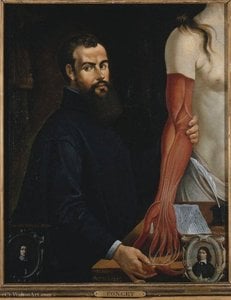
Andreas Vesalius: The Father of Modern Anatomy
Andreas Vesalius (1514 – 1564) stands as a monumental figure in the history of science and art, irrevocably altering our understanding of human anatomy and establishing a new paradigm for medical illustration. Born in Brussels, Belgium, Vesalius’s early life was marked by intellectual curiosity and a fascination with dissection—activities that would ultimately define his groundbreaking career. His father, Gerard Vesalius, was a physician who instilled in him a passion for observation and meticulous anatomical study, shaping the trajectory of Vesalius's scholarly pursuits.
- Early Life & Education:
- Academic Pursuits at Padua:
- De Humani Corporis Fabrica: A Revolution in Illustration
- Influence and Legacy
Padua University became Vesalius’s academic home, where he excelled as a student of medicine under Alessandro Vesalius (his uncle), furthering his commitment to anatomical investigation. It was during this time that he began to challenge the prevailing Galenic dogma—the dominant medical theory of his era—which relied heavily on speculation and lacked empirical evidence. Vesalius recognized the necessity for direct observation and dissection to accurately depict the human body, a conviction that fueled his determination to overturn established beliefs.
De Humani Corporis Fabrica: A Revolution in Illustration
Vesalius’s magnum opus, *De Humani Corporis Fabrica* ("On the Fabric of Human Body"), published in 1543, represents a watershed moment in anatomical history. This monumental atlas meticulously documented human anatomy through detailed drawings—the first truly accurate representations based on dissection—challenging centuries of inaccurate depictions propagated by Galen and Aristotle. Vesalius’s artistic skill was unparalleled; he painstakingly recreated cadavers with astonishing precision, capturing subtle muscular movements and skeletal structures with unprecedented realism. The illustrations themselves are considered masterpieces of Renaissance art, demonstrating a mastery of perspective, shading, and anatomical detail that surpassed anything seen before.
- Detailed Anatomical Drawings:
- Innovative Artistic Techniques:
- Impact on Medical Knowledge:
Vesalius’s artistic techniques were revolutionary for their time, utilizing a combination of meticulous observation and innovative drawing methods. He employed the humanist perspective—a focus on human form and proportion—to elevate anatomical study to an art form itself. Vesalius's drawings weren't merely representations; they were expressions of intellectual curiosity and a profound respect for the complexity of human anatomy. The atlas swiftly gained acclaim among physicians and scholars across Europe, sparking debate and ultimately contributing to the gradual acceptance of empirical observation as a cornerstone of medical science.
Influence and Legacy
The impact of Vesalius’s work extended far beyond the immediate scientific community. *De Humani Corporis Fabrica* fundamentally reshaped anatomical education and spurred advancements in surgical techniques. Vesalius's insistence on dissection as a method of study established a precedent that endured for centuries, influencing generations of anatomists and physicians. Furthermore, his artistic legacy continues to inspire artists today—his drawings serve as enduring models of anatomical accuracy and aesthetic beauty. Vesalius’s contribution to both art and science cemented his place as “The Father of Modern Anatomy,” ensuring his name would forever be synonymous with the pursuit of knowledge through observation and artistic excellence.



 Preview
 Buy Hand Made Painting
 Send
Send Share
Share
 Details
 Guide
Guide

 Download
 Similars
 X-Ray
X-Ray Diaporama
 Q&A
Q&A Stats
Stats


 Read More






































 Glass option is only available in size under 110 CM