

The artwork displayed on this page is protected by copyright law, which means we cannot legally create or sell an identical reproduction. This protection is enforced under international agreements such as the Berne Convention and by national laws, including those outlined by the U.S. Copyright Law - Title 17.
As a respectful and legal alternative, we offer custom, hand-painted artworks inspired by the original. Our skilled and professional artists carefully study the original's style, mood, and artistic essence to create a new, unique piece that evokes the same feeling - while remaining an original creation in its own right.
This method fully complies with copyright regulations because it does not involve copying or duplicating the protected artwork. Instead, it is a creative reinterpretation - a new painting that is influenced by the original but not identical to it.
Hand-painted oil on canvas in your size and frame, made to order by our artists. ( Switch to Print Switch to Digital Image)





























Pick from our preset sizes that match the artwork's original proportions.

Type the width and the height you need, to fit your frame or your wall. This is hand-painted, so for a size with a different shape the artist can paint a bit more around the picture, or cut a bit — you choose. We send you a digital mockup to approve before the painting starts. The picture shown on this page does not show the real result — only the mockup does.
Worldwide Delivery () in 3/4 weeks instead of standard 5 weeks. (26 October). No compromise on quality.
Infinite Cell
Reproduction Size
Alfredo Jaar's 2004 installation, *Infinite Cell*, isn’t merely a visual experience; it’s an invitation to contemplate the very nature of perception and confinement. Born in Santiago, Chile, during a period of political upheaval, Jaar’s work consistently grapples with themes of memory, representation, and the often-distorted realities presented through media and societal structures. *Infinite Cell*, housed within a stark architectural space, masterfully utilizes mirrors to create an illusion of boundless depth—a seemingly endless hallway that simultaneously draws you in and isolates you within its reflective embrace. This piece transcends simple replication; it’s a carefully constructed dialogue between the viewer, the artwork, and the unsettling questions it provokes.
The photograph captures this space with remarkable precision, highlighting the deliberate geometry of the composition. The strong vertical lines established by the mirrored walls and the imposing metal gate create a sense of controlled order, while the horizontal elements—the floor and ceiling—ground the viewer in the physical reality of the installation. Subtle variations in grayscale tone, achieved through masterful lighting, add depth and texture to the scene, emphasizing the smooth surfaces of the mirrors and the slightly rough texture of the floor tiles. The photograph’s low angle subtly exaggerates the height of the space, further contributing to the feeling of being enveloped within a contained environment.
Crucially, *Infinite Cell* is part of Jaar's “Gramsci Trilogy,” a series dedicated to the Italian intellectual Antonio Gramsci, imprisoned during the Fascist period. This context profoundly shapes the artwork’s meaning. As Jaar himself explains, the cell-installation represents the condition of the intellectual in contemporary Italy—a state of confinement not just by physical walls but also by societal pressures and the suppression of dissenting voices. The mirrors, reflecting endlessly, symbolize this internal imprisonment, forcing the viewer to confront their own reflections and consider the limitations imposed upon thought itself. The work directly references Pasolini’s assertion that culture is a prison, urging intellectuals to break free from its constraints and engage with the world.
Beyond Gramsci, *Infinite Cell* speaks to broader themes of confinement and repetition. The mirrored hallway creates an infinite loop, mirroring the viewer's own movements and blurring the boundaries between reality and illusion. This effect is heightened by the central placement of a doorway and gate—a symbolic barrier that suggests restriction and the difficulty of accessing genuine connection or understanding. The photograph’s composition deliberately utilizes symmetry and repetition, reinforcing this sense of cyclical confinement.
Jaar's skillful manipulation of perspective is central to *Infinite Cell*'s impact. The use of mirrors creates an illusion of infinite depth, far exceeding the physical dimensions of the space. Linear perspective—the converging lines that draw the eye towards a vanishing point—is subtly employed, guiding the viewer through the hallway and intensifying the feeling of spatial disorientation. The photograph itself was likely taken with a large-format camera to capture the intricate details and tonal range necessary for this complex composition. The photographer’s attention to lighting is particularly noteworthy; it not only illuminates the space but also contributes significantly to the artwork's overall mood, creating highlights on the mirrored surfaces and subtly shifting the tones within the grayscale palette.
The materials—mirrors, metal, concrete or tile flooring—are deliberately chosen for their contrasting textures. The smooth, reflective surfaces of the mirrors create a sense of detachment, while the slightly rough texture of the floor tiles grounds the viewer in the physical reality of the installation. This juxtaposition of tactile and visual elements further enhances the artwork’s complexity and invites contemplation on the relationship between perception and experience.
*Infinite Cell* is more than just a technical exercise in illusion; it's a powerful meditation on human psychology. The mirrored walls can be interpreted as representing introspection—a journey into one’s own thoughts and emotions. The gate, partially obscuring the doorway, symbolizes restriction and the challenges of breaking free from limiting beliefs or societal constraints. Jaar’s work consistently prompts viewers to question their assumptions about reality and consider the ways in which perception is shaped by external forces. The photograph captures this emotional resonance, inviting us to contemplate our own experiences within a space that simultaneously isolates and expands our understanding.
"Infinite Cell" by Alfredo Jaar has a soft shadow luminance. Luminance describes how much light the colors appear to reflect.
To get a print of "Infinite Cell" by Alfredo Jaar, simply order it on its Fine Art Print page: a fine art print on cotton canvas or archival canvas paper.
Use (reflective) and space (living room) are the two recommendations recorded for "Infinite Cell" by Alfredo Jaar.

In the vast, often overwhelming landscape of contemporary art, few voices resonate with the haunting clarity and moral urgency of Alfredo Jaar. Born in Santiago, Chile, in 1956, Jaar’s artistic identity was forged in a crucible of movement and political upheaval. His early life, marked by a nomadic existence that took him from his Chilean roots to Martinique, instilled in him a profound sensitivity to the shifting borders of culture and identity. This sense of displacement would later become a cornerstone of his practice, as he transitioned from studying architecture and filmmaking at the University of Chile to establishing himself within the frenetic, intellectually charged art scene of New York City in 1982. He did not merely arrive in New York as an observer; he arrived as a provocateur, ready to use the medium of installation to bridge the gap between seen and unseen realities.
Jaar’s work is rarely about the object itself; rather, it is about the space between reality and its representation. He often speaks of "the gap"—that irreconceless chasm where the truth of human suffering meets the sanitized, often desensitized lens of global media. Through a masterful synthesis of photography, film, architecture, and performance, Jaar constructs immersive environments that demand more than passive viewing; they require an emotional and ethical reckoning. His practice is deeply rooted in the investigation of power imbalances, particularly those between the industrialized North and the developing South. Whether through the use of neon signs in Berlin or electronic billboards in Times Square, Jaar utilizes public interventions to force a confrontation with truths that society often prefers to look past.
The historical significance of Jaar’s oeuvre lies in his role as a visual witness to the tragedies of the late twentieth century. Perhaps his most profound and harrowing achievement is The Rwanda Project, a monumental, multi-year undertaking that sought to document the 1994 genocide not through the sensationalist imagery of news broadcasts, but through a deeply empathetic lens. By focusing on the eyes of the victims and the lingering shadows of loss, Jaar challenged the viewer’s complicity in the media's tendency to turn catastrophe into mere spectacle. This commitment to "bearing witness" extends to his explorations of gold mining in Brazil, toxic pollution in Nigeria, and the complex political tensions along the Mexico-USA border.
His ability to weave socio-political critique into poetic, elegiac installations has earned him the highest accolades in the art world. His career is punctuated by significant milestones, including:
Beyond the political, Jaar’s work possesses a lyrical, almost architectural quality that speaks to the fundamental human desire for connection. His installations often function as meditations on memory, using light, shadow, and scale to evoke the weight of history. In works like A Logo for America, he used the simple power of text and imagery to deconstruct linguistic colonialisms, reminding the world that the term "America" encompasses much more than a single continent. This intellectual rigor, paired with an unwavering commitment to social justice, ensures that his work remains perpetually relevant in an era of digital saturation and information overload.
As we navigate a contemporary world increasingly defined by fragmented truths and global crises, Alfredo Jaar’s art serves as both a mirror and a compass. He does not offer easy answers or comforting illusions; instead, he provides the tools to look deeper into the shadows of history. His legacy is found in every viewer who, after exiting his installations, finds themselves unable to look at the world with the same indifference. Through his visionary lens, the act of seeing becomes an act of resistance, and the pursuit of truth becomes a shared human responsibility.

1956 - , Chile

Explore the profound symbolism of mirrors in fine art history. From Surrealist distortions to Vanitas themes, discover how masters use reflections to capture reality and the metaphysical soul.
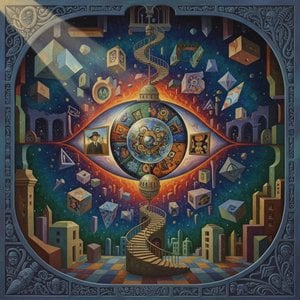
Embark on a visual journey through the world's most captivating illusions. From Trompe l'oeil realism to the geometric wonders of Op Art, explore how master artists manipulate perception and depth to create timeless masterpieces of optical wonder.
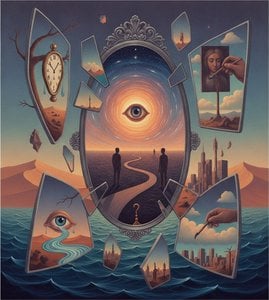
Explore the profound symbolism of mirror art through a journey of Surrealist mastery. From Dalí's fractured realities to technical brilliance, discover how reflections redefine art history and inspire sophisticated modern collections.

Embark on a sophisticated journey through art history's most captivating masterpieces of reflection. Explore how legendary artists used mirrors to explore identity, surrealism, and the soul through expert art historical analysis.

Explore the profound symbolism of mirror images in fine art. From Surrealist distortions to classical self-portraits, discover how masters use reflections to explore reality, identity, and the infinite through a sophisticated art-historical lens.

 Preview
 Send
Send Share
Share
 Details
 Guide
Guide

 Download
 Similars
 X-Ray
X-Ray Diaporama
 Stats
Stats

 Read More









 Glass option is only available in size under 110 CM


