

Museum-quality giclée or canvas print with fast production and flexible finish options. ( Buy Hand Made Painting Switch to Digital Image)
Pick from our preset sizes that match the artwork's original proportions.

You may enter your own dimensions to fit a specific frame or space. If your selected size does not match the original image's proportions, we will either crop the artwork or extend the image with a mirrored or solid-fill edge. A digital mockup will be sent for your approval before production begins.
Please note that the on-screen preview does not reflect the actual cropping or extension. Only the mockup will accurately show the final composition.
While custom sizes are available, we recommend selecting a dimension from the predefined list to preserve the original proportions.
Worldwide Delivery () in 2 weeks instead of standard 4/5 weeks. (10 September)


O Artico não existe
Reproduction Size
In the hauntingly beautiful monochrome intaglio print O Artico não existe, created in 1982 by the Brazilian visionary Alexandre Cerveny, we are invited to step into a realm where reality and dreamscape collide. This piece serves as a profound exploration of isolation and spirituality, presenting a world that feels both ancient and otherworldly. The composition is tightly focused, drawing the viewer’s eye toward a central, enigmatic figure that stands amidst a stark, stylized landscape. Through the masterful use of line and shadow, Cerveny constructs a scene that transcends mere representation, offering instead a window into the depths of the human psyche.
The technique employed here is a testament to the artist's command over the intaglio process, likely utilizing etching or engraving to achieve its striking textures. Every stroke feels deliberate, with sharp, defined lines creating a sense of structural permanence against the more organic, skeletal forms of bare trees in the background. Through the meticulous application of cross-hatching and stippling, Cerveny builds up tonal depths that emerge from the darkness, giving the piece a tactile, three-dimensional quality despite its flattened perspective. This interplay of light and shadow—or rather, the absence of a discernible light source—creates an unsettling, dreamlike atmosphere where shapes seem to emerge from a primordial void.
At the heart of this work lies a humanoid figure, adorned with elaborate headgear that serves as a focal point for the piece's symbolic weight. Adorned with stars and cryptic symbols, this figure suggests a mythological or celestial being, perhaps a guardian of a forgotten realm. The geometric shape behind the subject, reminiscent of a shield or a helmet, introduces an element of structural rigidity that contrasts sharply with the spindly, organic silhouettes of the surrounding trees. This tension between the geometric and the natural reflects the broader themes found in Cerveny’s oeuvre: the dialogue between construction and deconstruction, and the intersection of human identity with the vastness of nature.
The title itself, O Artico não existe (The Arctic does not exist), adds a layer of surrealist provocation. It challenges our perception of geography and truth, much like the artwork challenges our perception of the subject matter. The piece evokes a sense of melancholic mystery, pulling at the viewer's emotions through its somber palette and lonely atmosphere. For the collector or interior designer, this work offers more than just visual interest; it provides a profound emotional anchor for a space, inviting contemplation and deep thought.
For those seeking to curate a collection defined by depth and intellectual rigor, O Artico não existe stands as an exceptional choice. Its Expressionist roots and Symbolist undertones make it a versatile piece that can anchor a room with its commanding presence. Whether placed in a contemporary gallery setting or integrated into a sophisticated residential interior, the print’s monochromatic elegance ensures it complements a wide variety of design aesthetics.
Owning a high-quality reproduction of this work allows one to possess a fragment of Cerveny's profound artistic journey. It is an invitation to dwell within the shadows, to find beauty in the enigmatic, and to appreciate the masterful precision of Brazilian printmaking. This artwork is not merely a decoration; it is a conversation piece that continues to whisper its secrets to anyone willing to look closely.

Born in São Paulo, Brazil, in 1963, Alexandre Cerveny is a multifaceted artist whose work—spanning painting, sculpture, engraving, and illustration—is characterized by a vibrant energy and a compelling dialogue between construction and deconstruction. His artistic journey has been shaped by rigorous training alongside influential figures like Valdir Sarubbi and Selma D’Affre, grounding him in the traditions of Brazilian art while simultaneously pushing him toward a uniquely personal vision. Cerveny's work isn't merely decorative; it’s an exploration of complex themes—nature, human experience, and the very nature of representation—presented through bold colors, dynamic compositions, and often, a touch of surrealism.
Cerveny's artistic development began with formal training in drawing and painting under Valdir Sarubbi, a renowned Brazilian artist known for his expressive figurative work. This early exposure instilled in him an appreciation for the power of line and form. Subsequently, he honed his technical skills in metal engraving and printing techniques with Selma D’Affre, gaining expertise in traditional printmaking methods. A pivotal experience occurred during his enrollment in the lithography course at FAAP (Fundação Armando Álvares de Andrade), further expanding his artistic repertoire. Notably, a period spent studying contortionism within the Piolin Circus Arts Academy and Picadeiro Circus School profoundly impacted his oeuvre, imbuing it with a sense of fluidity, movement, and an understanding of the human body’s capacity for transformation – a recurring motif in his work.
Cerveny's artistic practice is fundamentally rooted in a tension between opposing forces. He navigates the interplay between construction and deconstruction, form and function, creating works that are simultaneously structured and fragmented. This duality manifests itself through layered imagery, unexpected juxtapositions, and a deliberate blurring of boundaries. His paintings frequently feature bold color palettes—often saturated hues—that seem to vibrate with energy. These colors aren’t simply decorative; they serve as vehicles for conveying emotion, atmosphere, and symbolic meaning. Recurring themes include depictions of nature, particularly the human figure, rendered in abstracted forms that invite interpretation rather than offering straightforward representation.
Several of Cerveny’s works stand out as testaments to his unique artistic vision. “Alexandre Cerveny: O Artico Não Existe” (The Arctic Doesn't Exist) is a particularly captivating piece, prompting viewers to decipher its layered meanings and engage in active interpretation. His work has been exhibited extensively throughout Brazil and internationally, including at the Museu Civico Giovanni Fattori and the Frederic Remington Art Museum. He’s received significant recognition for his talent, culminating in the Prêmio Marcantonio Vilaça from the National Arts Foundation (FUNARTE) in 2012 and the Proac Book Artist Award in 2016. His pieces are held within prestigious collections such as the Musée Baron Gérard and the Pinacoteca do Estado de São Paulo, solidifying his place within the contemporary art landscape.
Alexandre Cerveny’s work continues to evolve, reflecting a deep engagement with both Brazilian identity and broader global concerns. His recent exhibitions at institutions like the Cartier Foundation and the Ibero-American Art Museum (Museo de Arte Iberoamericana) demonstrate his continued relevance within contemporary art discourse. Furthermore, his participation in projects such as *rīvus* – a Biennale of Sydney initiative – highlights his willingness to experiment with new mediums and explore complex themes related to environmental sustainability and cultural heritage. His ongoing collaborations and exhibitions ensure that Cerveny remains a vital voice in the Brazilian art scene and beyond. You can find more information about his work on platforms like WahooArt, Wikipedia, and WahooArt.

1963 - , Brazil
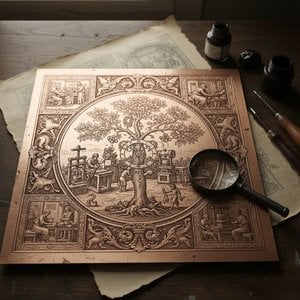
Explore the intricate world of etching and intaglio printmaking. Discover how masters use acid and metal to create profound textures and lines, from Romanticism to modern era, through an expert lens of art history and technical mastery.

Explore the profound emotional depth of Expressionist landscapes. Discover how masters use color, texture, and light to transcend reality, capturing the raw essence of nature through an art-historical lens for the true connoisseur.

 Preview
 Send
Send Share
Share
 Details

 Download
 Similars
 X-Ray
X-Ray Diaporama
 Stats
Stats


 Read More




































 Glass option is only available in size under 110 CM


