Museum-quality giclée or canvas print with fast production and flexible finish options. ( Buy Hand Made Painting Switch to Digital Image)
Pick from our preset sizes that match the artwork's original proportions.

Type the width and the height you need, to fit your frame or your wall. A print can only be cut, never made bigger than the picture, so a size with a different shape loses a part of the image. We send you a digital mockup to approve before we print anything. The picture shown on this page does not show the real cut — only the mockup does.
Worldwide Delivery () in 2 weeks instead of standard 4/5 weeks. (7 November)
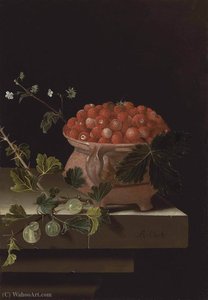
Gooseberries on a Table
Reproduction Size

Adriaen Coorte, a name largely absent from the annals of art history for centuries, represents a fascinating and poignant story of rediscovery within the world of 17th-century Dutch painting. Born in Middelburg, Netherlands, around 1665 and tragically passing away sometime after 1707, Coorte’s life remains shrouded in relative obscurity – a characteristic that paradoxically contributed to his enduring appeal. He wasn't a flamboyant figure of the Golden Age, nor did he produce works destined for grand salons or royal collections. Instead, Coorte carved out a unique niche as one of the last practitioners of a highly intimate and meticulously observed category of still life painting: small, understated arrangements that offered a profound meditation on light, texture, and the fleeting beauty of everyday objects.
Coorte’s artistic journey began under the tutelage of Melchior d'Hondecoeter in Amsterdam around 1680. Hondecoeter, renowned for his detailed depictions of birds and his systematic approach to repetition – often painting multiple variations of the same subject – appears to have instilled in Coorte a disciplined eye for observation and a penchant for creating carefully constructed compositions. However, Coorte’s trajectory soon led him back to his native Middelburg, where he established a workshop and began signing his works around 1683. This return marked a shift towards a distinctly personal style, characterized by an almost austere simplicity that distinguished him from his teacher's more elaborate approach.
Coorte’s paintings are immediately recognizable for their remarkable restraint and quiet elegance. Unlike the opulent still lifes favored by many of his contemporaries – brimming with exotic fruits, silver vessels, and luxurious fabrics – Coorte’s arrangements were remarkably pared down. His compositions typically featured small groupings of humble objects: a single peach or apricot resting on a rough-hewn stone slab, a scattering of shells, or a few sprigs of asparagus arranged against a dark, almost impenetrable background. The tableware was equally basic—simple pottery rather than elaborate silver – emphasizing the inherent beauty of the materials themselves. This deliberate minimalism wasn’t born of poverty; rather, it reflected Coorte's intense focus on capturing the essence of each object through careful observation and masterful manipulation of light.
The lighting in Coorte’s paintings is particularly noteworthy. He employed a single, often unseen source of illumination, creating dramatic contrasts between light and shadow that heightened the textures and forms of his subjects. The dark backgrounds served to isolate and emphasize the delicate details of each object, drawing the viewer's eye to their subtle variations in color and shape. This technique, combined with Coorte’s meticulous attention to detail, resulted in paintings that possess a remarkable sense of immediacy and intimacy – as if the viewer were peering directly into a small, carefully arranged still life within a domestic setting.
While Coorte's style is undeniably unique, it’s clear that he was influenced by both his teacher, Hondecoeter, and earlier generations of Dutch still life painters. The systematic approach to repetition evident in Hondecoeter’s work – the careful duplication of bird poses – can be seen as a foundational element in Coorte’s own compositions. However, Coorte’s paintings also possess a certain austerity and directness that distinguishes them from the more decorative style of many of his contemporaries. He seems to have been particularly drawn to the works of older masters, such as Pieter Pietersz. Compagnon, whose spare arrangements and emphasis on light and shadow foreshadowed Coorte's own approach.
Despite his talent and dedication, Coorte remained largely unknown outside of Middelburg for over two centuries. It wasn’t until the mid-20th century that art historian Laurens J. Bol began to champion his work, meticulously cataloging his paintings and publishing a comprehensive monograph in 1977. This rediscovery sparked renewed interest in Coorte's art, leading to exhibitions at prestigious museums such as the Rijksmuseum in Amsterdam and the National Gallery of Art in Washington D.C. Today, Adriaen Coorte is recognized as one of the most important – and tragically overlooked – figures of the Dutch Golden Age, a testament to the enduring power of quiet observation and understated beauty.
Adriaen Coorte's significance lies not in grand narratives or revolutionary techniques, but rather in his steadfast commitment to a specific aesthetic. He represents a counterpoint to the prevailing trends of the Dutch Golden Age – a period often characterized by opulent displays of wealth and luxury. Coorte’s paintings offer a glimpse into a different sensibility: one that valued simplicity, observation, and the quiet contemplation of everyday objects. His rediscovery serves as a reminder that true artistic merit can be found not only in grand gestures but also in the subtle nuances of a well-observed still life – a testament to the enduring power of understated beauty.

1665 - 1707 , Netherlands
 Preview
 Send
Send Share
Share
 Details
 Guide
Guide

 Download
 Similars
 X-Ray
X-Ray Diaporama
 Q&A
Q&A
 Stats
Stats Read More






































 Glass option is only available in size under 110 CM