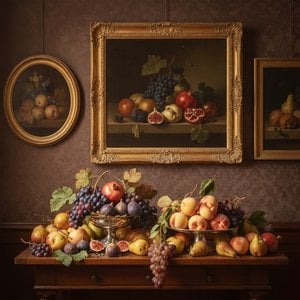
The Quiet Brilliance of Louise Moillon
In the grand, sweeping narratives of the Baroque era, where drama and movement often dominate the canvas, the work of Louise Moillon offers a profound and meditative alternative. Born in Paris in 1610, Moillon emerged from a world shaped by the intense religious and cultural shifts of 17th-century France. Her very lineage tells a story of resilience and artistic heritage; as a descendant of Huguenot refugees from Holland, she was immersed in a tradition that valued the meticulous observation of the natural world. This background provided more than just a family history—it offered a stylistic vocabulary rooted in the Dutch mastery of light, texture, and symbolic realism.
Moillon’s early life was marked by both loss and profound artistic mentorship. The death of her father, the landscape painter and dealer Nicolas Moillon, when she was only ten, could have altered her path, yet her upbringing remained deeply embedded in the arts. Under the guidance of her stepfather, François Garnier, a skilled artist and dealer, she refined a technique that would become her hallmark. Her education was not merely about the application of pigment to canvas, but an immersion into the humanist values of her time, learning to see the divine within the minute details of a ripening fruit or the delicate curve of a petal.
A Mastery of Texture and Light
The true genius of Moillon lies in her ability to transform the mundane into the extraordinary. Her compositions are characterized by a serene stillness, a quietude that invites the viewer to linger and observe. She possessed an almost supernatural ability to capture the tactile qualities of her subjects—the waxy skin of a citron, the soft fuzz of a peach, or the translucent juice of a crushed berry. In works such as Still Life of Citrons and Curaçao Oranges in a White Polylobed Dish, one can sense the cool moisture of the fruit against the hard, glazed surface of the porcelain, creating a sensory experience that transcends the two-dimensional plane.
Her technique was deeply influenced by the naturalistic traditions of the Protestant circles in which she moved. This approach favored clarity and precision over the theatrical shadows of the more flamboyant Baroque masters. Instead, Moillon utilized light to sculpt her subjects, using subtle gradations of tone to create volume and depth. Her palette, while often focused on the vibrant hues of nature, was used with such restraint that each color felt luminous, as if lit from within. This mastery allowed her to bridge the gap between mere botanical illustration and high art, imbuing every piece with a sense of life and vitality.
Legacy and Historical Significance
Throughout her long life, which spanned nearly nine decades, Moillon achieved a level of renown that was rare for female artists of her era. Her ability to secure commissions from prestigious patrons, including members of the royal court, speaks to the undeniable quality and sophistication of her oeuvre. While her work often focused on the intimate scale of still life, its impact was expansive, contributing significantly to the development of the French still-life tradition.
The historical significance of Louise Moillon extends beyond her technical skill; she represents a vital link between the Dutch naturalistic tradition and the burgeoning French aesthetic of the 17th century. Her paintings serve as windows into a lost world of Parisian markets and private gardens, capturing a sense of abundance and ephemeral beauty. Today, her works remain cherished treasures in institutions such as the Louvre, standing as enduring testaments to a life dedicated to finding the extraordinary within the ordinary. Her legacy is found in every brushstroke that celebrates the quiet, breathtaking splendor of the natural world.