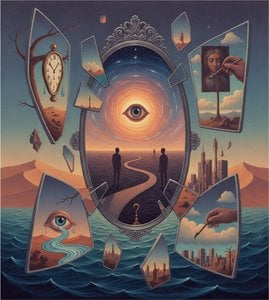
John Mare is a contemporary artist whose work occupies a fascinating space between abstraction and figuration, dreamscape and reality. Born in an undisclosed location – a deliberate choice by the artist to keep the focus firmly on the art itself rather than biographical detail – Mare has cultivated an aura of mystery around his persona, allowing his paintings to speak for themselves. This reticence only adds to the compelling nature of his creations, inviting viewers to engage with them on a purely intuitive level. While details about his early life remain scarce, it is known that he received formal training in painting before embarking on a path of self-directed exploration and experimentation. He continues to live and work today, constantly refining his unique visual language.
A Journey Through Form and Color
Mare’s artistic development has been characterized by a relentless pursuit of emotional resonance through the manipulation of form and color. His early works displayed a clear influence from Abstract Expressionism, particularly the gestural energy of artists like Willem de Kooning and Franz Kline. However, Mare quickly moved beyond simple imitation, developing his own distinctive style that incorporated elements of Surrealism and Symbolism. Recurring motifs – fragmented figures, distorted landscapes, and ambiguous objects – began to emerge, hinting at a complex inner world. Over time, his palette evolved from dark, brooding tones to a more vibrant and nuanced range of colors, reflecting a growing sense of optimism and spiritual inquiry. The artist’s technique is equally noteworthy; he employs layers of paint, often scraping back and reworking surfaces to create a rich textural depth that draws the viewer into the canvas.
Themes of Memory and Transformation
At the heart of Mare's work lies an exploration of memory, transformation, and the elusive nature of identity. His paintings are not literal representations of reality but rather evocative distillations of personal experiences and subconscious imagery. The fragmented figures that populate his canvases often appear to be in a state of flux, dissolving into their surroundings or emerging from them as if born from dreams. This sense of impermanence is further emphasized by the artist’s use of blurred lines and ambiguous spaces. Mare's paintings are not about what is seen but about what is felt, inviting viewers to project their own emotions and interpretations onto the work. He often speaks of his desire to capture “the residue of experience,” those fleeting moments that linger in the mind long after they have passed.
Influences and Artistic Dialogue
While Mare deliberately avoids explicit references to other artists, it is possible to discern a number of influences at play in his work. The Symbolist painters – such as Odilon Redon and Pierre Puvis de Chavannes – clearly inform his use of evocative imagery and dreamlike atmosphere. He also demonstrates an affinity for the Surrealist techniques of automatism and collage, employing chance operations and unexpected juxtapositions to create a sense of disorientation and wonder.
The works of Giorgio de Chirico, with their unsettling architectural spaces and enigmatic figures, resonate strongly in Mare’s compositions.
His fascination with the human psyche aligns him with artists like Francis Bacon and Edvard Munch, who sought to expose the darker aspects of the human condition.
Historical Significance and Legacy
Although relatively young in his career, John Mare has already established himself as a significant voice in contemporary art. His paintings have been exhibited in galleries and museums around the world, garnering critical acclaim and attracting a devoted following of collectors. Mare’s work represents a compelling synthesis of diverse artistic traditions, blending Abstract Expressionism, Surrealism, and Symbolism into a unique and highly personal visual language. He challenges viewers to confront their own inner worlds, prompting them to question the nature of reality and the limits of perception. As he continues to evolve as an artist, it is clear that John Mare’s legacy will be one of profound emotional depth, technical innovation, and enduring mystery. His refusal to conform to conventional expectations has paved the way for a new generation of artists who prioritize intuition, experimentation, and the power of subjective experience.
Explore the profound symbolism of mirror art through a journey of Surrealist mastery. From Dalí's fractured realities to technical brilliance, discover how reflections redefine art history and inspire sophisticated modern collections.