The Mythological Subject of Jupiter and Danaë
In JUPITER ET DANAE, Joachim Anthonisz Wtewael explores a pivotal moment of divine intervention. The mythological narrative centers on the clandestine encounter between Zeus and Danaë, the daughter of King Acrisius of Argos. This specific scene captures the moment of Zeus’s transformation, as he descends to impregnate Danaë with golden rain. It is a quiet, yet profound, intersection of the mortal and the divine.
The weight of this encounter carries significant consequences for the lineage of heroes. Through this celestial union, the birth of Perseus is secured, a child destined to eventually slay Medusa and liberate Greece from tyranny. Joachim Anthonisz Wtewael focuses on the tension inherent in this prophecy, framing the event within the intimate confines of a bedchamber. The presence of gold and the vulnerability of the figures underscore the gravity of the unfolding fate.
Composition and Visual Elements
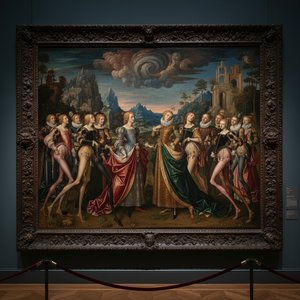
The vertical orientation of this work immediately directs the eye upward, following the descent of the divine into the earthly realm. Wtewael divides the composition into two distinct zones. The lower portion is set within the intimate confines of a bedchamber, where Danaë is positioned amidst the furniture. Above this, the scene opens into a turbulent, stormy sky, marking the arrival of Jupiter. This structural division creates a sense of tension between the domestic space and the celestial upheaval.
Movement is achieved through a series of dynamic diagonal lines, particularly those formed by the limbs and body of Zeus. These lines cut through the space, mirroring the energy of the swirling clouds. The artist balances the composition by juxtaposing organic forms, such as the human figures and the billowing clouds, against the more rigid, geometric lines of the architectural elements, like the window frames and bedposts. It is a careful arrangement of soft curves and sharp edges.
Lighting is used with great intention here. A strong, focused light source illuminates the figures of Jupiter and Danaë, pulling them out from the surrounding shadows. This selective illumination emphasizes their expressions and the physical interaction between them, while the rest of the chamber remains in a state of soft, atmospheric gloom. The interplay of light and shadow provides a sense of depth, even within the somewhat flattened perspective characteristic of the Mannerist style.
Materials and Artistic Technique
The work is executed in oil paint upon a copper plate. This choice of support allows for a specific kind of luminosity and a level of detail that canvas often struggles to sustain. One can see the artist's mastery in the way he handles the medium, employing sophisticated layering and blending to achieve a sense of depth. The surface is not merely a flat plane of color but a carefully constructed space where light and shadow interact to define form.
There is a tactile quality to the application of the paint. While the figures possess a polished finish, visible brushstrokes remain present, contributing to a textured surface. This technique captures the specific materiality of skin, the weight of fabric, and the ephemeral nature of clouds with remarkable accuracy. The interplay of these elements creates a sense of movement within the composition, particularly where the light catches the edges of the forms.
Current Location and Collection History
This work resides within the prestigious collection of the Louvre Museum in Paris. It is held specifically under the care of the Department of Paintings. To locate it during a visit, one must find the Richelieu Wing, where it is displayed in Room 808. It is cataloged under the inventory number RF 1979-23.
The painting's presence in such a significant institution ensures its preservation within a controlled environment. It remains a permanent part of the museum's holdings, situated among other significant works of the sixteenth century. Its placement in the Richelieu Wing allows for a quiet contemplation of its complex Mannerist composition.
Frågor och svar
Vilken underliggande nyans genomsyrar "JUPITER ET DANAE" av Joachim Anthonisz Wtewael?
"JUPITER ET DANAE" lutar åt en Ochre to Sepia ton.
Vilken typ av konstverk är "JUPITER ET DANAE" av Joachim Anthonisz Wtewael?
"JUPITER ET DANAE" är ett verk av typen WallArt.
Hur hög är kontrasten i "JUPITER ET DANAE" av Joachim Anthonisz Wtewael?
"JUPITER ET DANAE" av Joachim Anthonisz Wtewael uppvisar en Statement kontrast mellan sina ljusa och mörka partier.