CONSULTAȚIE GRATUITĂ ÎN ARTE VIZUALE

x
Comandă reproducere pictată Comandă reproducere pictatăCumpără imaginea Cumpără imaginea TrimiteTrimite
DetailsDetails Adaugă la favorite Adaugă la favorite DescarcăDescarcă SimilareSimilare X-RayX-Ray DiaporamaDiaporama

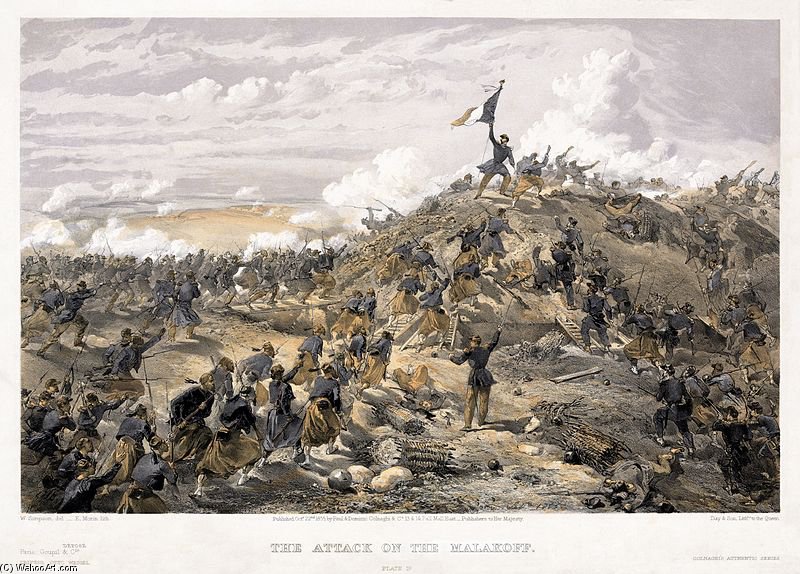
Attack On The Malakoff

Explore William Simpson’s "Attack On The Malakoff," a dynamic lithograph depicting Crimean War chaos. A detailed historical artwork showcasing realism & dramatic battle scenes.

William Simpson (1823-1899): Artist și cronist al Războiului Crimean, al Indiei și al altor aventuri. Explorează acuarelele sale detaliate și gravurile din perioada victoriană.

Giclée / Imprimare artistică

Print giclée sau pe canvas de calitate muzeală, cu producție rapidă și opțiuni flexibile de finisare.

Standard
custom
CM
INCH

Alegeți dintre dimensiunile noastre prestabilite, care respectă proporțiile originale ale operei de artă.

lățime
înălțime

Puteți introduce propriile dimensiuni pentru a se potrivi unui anumit cadru sau spațiu. Dacă dimensiunea selectată nu corespunde proporțiilor imaginii originale, vom decupa lucrarea de artă sau vom extinde imaginea cu margini oglindite sau cu o culoare uniformă. Un mockup digital va fi trimis pentru aprobarea dumneavoastră înainte de începerea producției.
Vă rugăm să rețineți că previzualizarea de pe ecran nu reflectă decuparea sau extinderea reală. Doar mockup-ul va arăta cu exactitate compoziția finală.
Deși dimensiunile personalizate sunt disponibile, vă recomandăm să selectați o dimensiune din lista predefinită pentru a păstra proporțiile originale.

Livrare în întreaga lume () în 2 săptămâni, în loc de cele 4/5 săptămâni standard. (2 Iulie)

why_choose_icon
Livrare expres gratuită la nivel mondial
why_choose_icon
Pânză de in de înaltă calitate
why_choose_icon
Asigurare completă pentru transport
why_choose_icon
Garanție de rambursare a taxelor vamale
why_choose_icon
Garanția fidelității culorilor
why_choose_icon
Politica de retur de 60 de zile (doar pentru defecte)
why_choose_icon
Garanție 100% de rambursare
why_choose_icon
Reducere la comenzi multiple

Preț total

-

reproduction

Attack On The Malakoff

Giclée / Imprimare artistică

Dimensiune reproducere

-

Preț total calculat

-

Opere de artă similare


Biografie artist

A Life Etched in Conflict and Culture

William Simpson, a name inextricably linked to the brutal realities of the Crimean War—often whispered as “Crimean Simpson”—was far more than simply a war artist. He was a visual chronicler, an intrepid observer who meticulously documented a rapidly transforming 19th-century world, capturing not just battles but also the profound human cost and cultural nuances of his time. Born into the crushing poverty of Glasgow in 1823, his journey from hardship to recognition stands as a testament to both innate artistic talent and unwavering tenacity. His early years were shadowed by a difficult family life; an abusive and alcoholic father drove him to seek refuge with his grandmother in Perth at the tender age of ten—a move that, while offering stability, curtailed formal schooling but ignited within him a lifelong dedication to self-directed learning and a deep curiosity about the world beyond Britain’s shores. This pursuit of knowledge continued through apprenticeships at the Glasgow lithographic firm of Macfarlane, which he later described as profoundly formative, and evening studies at the Andersonian University and Mechanics' Institute—institutions that fostered his intellectual growth and honed his observational skills. These early experiences laid a solid foundation for a career that would seamlessly blend artistic skill with an insatiable desire to understand and represent the world around him.

Witness to War: The Crimean Revelation

The outbreak of the Crimean War in 1853—a conflict fueled by imperial ambitions and political maneuvering—completely reshaped William Simpson’s trajectory. Initially commissioned to create a lithograph based on secondhand accounts of the Battle of Alma, his exceptional talent quickly caught the attention of Colnaghi & Son, who swiftly dispatched him directly to Crimea in November 1854. This wasn't merely about illustrating battles; it was about *experiencing* them firsthand and translating that visceral reality onto paper with painstaking detail. Simpson didn’t shy away from depicting the grim realities of war—the pervasive mud, the agonizing suffering etched on the faces of exhausted soldiers, the sheer, overwhelming exhaustion that permeated every aspect of military life. His watercolors weren't romanticized depictions of heroism; they were unflinching records of a brutal and devastating conflict. These images, rendered with remarkable sensitivity and realism, were then transformed into lithographs for publications like *The Illustrated London News*, bringing the horrors—and occasionally, the moments of quiet bravery—of the Crimean War directly into British homes, shaping public opinion and fostering a greater understanding of the conflict’s impact. He became known as “Crimean Simpson” not just for his presence on the front lines, but for the authenticity and immediacy he brought to his visual reporting – a rare quality in an era dominated by often-distant and abstract accounts of war. The Seat of War in the East, his seminal series of lithographs based on these sketches, remains a landmark achievement in war journalism and visual storytelling—a powerful testament to his courage, artistic skill, and unwavering commitment to documenting the truth as he saw it.

Beyond Crimea: India, Exploration, and Artistic Ambition

Following his distinguished service during the Crimean War, Simpson’s success with *The Illustrated London News* opened doors to further assignments as a special artist and correspondent—a role that allowed him to travel extensively and document diverse cultures and landscapes. In the late 1850s, he embarked on an ambitious journey to India, a land of immense historical significance and burgeoning imperial ambitions. This expedition wasn’t simply about recording military events; it was a deep dive into Indian society—its vibrant marketplaces, serene temples, majestic palaces, and the daily lives of its diverse population. Simpson's watercolors from this period reveal a remarkable sensitivity and understanding of the subcontinent—a far cry from the often-stereotypical depictions prevalent at the time. He meticulously captured the textures of silk fabrics, the intricate details of religious iconography, and the expressions on the faces of local people, conveying not just visual information but also a sense of respect and empathy for the culture he was observing. Despite facing considerable challenges—including logistical difficulties and cultural barriers—Simpson persevered in his quest to document India’s rich tapestry of life. He envisioned a comprehensive illustrated volume on India, an ambitious project that unfortunately fell through due to financial constraints faced by Day & Son, the intended publisher. Nevertheless, his Indian watercolors remain invaluable historical records, offering a nuanced perspective on a pivotal period in British colonial history and showcasing both the grandeur of the subcontinent and the complexities inherent in imperial rule. He continued his travels throughout the 1860s, documenting scenes from Russia, China, Afghanistan, and beyond—always bringing back detailed observations rendered with remarkable skill and artistic flair.

The Development of a Distinctive Style

Simpson’s artistic style evolved significantly over his career, influenced by his diverse experiences and evolving techniques. Initially trained in the conventions of academic watercolor painting, he gradually developed a more expressive and observational approach. His Crimean War sketches were characterized by their rapid execution and loose brushwork—a deliberate choice that captured the immediacy and chaos of battle. However, as he traveled to new regions and encountered different cultures, his style became increasingly refined and detailed. In India, for example, he employed richer colors and more intricate compositions to convey the vibrancy and complexity of the landscape and its people. He was particularly adept at capturing light and shadow—a skill that contributed significantly to the atmospheric quality of his paintings. Furthermore, Simpson’s work demonstrates a keen eye for detail—he meticulously rendered textures, patterns, and architectural features with remarkable precision. This combination of spontaneity and control—of loose brushwork and careful observation—defined his distinctive artistic style and set him apart from many of his contemporaries.

Legacy and Lasting Influence

William Simpson’s legacy extends far beyond his stunning visual documentation of 19th-century events. He played a crucial role in establishing the concept of the “special artist”—an embedded observer who provided firsthand, visual reporting from conflict zones and distant lands—a precursor to modern photojournalism. His work wasn't simply art; it was journalism, history, and cultural observation all rolled into one. Simpson enjoyed the patronage of Queen Victoria herself, a testament to the esteem his artistry garnered. He was elected an associate of the Institute of Painters in Water Colours in 1874 and became a full member five years later. His detailed watercolors and lithographs continue to be studied by historians and art enthusiasts alike, offering invaluable insights into the past. **He was, as some called him, a “Prince of Pictorial Correspondents,”** whose work continues to resonate with audiences today—a reminder of the power of visual storytelling to illuminate history and foster understanding.

Notable Works

  • The Seat of War in the East: A seminal series of lithographs based on his Crimean sketches, offering a detailed visual record of the conflict.
  • Retreat of the Russians from Sebastopol: A powerful watercolor capturing a pivotal moment in the fall of Sevastopol, showcasing Simpson’s skill in depicting dramatic scenes.
  • Mongolia. Group Near The Great Wall Of China.: Demonstrates his ability to capture cultural exchange and landscapes with realism and romanticism.
  • Akalis at the Holy Tank, Umritsar: A vibrant depiction of Sikh devotion, rich in historical and cultural detail.
  • Camp of the Fourth Division: An evocative painting depicting a 19th-century military encampment.
William Simpson (Simpsonul)

William Simpson (Simpsonul)

1823 - 1899 , Regatul Unit al Marii Britanii și Irlandei

Detalii rapide

  • Artistic Movement Or Style: Victorian art
  • Artists Or Movements Influenced By This Artist: ['Orientalist painting']
  • Artists Who Influenced This Artist: ['David Roberts']
  • Date Of Birth: 1823
  • Date Of Death: 1899
  • Full Name: William Simpson
  • Nationality: British
  • Notable Artworks:
    • The Seat of War
    • Retreat from Sevastopol
    • Mongolia near Great Wall
    • Akalis at Holy Tank
    • Camp Fourth Division
  • Place Of Birth: Glasgow, UK