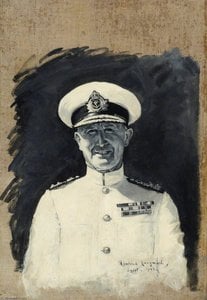
Rowland Langmaid: A Master of Maritime Majesty
Rowland John Robb Langmaid (1897-1956) wasn’t merely a painter; he was a conduit to the heart of the British Navy, capturing its power, its drama, and its inherent beauty with an almost obsessive dedication. Born in Vancouver, Canada, into a family deeply rooted in naval service, Langmaid's artistic journey began not in a formal studio but amidst the rhythms of the sea itself. This early immersion profoundly shaped his perspective, instilling within him a profound respect for maritime life and a keen eye for detail that would become hallmarks of his distinctive style.
His formative years were spent studying under William Lionel Wyllie, a renowned marine artist whose influence is undeniably present in Langmaid’s early works. However, it was his own service in the Royal Navy – beginning in 1910 and culminating in the rank of Lieutenant Commander – that truly ignited his artistic fire. He witnessed firsthand the grandeur of warships, the relentless churn of the ocean, and the stoic faces of sailors, experiences he translated onto canvas with remarkable accuracy and emotional depth. Langmaid’s time on HMS Agamemnon during the turbulent years of World War I provided invaluable experience, sketching the harrowing landings at the Dardanelles – a scene that undoubtedly informed his later depictions of naval conflict.
The War Artist's Vision
Langmaid’s contribution to British art during World War II is particularly significant. Appointed as an official war artist in 1941, he was tasked with documenting the crucial naval battles and operations of the Mediterranean Fleet. His paintings weren’t simply technical representations; they were imbued with a palpable sense of urgency, heroism, and the sheer scale of the conflict. He eschewed romanticized notions of warfare, instead focusing on the gritty reality of sailors at sea – the cramped quarters of warships, the spray of saltwater, and the determined faces of men facing danger.
His work during this period is characterized by a masterful use of muted colors—grays, blues, and greens—that evoke the atmosphere of the ocean and the somber mood of wartime. Notable examples include “Destroyer Attacking the ‘Littorio’,” a dynamic depiction of naval combat that captures both the chaos and the precision of the engagement; "Matapan Phase 1," showcasing the power and movement of warships amidst a turbulent sea, and “HMS ‘Eagle’ and ‘Gloucester’ off Calabria,” illustrating the strategic importance of these vessels in a critical battle. These paintings aren't just records of events; they are powerful testaments to the courage and resilience of those who served.
Technique and Style
Langmaid’s artistic technique was rooted in meticulous observation and a deep understanding of perspective. He employed watercolor and gouache, often layering thin washes to create subtle gradations of tone and texture. His attention to detail is astonishing – from the rigging of a ship to the individual faces of sailors – reflecting his commitment to realism. He wasn’t interested in grand, sweeping vistas; instead, he favored intimate scenes that allowed him to capture the nuances of light, shadow, and atmosphere. The influence of Wyllie is evident in Langmaid's ability to convey movement and depth within a relatively small format.
His work also demonstrates an understanding of composition—often utilizing strong diagonals and carefully placed figures to draw the viewer’s eye through the scene. The use of light, particularly reflected off the water, is consistently masterful, adding a sense of luminosity and drama to his paintings. He was a master of capturing the essence of maritime life – its beauty, its danger, and its enduring spirit.
Legacy and Recognition
Rowland Langmaid’s contribution to British art extends beyond his wartime commissions. His paintings are held in numerous collections, including the Royal Academy and the Walker Gallery in Liverpool, testament to their artistic merit and historical significance. His work offers a unique window into a pivotal period of British history – the World Wars – and remains a powerful reminder of the courage and sacrifice of those who served. Langmaid’s legacy is not simply that of a skilled artist; it's that of a chronicler of an era, capturing the spirit of a nation at war with remarkable sensitivity and skill.
His work continues to be studied and appreciated for its technical brilliance, emotional depth, and historical importance. Rowland Langmaid’s paintings are more than just images; they are windows into the past, offering a glimpse into the lives and experiences of those who shaped the course of history.
Questions & Answers
How did Rowland Langmaid's art evolve over time?
The Chronicle of Rowland Langmaid is a scroll-driven timeline that presents the artist's works in chronological order, grouped into career-period chapters.
Can I study Rowland Langmaid's use of color across all works?
The Palette Genome of Rowland Langmaid is a page that presents the color profile of the artist's body of work.
Where can I see Rowland Langmaid's artworks arranged by atmosphere?
The Mood Room of Rowland Langmaid is a page that arranges the artist's artworks by mood.