Biografie artist
A Dual Pursuit: The Philosophical Eye of Timothy John Williamson
Timothy John Williamson, born in Uppsala, Sweden in 1955, presents a truly remarkable convergence of intellectual and artistic pursuits. He’s not merely a philosopher who occasionally ventures into art, nor an artist whose work is solely inspired by philosophical concepts; rather, he embodies a rare synthesis – a rigorous analytical mind coupled with meticulous observational skill. His journey represents a beautiful demonstration of how seemingly disparate disciplines can enrich one another, resulting in creations that are both intellectually stimulating and profoundly aesthetically compelling. While globally recognized as a leading figure in contemporary philosophy—particularly for his groundbreaking contributions to epistemology, most notably detailed in *Knowledge and Its Limits* (2000)—Williamson has quietly cultivated an impressive body of botanical illustrations, specializing in the intricate beauty and often overlooked world of fungi. This artistic endeavor isn’t simply a pastime; it's an extension of his philosophical inquiry, a tangible exploration of perception, detail, and fundamentally, the very nature of knowledge itself.
From Logic to Lichens: The Development of a Unique Vision
Williamson’s intellectual foundation was firmly rooted in the traditions of British analytic philosophy. He was deeply influenced by giants of the field – figures like Bertrand Russell and Ludwig Wittgenstein – absorbing their emphasis on precision, clarity, and logical structure. This philosophical lineage profoundly shaped his approach to both his academic work and his artistic practice. He developed what he termed ‘knowledge-first epistemology’ – a perspective that places knowledge at the very core of epistemological investigation. This wasn't an arbitrary shift; it stemmed from a deep and abiding appreciation for the natural world, specifically its hidden complexities. He found in fungi—often dismissed as unremarkable or even slightly unsettling—a subject perfectly suited to his meticulous nature and analytical mind. Their complex forms, subtle color variations, and delicate structures demanded careful study, mirroring the painstaking analysis he applied to philosophical problems. The act of painting became a form of visual thinking – a way to explore the boundaries between what we perceive and how we understand it. It was a deliberate attempt to translate abstract thought into a concrete, tangible representation.
The Art of Observation: Style and Themes
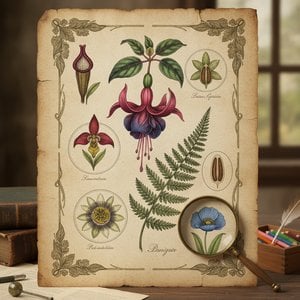
Williamson’s botanical illustrations are characterized by an unwavering commitment to realism and scientific accuracy. He doesn't simply *depict* fungi; he dissects them visually, revealing their intricate morphology with astonishing detail. Each painting is a testament to hours spent observing, meticulously capturing the subtle nuances of texture, color, and form. His style evokes the tradition of 19th-century botanical illustration – reminiscent of the detailed work produced for scientific documentation during that era. However, Williamson’s paintings transcend mere technical skill; they possess an aesthetic sensibility that elevates them to the realm of fine art. The compositions are often deceptively simple, focusing attention on the inherent beauty and unique character of the subject matter itself. He deliberately avoids imposing a narrative or symbolic meaning onto his work; instead, he allows the fungi themselves to speak, revealing their individual qualities through precise representation. Key themes consistently emerge: detailed realism, botanical accuracy, and a powerful demonstration of the interconnectedness between art and scientific documentation. He seeks not to romanticize nature, but to present it with an honest and unvarnished portrayal.
Notable Works and Growing Recognition
Williamson’s portfolio encompasses a diverse range of fungal studies, each showcasing his exceptional skill and dedication to detail. Paintings like *An Unknown Mahogany Cortinarius*, *The Lobster Mushroom*, and detailed studies of species such as *Boletinus porosu*, *Clitocybe Multiceps*, and *Paxillus atrotomentosus* demonstrate his ability to capture the subtle variations within fungal species. Works like *Cortinarius glaucopus* highlight his fascination with complex forms and textures, while pieces like *The Fly Agaric* – a striking depiction of this well-known but often misunderstood fungus – stand as particularly iconic examples of his work. While not widely exhibited in mainstream art galleries, Williamson’s paintings have gained increasing recognition within specialized circles for their precision, beauty, and unwavering commitment to capturing the natural world with scientific accuracy. The availability of his works through platforms like WahooArt.com is steadily bringing this exceptional talent to a wider audience.
A Legacy Bridging Disciplines
Timothy John Williamson’s legacy extends beyond his philosophical contributions and his botanical illustrations; it lies in the very act of demonstrating the profound interconnectedness between seemingly disparate fields. He embodies the idea that rigorous intellectual inquiry can inform and enrich artistic expression, and vice versa. His work challenges us to reconsider the boundaries between science and art, logic and intuition, observation and understanding. In a world increasingly defined by specialization, Williamson stands as a powerful advocate for interdisciplinary thinking – a holistic approach to knowledge. His paintings serve as a reminder that true insight often emerges from the intersection of different perspectives, and that beauty can be found in the most unexpected places—even within the intricate structures of a humble fungus. He represents a rare convergence of mind and vision, leaving behind a body of work that is both intellectually stimulating and profoundly beautiful.



 Vezi în context
 Comandă pictură realizată manual
 Trimite
 Distribuie
 Detalii
 Ghidul

 Descarcă
 Produse similare
 Radiografie
 Diaporama
 Statistici


 Citește mai mult






































 Opțiunea cu sticlă este disponibilă doar pentru dimensiuni de sub 110 cm