A Life Blossoming in Watercolor: The World of Mary Vaux Walcott
Mary Vaux Walcott, born in Philadelphia in 1860, seemed destined for a life steeped in quiet domesticity – a path dictated by the expectations of her Quaker upbringing. Yet, from an early age, a vibrant artistic spirit ignited within her, fueled by a simple gift: a set of watercolor paints at the tender age of eight. These weren’t mere tools; they were keys unlocking a lifelong passion for capturing the delicate beauty of the natural world, particularly the ephemeral splendor of wildflowers. Little did anyone suspect that this nascent inclination would blossom into a remarkable career, earning her the affectionate and enduring title “the Audubon of Botany.” Her story is far more than just artistic talent; it’s a testament to resilience, an insatiable curiosity about the natural world, and a pioneering spirit that bravely defied the societal constraints placed upon women in the late 19th century. The responsibility for caring for her father and two younger brothers fell heavily upon young Mary after the untimely death of her mother in 1880 – a profound loss that shaped her life’s trajectory and instilled within her an unwavering sense of duty. This devotion, however, didn't extinguish her creative flame; rather, it deepened her connection to the landscapes they explored together during their annual summer expeditions to the majestic Canadian Rockies.The Allure of the Rockies: Nature as Muse and Subject
These journeys to the Canadian Rockies became the very crucible in which Mary’s artistic talent truly flourished. The rugged grandeur of these mountains – the towering peaks, the glacial valleys, and the vibrant alpine flora – transformed into her personal laboratory. Unlike many artists who merely sought to depict a landscape for its aesthetic beauty, Mary engaged with it on a far deeper level. Alongside her brothers, she meticulously documented the Rockies, not just through sketches and photographs, but also by studying mineralogy, charting the slow, inexorable retreat of glaciers through detailed drawings and measurements, and immersing herself in the intricate details of alpine wildflowers. This wasn’t passive observation; it was an active, almost scientific pursuit – a desire to understand the underlying processes that shaped this extraordinary environment. It was during these expeditions that Mary began to hone her remarkable skills as a botanical illustrator, initially at the request of botanists eager for accurate and detailed depictions of rare and elusive plant species. Her approach was revolutionary for its time; she didn’t simply paint flowers; she rendered them to scale, meticulously capturing their delicate structures, vibrant colors, and subtle textures with an unprecedented level of precision. Her illustrations were not romanticized or idealized; they prioritized scientific accuracy alongside artistic expression, presenting a remarkably honest portrayal of the natural world. The vastness of the landscape also fostered a spirit of adventure – in 1900, Mary became the first woman recorded to successfully summit Mount Stephen, a feat that underscored her physical courage and unwavering determination.A Partnership Forged in Science and Art
Mary’s life took another significant turn in 1914 when she married Charles Doolittle Walcott, then Secretary of the Smithsonian Institution and a renowned paleontologist. This union wasn't merely a personal connection; it was a meeting of minds deeply committed to scientific exploration. Their marriage fostered a unique partnership where art and science intertwined seamlessly. They continued their annual expeditions to the Rockies, with Charles pursuing his geological research while Mary dedicated herself to her botanical paintings – often working side-by-side, documenting both the rocks and the flowers that adorned the landscape. This collaboration enriched both of their pursuits, providing Mary with a broader context for understanding the natural world and offering Charles a fresh perspective on the beauty and complexity of the Rockies. The Smithsonian Institution became a crucial platform for showcasing Mary’s work, culminating in the publication of *North American Wild Flowers* in 1925 – a monumental five-volume collection featuring over 400 of her meticulously crafted illustrations accompanied by detailed descriptions and scientific observations. This publication cemented her reputation as a leading botanical artist and earned her the enduring moniker “the Audubon of Botany,” acknowledging the parallel between her detailed floral studies and John James Audubon’s iconic depictions of birds.The Art of Observation: Technique and Style
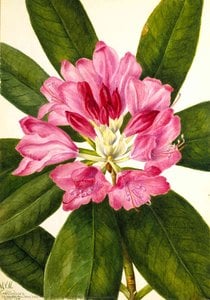
Mary Vaux Walcott's artistic style was characterized by an extraordinary level of detail and scientific accuracy, a departure from the more romanticized approaches prevalent in botanical illustration at the time. She meticulously studied each flower, rendering its delicate petals, intricate veins, and subtle variations in color with remarkable precision. Her illustrations were not merely decorative; they served as valuable scientific records, providing botanists with accurate depictions of rare and elusive species. Walcott’s technique involved working directly from nature, often painting outdoors on location to capture the fleeting effects of light and shadow. She employed a layered approach, building up color gradually through multiple washes, creating a sense of depth and luminosity. Her use of watercolor was masterful – she skillfully manipulated the medium's transparency and fluidity to achieve subtle gradations of tone and texture. Furthermore, her illustrations were notable for their scale; she rendered plants to life-size or even larger, showcasing their full beauty and complexity. This commitment to realism, combined with her artistic skill, resulted in images that are both scientifically informative and aesthetically captivating.Legacy and Recognition
Mary Vaux Walcott’s influence extends far beyond the beauty of her paintings. Her work represents a unique synthesis of artistic skill, scientific observation, and adventurous spirit – a testament to her pioneering nature. She wasn't simply documenting flowers; she was capturing their essence, revealing their intricate structures, and celebrating their vital role in the natural world. Her illustrations continue to be valued by both art enthusiasts and botanists alike, serving as invaluable resources for identifying and studying North American flora. Beyond her artistic achievements, Walcott also demonstrated a commitment to public service, serving on the federal Board of Indian Commissioners from 1927 to 1932 and actively advocating for improved conditions on Native American reservations. Upon her death in 1940, she bequeathed a substantial sum to the Smithsonian Institution, ensuring that future generations would benefit from scientific research and publication. A mountain peak in Jasper National Park, Mount Mary Vaux, stands as a lasting tribute to her adventurous spirit and enduring legacy – a reminder of a woman who dared to combine passion, dedication, and a deep connection with nature into a life of remarkable achievement.Întrebări și răspunsuri
Cum pot găsi lucrările lui Mary Vaux Walcott dintr-o anumită paletă de culori?
Pentru a găsi lucrări de Mary Vaux Walcott dintr-o anumită paletă de culori, accesați pagina După paletă de culori a artistului.
Care sunt cele mai vizionate opere ale lui Mary Vaux Walcott?
Pagina Statistici a lui Mary Vaux Walcott prezintă statistici calculate pe baza operelor de artă ale artistului listate pe acest site web.
De unde este Mary Vaux Walcott?
Mary Vaux Walcott s-a născut în Statele Unite ale Americii.