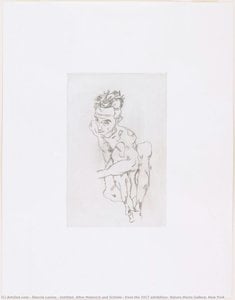
A Vision of Neoclassical Elegance
In this exquisite drawing for a table with a marble top, we are transported back to the refined atmosphere of 1774, an era where furniture was not merely functional but a profound expression of architectural grace. Attributed to the skilled hand of Thomas Chippendale the Younger, this delicate work serves as a window into the sophisticated design language of the late 18th century. The drawing captures a piece of furniture that embodies the transition from the ornate flourishes of the Rococo to the disciplined, structured beauty of Neoclassicism. Through precise linework, the artist invites us to contemplate the harmony between weight and lightness, where a heavy marble surface is supported by an ethereal arrangement of columns and legs.
The composition reveals a masterful command of proportion, showcasing the structural integrity required for such a luxurious object. The table features two elegant legs on each side, balanced by decorative columns that lend a sense of classical permanence to the design. Every stroke of the pen emphasizes the intricate details—the subtle fluting and the rhythmic placement of decorative elements—that would have once guided the hands of master craftsmen. For the discerning collector or interior designer, this drawing represents more than a blueprint; it is an evocative study in balance and symmetry that continues to inspire contemporary luxury aesthetics.
The Legacy of the Chippendale Lineage
To understand the soul of this drawing, one must look toward the illustrious lineage of its creator. Thomas Chippendale the Younger was born into a world of unparalleled craftsmanship, being the son of the legendary Thomas Chippendale Senior. Growing up in the heart of London’s design scene, the younger Chippendale inherited not only a family business but a profound artistic vocabulary. His work, much like this drawing, reflects a sophisticated blend of traditional English design and the emerging Neoclassical influences that were sweeping through European courts. This piece stands as a testament to a period when furniture design was an integral part of the fine arts, often exhibited with the same reverence as paintings at the Royal Academy.
The historical provenance of this specific drawing adds a layer of narrative depth that captivates the imagination. It was once part of a cherished album assembled by Alexander Manning, a prominent 19th-century builder and philanthropist in Toronto. The journey of this drawing—from the workshops of London to the hands of a successful Canadian pioneer—mirrors the global spread of English design ideals. There is a poignant connection between the technical precision of the drawing and Manning’s own professional life as a carpenter and developer, suggesting that these sketches were not merely aesthetic objects but practical inspirations for the construction of grand estates.
Timeless Inspiration for the Modern Interior
For those seeking to infuse their living spaces with historical grandeur, this work offers endless inspiration. The interplay of light and shadow captured in the black and white medium highlights the textures that define high-end decor: the cool, smooth surface of marble contrasted against the detailed carvings of wood. Recreating or displaying a reproduction of such a piece allows for a sophisticated dialogue between historical reverence and modern minimalism. It serves as a focal point that commands attention through its understated complexity rather than through loud ornamentation.
Owning a tribute to this era of design is an invitation to celebrate the enduring power of craftsmanship. Whether integrated into a classical study or used as a subtle accent in a contemporary gallery-style room, the drawing evokes a sense of stability, luxury, and intellectual depth. It reminds us that true beauty lies in the meticulous attention to detail and the timeless pursuit of perfect proportion—qualities that remain as relevant in today's design landscape as they were in 1774.



 Previzualizare
 Comută pe Print
 Trimite
 Distribuie
 Detalii despre lucrare

 Descarcă
 Produse similare
 Radiografie
 Diapozitive automate
 Statistici


 Vezi mai mult