CONSULTAȚIE GRATUITĂ ÎN ARTE VIZUALE

x
Comandă reproducere pictată Comandă reproducere pictatăCumpără imaginea Cumpără imaginea TrimiteTrimite
DetaliiDetalii Adaugă la favorite Adaugă la favorite DescarcăDescarcă SimilareSimilare Raze XRaze X DiaporamaDiaporama

L

Juan Gris (1887-1927) was a Spanish painter who embraced Cubism alongside fellow artists like Picasso and Braque. His distinctive approach to geometric abstraction and muted tones is exemplified in works such as "Guitar & Music Paper" and "The Miller," showcasing his pioneering vision.

Juan Gris (1887-1927) - pictor spaniol revoluționar al cubismului, cunoscut pentru forme geometrice și culori vibrante. Explorează operele sale unice!

Giclée / Imprimare artistică

Print giclée sau pe canvas de calitate muzeală, cu producție rapidă și opțiuni flexibile de finisare.

P118B $10
P118H $10
P118W $10
P438Z $10
P508JH $12
P508YH $12
P805H $10
P805Z $10
P919BZ $10
P919G $10
P919XJ $10
P959ZH $10
P968JZ $12
W106C $8
W218G $10
W218JH $8
W218Y $10
W307PJ $10
W316G $10
W316PJ $8
W316Y $10
W398PJ $8
W4111J $10
W500HY $15
W500JH $15
W692G $12
W849H $8
W940BG $15
W953PJ $8

Standard
custom
CM
INCH

Alegeți dintre dimensiunile noastre prestabilite, care respectă proporțiile originale ale operei de artă.

lățime
înălțime

Puteți introduce propriile dimensiuni pentru a se potrivi unui anumit cadru sau spațiu. Dacă dimensiunea selectată nu corespunde proporțiilor imaginii originale, vom decupa lucrarea de artă sau vom extinde imaginea cu margini oglindite sau cu o culoare uniformă. Un mockup digital va fi trimis pentru aprobarea dumneavoastră înainte de începerea producției.
Vă rugăm să rețineți că previzualizarea de pe ecran nu reflectă decuparea sau extinderea reală. Doar mockup-ul va arăta cu exactitate compoziția finală.
Deși dimensiunile personalizate sunt disponibile, vă recomandăm să selectați o dimensiune din lista predefinită pentru a păstra proporțiile originale.

Livrare în întreaga lume () în 2 săptămâni, în loc de cele 4/5 săptămâni standard. (2 Iulie)

why_choose_icon
Livrare expres gratuită la nivel mondial
why_choose_icon
Pânză de in de înaltă calitate
why_choose_icon
Asigurare completă pentru transport
why_choose_icon
Garanție de rambursare a taxelor vamale
why_choose_icon
Garanția fidelității culorilor
why_choose_icon
Politica de retur de 60 de zile (doar pentru defecte)
why_choose_icon
Garanție 100% de rambursare
why_choose_icon
Reducere la comenzi multiple

Preț total

-

reproduction

L

Giclée / Imprimare artistică

Dimensiune reproducere

-

Preț total calculat

-

Informații rapide

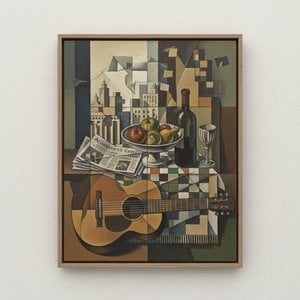
  • Movement: Cubism
  • Subject or theme: Guitar and Music Paper
  • Notable elements or techniques: Geometric abstraction, muted tones
  • Year: 1927
  • Location: Kunstmuseum Basel
  • Medium: Oil on canvas

Test de cunoștințe despre artă

Fiecare întrebare are un singur răspuns corect.

Întrebare 1:
What artistic movement is Juan Gris primarily associated with?
Întrebare 2:
The image depicts a man playing the guitar. What stylistic technique is prominently used in this depiction?
Întrebare 3:
Juan Gris's work often explores themes of fragmentation and simultaneity. How does this reflect the core principles of Cubism?
Întrebare 4:
In what year was Juan Gris born?
Întrebare 5:
Juan Gris's artistic style is characterized by muted tones and simplified forms. What was his primary influence in developing this aesthetic?

Descriere obiect de colecție

Juan Gris: A Pioneer of Cubist Synthesis

José Victoriano González-Pérez, better known as Juan Gris (1887 – 1927), stands as one of the most influential figures in early 20th-century art—a sculptor and painter whose unwavering dedication to Cubism irrevocably altered the course of artistic expression. Born in Madrid, Spain, Gris’s formative years were marked by a fascination with engineering alongside an undeniable impulse toward visual creativity, evidenced by his contributions to periodicals showcasing his burgeoning talent for drawing.

The Parisian Embrace: Genesis of Cubist Vision

His relocation to Paris in 1906 proved pivotal. Surrounded by fellow artists—Guillaume Apollinaire, Max Jacob, Henri Matisse, Georges Braque, Fernand Léger—and Pablo Picasso—Gris embarked on a collaborative journey that solidified his commitment to the revolutionary aesthetic principles of Cubism. This movement, spearheaded by Picasso and Braque, challenged traditional representational conventions, advocating for fragmentation and geometric abstraction as tools for conveying complex visual realities.

“Guitar & Music Paper”: A Symphony in Geometric Form

"Guitar & Music Paper," completed in 1927, exemplifies Gris’s masterful synthesis of Cubist ideas. Painted during his final years, this iconic artwork showcases a meticulously constructed composition dominated by interlocking geometric planes—primarily cubes and rectangles—that simultaneously depict the guitar and sheet music. The muted color palette—characterized by earthy tones—contributes to an atmosphere of contemplative stillness, inviting viewers to contemplate the interplay between form and content.

  • Style: Synthetic Cubism – Gris’s approach moved beyond Picasso's Analytical Cubism, prioritizing clarity and visual harmony.
  • Technique: Gris employed oil paint on canvas with a deliberate layering of textures—creating subtle gradations that enhance the illusion of depth despite the simplified geometry.
  • Historical Context: The painting emerged during a period of intense artistic experimentation, reflecting the broader intellectual currents of the Dada and Surrealist movements.
  • Symbolism: The guitar symbolizes musical expression and creativity, while the sheet music represents intellectual pursuit—a harmonious pairing that underscores Gris’s belief in the interconnectedness of art and thought.

Emotional Resonance: Beyond Representation

“Guitar & Music Paper” transcends mere visual depiction; it communicates a profound emotional resonance rooted in Gris’s exploration of form and color. The artwork's understated elegance speaks to an enduring fascination with the beauty of simplicity—a testament to Gris’s genius as a sculptor and painter who reshaped the landscape of modern art.

Discover more about Juan Gris and his groundbreaking contributions to Cubism at Kunstmuseum Basel: Kunstmuseum Basel

Opere de artă similare


Biografie artist

A Spanish Visionary of Cubism: The Life and Art of Juan Gris

Born José Victoriano González-Pérez in Madrid in 1887, the artist who would become known as Juan Gris embarked on a journey that would place him among the most significant figures of early 20th-century art. His initial path wasn’t one immediately leading to canvas and brush; he pursued engineering at the School of Arts and Sciences, demonstrating an analytical mind that would later profoundly influence his artistic approach. Even during these formative years, a creative spark flickered – contributing drawings to local periodicals hinted at a burgeoning visual talent. It was in 1905 that he adopted the pseudonym Juan Gris, a name resonating with a newfound sense of identity and purpose as he began formal painting studies under José Moreno Carbonero. This marked a pivotal shift, setting him on a course toward artistic innovation.

Parisian Awakening and the Embrace of Cubism

The year 1906 witnessed a transformative relocation to Paris, a city then pulsating with artistic energy. Gris immersed himself in this vibrant milieu, forging friendships with luminaries like Henri Matisse, Georges Braque, and Fernand Léger. He initially engaged in satirical illustration for publications such as *L'Assiette au Beurre*, honing his observational skills and developing a keen sense of visual wit. However, the magnetic pull of Pablo Picasso proved particularly influential. Around 1910, Gris began to seriously dedicate himself to painting, moving away from caricature towards the burgeoning language of Cubism. This wasn’t mere imitation; he embarked on a quest to distill the essence of form and space, seeking a new visual order. His early explorations were marked by a deliberate departure from traditional representation, embracing abstraction as a means of capturing reality's underlying structure. Picasso’s influence was undeniable, yet Gris quickly developed his own distinct style, characterized by a remarkable clarity and intellectual rigor.

The Geometry of Perception: Style and Key Works

Juan Gris’s artistic output is characterized by an exceptional clarity and intellectual rigor. He didn’t simply deconstruct objects; he reconstructed them with deliberate precision, emphasizing geometric forms and a carefully considered palette. This approach led to what became known as his “crystal period,” exemplified in masterpieces like *Still Life Before an Open Window* and *Place Ravignan* (1915). These works showcase a remarkable interplay of planes and angles, creating a sense of depth and solidity while simultaneously challenging conventional notions of perspective. The influence of Cézanne is evident in Gris’s use of flattened forms and simplified spatial relationships. After 1913, Gris wholeheartedly embraced Synthetic Cubism, pioneering the use of *papier collé* – collage – incorporating real-world materials like newspaper clippings and textured papers into his compositions. This technique added another layer of complexity and tactility to his work, blurring the boundaries between painting and sculpture. Notable examples include *Guitar in front of the sea* (1925), a testament to his simplified forms and adherence to cubist principles, and *Homage à Pablo Picasso* (1912), which signaled his growing recognition within the avant-garde art world.

The Development of His Style: From Analytic to Synthetic Cubism

Gris’s artistic journey wasn't a sudden shift but a gradual evolution. Initially exploring the analytical phase of Cubism, characterized by fragmented forms and overlapping planes—a technique heavily influenced by Picasso—he moved towards the more constructive and colorful approach of synthetic cubism. This transition involved a deliberate simplification of shapes, an increased use of color, and the incorporation of collage elements. He sought to represent objects not as they appear in reality but as they are perceived – broken down into their essential geometric components. The introduction of *papier collé* was a crucial step, allowing him to integrate textures and patterns into his paintings, creating a richer and more dynamic visual experience. His work during this period reflects a growing confidence and experimentation, pushing the boundaries of Cubism while retaining its core principles.

Legacy and Lasting Influence

Juan Gris’s contribution to Cubism extends beyond mere stylistic innovation; he brought a unique intellectual depth and structural clarity to the movement. He moved past the analytical phase, towards a more organized and synthetic approach, emphasizing order and precision. His work profoundly influenced the Purist style championed by Amédée Ozenfant and Charles Edouard Jeanneret (Le Corbusier), advocating for a return to classical principles of form and composition. Gris’s emphasis on geometric forms, harmonious color palettes, and the integration of everyday objects into his art established him as a pivotal figure in 20th-century art. His legacy continues to inspire artists today, demonstrating the enduring power of Cubism and the visionary genius of Juan Gris – a Spanish master who reshaped our understanding of perception and representation.
Juan Gris

Juan Gris

1887 - 1927 , Spania

Detalii rapide

  • Artistic Movement Or Style: Cubism, Sintetic Cubism
  • Artists Or Movements Influenced By This Artist:
    • Purism
    • Ozenfant
    • Le Corbusier
  • Artists Who Influenced This Artist:
    • Picasso
    • Matisse
    • Braque
  • Date Of Birth: 23 martie 1887
  • Date Of Death: 11 mai 1927
  • Full Name: José Victoriano González-Pérez
  • Nationality: Spaniol
  • Notable Artworks:
    • Guitar în fața mării
    • Homaj către Pablo Picasso
  • Place Of Birth: Madrid, Spania
Explorați opere de artă organizate pe teme, stiluri și caracteristici.