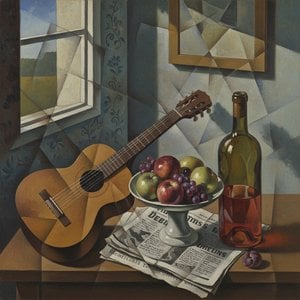
Early Influences & The Path to Cubism
 Wikipedia: Juan Gris
José Victoriano González-Pérez (23 March 1887 – 11 May 1927), better known as Juan Gris (Spanish: [ˈxwaŋ ˈɡɾis]; French: [gʀi]), was a Spanish painter born in Madrid who lived and worked in France for most of his active period. Closely connected to ...
José Victoriano González-Pérez, known universally as Juan Gris, was not born into the avant-garde; his journey toward becoming a pivotal figure in Cubism was one of deliberate exploration and intellectual awakening. Born in Madrid in 1887, Gris initially pursued formal training in engineering at the School of Arts and Sciences, a discipline that would later subtly inform his meticulous approach to composition and geometric structure. His early artistic endeavors involved illustrative work for local periodicals, honing his observational skills but offering little hint of the radical transformations to come. A move to Paris in 1906 proved catalytic, immersing him in the vibrant artistic milieu of Montmartre and introducing him to a circle of influential figures – poets like Guillaume Apollinaire and Max Jacob, and painters such as Henri Matisse, Georges Braque, and Pablo Picasso. These encounters were not merely social; they represented an intellectual ferment that challenged conventional notions of representation and paved the way for Gris’s embrace of Cubism.
Initially drawn to the expressive possibilities of Fauvism and Post-Impressionism, Gris gradually gravitated towards the more analytical concerns of Picasso and Braque. He wasn't a spontaneous convert; rather, he approached Cubism with an engineer’s precision, dissecting its principles and seeking to understand its underlying logic. This methodical approach would become a defining characteristic of his work, distinguishing it from the often intuitive explorations of his peers.
Analytical Cubism: Deconstructing Form and Perspective
Cubism is an early-20th-century avant-garde art movement which began in Paris. It revolutionized painting and the visual arts, and sparked artistic innovations in music, ballet, literature, and architecture. Cubist subjects are analyzed, broken up, a...
Gris's early foray into Cubism, beginning around 1911, aligned with the tenets of Analytical Cubism. This phase was characterized by a radical fragmentation of objects and figures, broken down into geometric facets and presented from multiple viewpoints simultaneously. Color palettes were deliberately muted – predominantly browns, grays, and blacks – to emphasize form and structure over purely aesthetic concerns. The goal wasn’t to replicate reality but to analyze it, to represent the totality of an object's presence in space rather than a single, fixed perspective. Works from this period demonstrate Gris’s commitment to intellectual rigor; he meticulously deconstructed forms, challenging traditional notions of pictorial space and representation.
However, even within this early phase, hints of his future direction were present. While embracing the fragmentation characteristic of Analytical Cubism, Gris often maintained a greater clarity of form than Picasso or Braque. This inclination towards order and legibility foreshadowed his eventual development of Synthetic Cubism, where reconstruction and simplification would take precedence over pure deconstruction.
The Rise of Synthetic Cubism: Collage, Color, and Composition
 Breakfast
Explore Juan Gris’ ‘Breakfast,’ a vibrant Synthetic Cubist masterpiece! Discover fragmented forms, bold colors & symbolic depth in this iconic 1915 artwork.
Around 1913, a pivotal shift occurred in Gris’s artistic practice – the emergence of Synthetic Cubism. This phase marked a departure from the exhaustive fragmentation of Analytical Cubism towards a more constructive approach. Instead of breaking down objects, Gris began to *build* them up using simplified geometric shapes and incorporating elements of collage—newspaper clippings, wallpaper fragments, and other found materials. This introduction of real-world textures and patterns into the canvas was revolutionary, blurring the boundaries between art and life.
Breakfast, Pears and Grapes on a Table, and Still Life before an Open Window (Place Ravignan) exemplify this new approach. These works are characterized by vibrant color palettes, bold compositions, and a deliberate flattening of pictorial space. Gris wasn’t merely representing objects; he was creating a new visual language—a synthesis of form, color, and texture that reflected the dynamism of modern life. The use of collage wasn't arbitrary; it introduced layers of meaning and symbolism, referencing contemporary culture and challenging traditional notions of artistic authorship.
Gris’s Unique Contribution: Beyond Picasso and Braque
While often discussed in conjunction with Picasso and Braque—the acknowledged pioneers of Cubism—Juan Gris carved out a distinct path within the movement. Unlike his colleagues, who frequently employed an intuitive approach to composition, Gris brought a mathematical precision and intellectual clarity to his work. He consciously sought to systematize Cubist principles, developing a rigorous framework for analyzing and reconstructing forms.
His preference for brighter, more harmonious colors also set him apart. While Picasso and Braque often favored monochromatic palettes, Gris embraced the expressive potential of color, creating works that were both intellectually stimulating and visually captivating. Furthermore, his use of collage was particularly innovative; he didn’t simply incorporate found materials as decorative elements but integrated them into the composition in a way that challenged traditional notions of representation and authorship. As Gertrude Stein famously noted, Gris was the only artist Picasso truly “wished away,” a testament to the perceived threat posed by his unique vision.
Key Works & Lasting Legacy
Gris’s relatively short career—he died in 1927 at the age of forty—yielded an astonishing body of work that continues to resonate with audiences today. Beyond the iconic still lifes, his explorations extended to portraiture and set design, demonstrating a remarkable versatility and intellectual curiosity.
His influence on subsequent generations of artists is undeniable. His emphasis on geometric abstraction paved the way for movements such as Purism and Constructivism, while his innovative use of collage inspired countless artists to explore the boundaries between art and life. Gris’s legacy extends beyond painting; he fundamentally altered our understanding of pictorial space, representation, and the very nature of artistic creation.
Collecting Juan Gris: Investment & Appreciation
Acquiring a work by Juan Gris represents not only an investment in a significant historical figure but also an appreciation for a truly innovative artistic vision. His paintings are highly sought after by collectors worldwide, commanding substantial prices at auction and consistently appearing in major museum collections.
The value of a Gris painting is determined by factors such as size, composition, provenance, and condition. However, beyond these quantifiable metrics, the true appeal lies in the work’s intellectual rigor, visual dynamism, and enduring aesthetic power. For those seeking to build a discerning collection of modern art, Juan Gris offers a compelling combination of historical significance, artistic merit, and investment potential. At WahooArt.com, we offer meticulously crafted reproductions of his masterpieces, allowing you to experience the brilliance of this Cubist master in your own home.