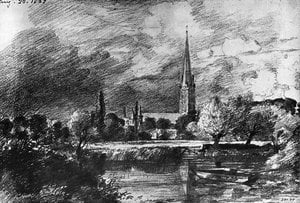
John Constable’s “A Barge below Flatford Lock”: A Symphony of Light and Rural Life
“A Barge below Flatford Lock,” painted by the English Romantic master John Constable in 1816, isn't merely a depiction of a riverside scene; it’s an immersive experience, a carefully constructed meditation on light, landscape, and the quiet rhythms of rural life. This iconic work, currently residing at the Yale Center for British Art, offers a profound glimpse into Constable’s artistic philosophy – his unwavering dedication to capturing the essence of nature with unparalleled emotional honesty. The painting transports us to the serene banks of the River Stour near East Bergholt, Constable's childhood home, a place that profoundly shaped his artistic vision and became the enduring subject of much of his oeuvre.
Constable’s genius lies not just in his technical skill – though it is undeniably masterful – but in his ability to infuse ordinary scenes with extraordinary feeling. The composition itself is deceptively simple: a barge, its presence both industrious and peaceful, glides along the calm waters beneath a sky brushed with delicate shades of blue and grey. Lush trees frame the scene, their branches reaching towards the heavens, while rolling hills provide a distant, hazy backdrop. Yet, within this apparent simplicity resides a complex interplay of light and shadow, color and texture that speaks volumes about Constable’s artistic intentions. He wasn't simply recording what he saw; he was translating his *feeling* for the landscape onto canvas.
The Language of Light: Technique and Detail
Constable’s technique is characterized by a remarkable sensitivity to light – a quality that set him apart from many of his contemporaries. He employed a broken brushstroke, layering thin washes of color to create an atmospheric effect, capturing the fleeting nuances of sunlight filtering through the trees. Notice how the warm glow illuminates the water, creating shimmering reflections and lending a sense of tranquility to the scene. The artist’s meticulous attention to detail is equally impressive; from the ripples on the surface of the river to the individual leaves on the trees, every element contributes to the painting's overall realism and depth. The use of complementary colors – the blues and greens of the water contrasting with the browns and yellows of the foliage – further enhances the visual impact.
Furthermore, Constable’s approach was revolutionary for his time. He deliberately avoided idealized representations of nature, opting instead to depict the landscape as he *actually* saw it – with its imperfections, its subtle variations in color and texture, and its inherent sense of transience. This commitment to truthfulness is what gives “A Barge below Flatford Lock” its enduring appeal; it’s a painting that invites us to slow down, to observe closely, and to appreciate the beauty of the everyday.
Historical Context and Constable's Journey
“A Barge below Flatford Lock” holds significant historical importance within Constable’s artistic career. Prior to this work, he faced considerable challenges gaining recognition for his unconventional approach to landscape painting – a style that prioritized emotional resonance over strict adherence to academic conventions. The success of this piece marked a turning point, establishing him as one of the leading figures in the Romantic movement and paving the way for future generations of landscape artists. His father’s position as a corn merchant and mill owner provided Constable with an intimate understanding of rural life and access to the very subjects he would later immortalize on canvas.
The painting also reflects the broader social and cultural context of early 19th-century England, a period marked by growing interest in nature and a desire to escape the confines of urban life. Constable’s work resonated with this sentiment, offering viewers a glimpse into a world of peace, beauty, and simplicity – a world that was increasingly threatened by industrialization and social change. The barge itself represents human activity within this idyllic setting, adding a touch of narrative without disrupting the overall sense of serenity.
Symbolism and Emotional Resonance
Beyond its technical brilliance and historical significance, “A Barge below Flatford Lock” is rich in symbolism. The barge symbolizes not just transportation but also connection – connecting people to each other, to their surroundings, and to a deeper understanding of the natural world. The river represents life’s flow, constantly moving forward while simultaneously reflecting the beauty of its banks. The distant hills evoke a sense of timelessness and permanence, anchoring the scene in the enduring landscape. Ultimately, Constable's painting is an invitation to contemplate the profound relationship between humanity and nature – a connection that remains as relevant today as it was over two centuries ago.



 Vezi în context
 Comandă pictură realizată manual
 Trimite
 Distribuie
 Detalii
 Ghidul

 Descarcă
 Produse similare
 Radiografie
 Diaporama
 Statistici
 Citește mai mult






































 Opțiunea cu sticlă este disponibilă doar pentru dimensiuni de sub 110 cm