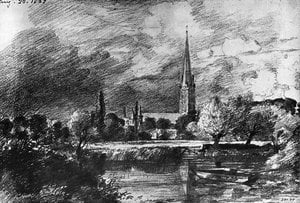
A Moment Frozen in Light: John Constable’s Salisbury Cathedral from the Bishop’s Grounds
John Constable's "Salisbury Cathedral from the Bishop’s Grounds," painted in 1823, isn’t merely a depiction of a magnificent cathedral; it’s an invitation into a serene English landscape imbued with quiet contemplation. This remarkable work transcends simple representation, capturing not just the physical structure of Salisbury but also the very essence of rural life and Constable’s deeply felt connection to his native Suffolk. The painting stands as a testament to his innovative approach to landscape art – a shift away from rigid academic conventions towards a more subjective and emotionally resonant portrayal of nature.
Constable’s decision to paint Salisbury Cathedral was, in part, driven by a personal challenge. He described the subject as “the most difficult subject in landscape I ever had on my easel,” reflecting the intricate interplay of light, shadow, and architectural detail that demanded his full attention. The painting's genesis lies in sketches made during a visit to Salisbury in 1811, followed by a more ambitious open-air oil study in 1820 – a crucial step that allowed him to truly immerse himself in the scene before committing it to canvas. This process is evident in the remarkable realism and atmospheric depth of the final work.
A Symphony of Light and Shadow
The composition itself is masterfully orchestrated, drawing the viewer into a carefully constructed space. The cathedral dominates the center, its towering spire piercing through an overcast sky – a dramatic contrast that emphasizes both its grandeur and vulnerability. Below, a tranquil scene unfolds: cattle graze peacefully in a nearby pond, while figures stroll along a winding path, suggesting a sense of everyday life interwoven with the majesty of the church. Constable’s genius lies not just in rendering these elements accurately but in capturing their subtle interactions with light and shadow.
Observe how he utilizes *chiaroscuro* – the dramatic contrast between light and dark – to create a palpable sense of depth and atmosphere. The muted tones of the landscape are punctuated by shafts of sunlight that illuminate specific areas, drawing our eye towards key details like the intricate stonework of the cathedral or the reflections shimmering on the water’s surface. This masterful manipulation of light isn’t merely decorative; it serves to evoke a feeling of quiet contemplation and spiritual resonance.
The Painter’s Soul: Technique and Emotion
Constable’s technique is characterized by loose, expressive brushstrokes – a departure from the smooth, polished surfaces favored by many of his contemporaries. These visible marks contribute to the painting’s sense of immediacy and spontaneity, as if Constable were capturing a fleeting moment in time. His use of color is equally nuanced, employing earthy tones—greens, browns, grays—to create a harmonious palette that reflects the natural beauty of the English countryside.
Furthermore, it’s important to note that this painting wasn’t simply an exercise in technical skill; it was deeply personal. Constable poured his own emotions and observations into the work, imbuing it with a sense of nostalgia for his childhood home in Suffolk. The inclusion of figures walking along the path suggests a connection between the viewer and the scene – inviting us to share in Constable’s appreciation of this idyllic landscape.
A Legacy Enduring: Reproductions and Beyond
The original "Salisbury Cathedral from the Bishop's Grounds" resides at the Frick Collection in New York City, a testament to its enduring artistic value. However, WahooArt offers meticulously crafted oil painting reproductions that faithfully capture the essence of Constable’s masterpiece. These high-quality reproductions allow art lovers and collectors to experience the beauty and emotional depth of this iconic work in their own homes.
Whether you’re drawn to the painting’s technical brilliance, its evocative atmosphere, or its profound connection to English landscape tradition, "Salisbury Cathedral from the Bishop’s Grounds" remains a timeless treasure. Explore our selection of WahooArt reproductions and bring this remarkable work into your space – a window to Constable’s soul and a celebration of the beauty of the English countryside.



 Vezi în context
 Comută pe versiunea Print
 Trimite
 Distribuie
 Detalii
 Ghidul

 Descarcă
 Produse similare
 Radiografie
 Diaporama
 Statistici


 Citește mai mult






































 Opțiunea cu sticlă este disponibilă doar pentru dimensiuni de sub 110 cm