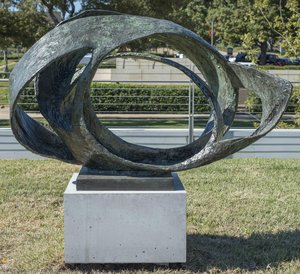
Involute II: A Dance of Form and Void by Barbara Hepworth
“Involute II,” sculpted by Dame Barbara Hepworth in 1956, isn’t merely a bronze form; it's an invitation to contemplate the relationship between space, movement, and the very essence of being. This remarkable piece, a cornerstone of modern sculpture, transcends simple representation, instead offering a profound sensory experience rooted in abstraction and a deep engagement with material. The photograph reveals a substantial metal sphere, meticulously hollowed out, presenting a dramatic interplay of solid mass and negative space – a deliberate disruption of traditional sculptural conventions that immediately draws the viewer into its enigmatic embrace.
Hepworth’s genius lay in her ability to capture not just the *appearance* of form but also its inherent dynamism. The title itself, derived from a mathematical term describing a spiral curve, hints at the underlying geometry and movement embedded within the sculpture's design. The smooth, polished surface of the bronze invites touch, while the carefully considered void suggests an openness, a suggestion of something beyond what is immediately visible. This duality—the tangible solidity of the metal against the implied emptiness—is central to the work’s power.
A Pioneer of Modernism: Hepworth's Context
Born in Wakefield, Yorkshire, in 1903, Barbara Hepworth emerged as a pivotal figure in British modern art. Her early training at Leeds School of Art and the Royal College of Art laid the foundation for her distinctive style, which drew heavily from Surrealism and Abstraction-Création – movements she actively participated in during the 1930s. Hepworth’s work reflected a profound shift away from representational art, embracing instead the exploration of pure form, texture, and spatial relationships. She sought to create sculptures that engaged with the viewer on an emotional level, bypassing literal depiction and tapping into universal human experiences.
During World War II, Hepworth and her husband, Ben Nicholson, found refuge in St Ives, Cornwall, a location that profoundly influenced their artistic practice. The rugged coastline, the shifting light, and the vibrant community of artists fostered an environment of experimentation and innovation. It was here that she developed many of her most iconic works, including “Involute II,” demonstrating a mastery of both carving and casting techniques.
Technique and Material: Bronze as a Living Medium
The creation of "Involute II" exemplifies Hepworth’s innovative approach to bronze sculpture. She began by creating detailed plaster models, meticulously refining the form before transferring it to the metal. This process allowed her to control every aspect of the final piece, from its overall shape to the subtle nuances of texture and surface detail. The use of a rough, unpolished surface—a deliberate contrast to the smooth interior—adds another layer of complexity, suggesting both vulnerability and resilience.
Hepworth’s mastery of bronze casting was exceptional. She employed a technique known as “lost-wax casting,” where a wax model is created, covered in plaster, and then heated until the wax melts away, leaving a hollow mold. Molten bronze is poured into this mold, and once cooled, the resulting cast is removed. This method allowed her to create complex forms with incredible precision and detail, while also retaining the inherent qualities of the material – its weight, texture, and reflectivity.
Symbolism and Emotional Resonance
While Hepworth herself resisted definitive interpretations of her work, “Involute II” is widely understood as a meditation on themes of containment, release, and transformation. The hollow sphere can be seen as representing the human psyche—a space of potentiality, vulnerability, and inner conflict. The opening suggests a yearning for openness, a desire to break free from constraints, while the solid bronze embodies strength and resilience.
Ultimately, “Involute II” is not simply an object; it’s an experience—a silent dialogue between form and void, inviting contemplation and sparking individual emotional responses. Reproductions of this iconic sculpture offer a remarkable opportunity to bring Hepworth's profound vision into any space, fostering a sense of serenity, introspection, and artistic appreciation.
Întrebări și răspunsuri
"Involute II" de Barbara Hepworth este o pictură, un desen sau o printă?
"Involute II" de Barbara Hepworth este clasificată ca Sculptură. Această categorie descrie tipul de operă de artă din care este compusă originalul.
În ce etapă a carierei lui Barbara Hepworth se încadrează „Involute II” (1956)?
Data din 1956 plasează "Involute II" în Mid-Century Modern dezvoltării lui Barbara Hepworth.
Din ce perioadă a carierei lui Barbara Hepworth face parte „Involute II”?
„Involute II” aparține perioadei Mid-Century Modern din cariera lui Barbara Hepworth. Această clasificare corelează opera cu evoluția artistului.



 Comandă pictură realizată manual
 Trimite
 Distribuie
 Detalii
 Ghidul

 Descarcă
 Produse similare
 Diaporama
 Statistici


 Citește mai mult






































 Opțiunea cu sticlă este disponibilă doar pentru dimensiuni de sub 110 cm