Alexandre Gabriel Decamps (1803-1860): A Pioneer of Orientalist Visions
Alexandre Gabriel Decamps, a name resonating with the vibrant hues of exotic landscapes and the dramatic flair of Romanticism, emerged as a pivotal figure in 19th-century French painting. Born in Paris on March 3, 1803, his artistic journey was one of bold innovation, challenging academic conventions and forging a path toward what would become known as Orientalism. While contemporaries like Delacroix and Ingres also held prominent positions within the French art world, Decamps distinguished himself through an intensely personal style—a blend of meticulous observation, dramatic composition, and a captivating narrative quality that drew viewers into worlds both familiar and utterly foreign. His early recognition as a talented artist foreshadowed a career marked by critical acclaim, culminating in the grand or council medal at the Paris Exhibition of 1855, a testament to his exceptional skill and unique vision. Beyond the canvas, Decamps was a man deeply connected to nature, finding solace and inspiration in the countryside surrounding Paris, where he indulged his passion for animals and field sports—a fondness that would subtly permeate much of his artistic output.
- Early Life and Artistic Training:
- Travels to the East: Shaping His Vision:
- Style and Technique: Romantic Drama Meets Observation:
- Notable Works: Landscapes, Biblical Scenes and Genre Art:
- Legacy and Influence: The Father of Orientalism
Early Life and Artistic Training
Decamps’s formative years were steeped in Parisian intellectual life. He received a comprehensive education, mastering Latin and Greek—languages crucial for understanding the humanist tradition that underpinned much of European art at the time. This scholarly grounding would prove invaluable as he honed his artistic skills under the tutelage of Jean-Baptiste Camille Bouchardy, a respected teacher known for fostering realism and capturing the essence of human emotion. Decamps’s early works demonstrated an aptitude for portraiture and genre scenes—domestic interiors populated with figures imbued with psychological depth—reflecting the prevailing stylistic trends of the École de Barbizon, where artists sought inspiration in rural landscapes and celebrated the beauty of everyday life.
Travels to the East: Shaping His Vision
A pivotal moment in Decamps’s artistic development arrived when he embarked on expeditions to Egypt and Syria during the 1830s. These journeys profoundly impacted his sensibilities, exposing him to cultures vastly different from those of France—a contrast that fueled his desire to depict these lands with unprecedented accuracy and sensitivity. Unlike many artists of his era who relied on idealized representations or fantastical embellishments, Decamps meticulously documented the sights and sounds of the Middle East, capturing the textures of desert sands, the bustling marketplaces of Damascus, and the serene beauty of monastic churches. This commitment to realism wasn’t merely a matter of technical proficiency; it stemmed from a genuine fascination with Eastern traditions and beliefs—a fascination that would permeate his artistic output for decades to come.
Style and Technique: Romantic Drama Meets Observation
Decamps's artistic style was characterized by a masterful blend of Romantic drama and meticulous observation. He employed bold brushstrokes, creating textured surfaces that conveyed the palpable atmosphere of his subjects—whether biblical narratives or landscapes bathed in golden sunlight. His compositions were dynamic and theatrical, capturing movement and emotion with dramatic flair—a hallmark of the École de Barbizon’s influence. However, Decamps distinguished himself from his peers by grounding his artistic vision in detailed realism—a technique honed through countless hours spent studying nature and painstakingly recreating its nuances on canvas. This approach resulted in paintings that possessed both grandeur and intimacy, inviting viewers to immerse themselves in worlds rendered with breathtaking precision.
Notable Works: Landscapes, Biblical Scenes and Genre Art
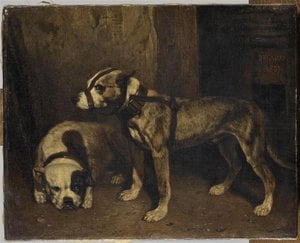
Decamps produced a prolific oeuvre encompassing landscapes, biblical scenes, and genre art—each reflecting his distinctive artistic sensibilities. Among his most celebrated works are “Joseph Sold by His Brethren,” depicting a poignant depiction of biblical storytelling with remarkable attention to detail; “The Defeat of the Cimbri,” capturing the chaos and brutality of battle with dynamic energy; and “Incendie d’un village italien,” portraying a dramatic confrontation between figures against a backdrop of fiery hues. Furthermore, Decamps excelled in genre paintings—scenes from everyday life—such as “La Cour de ferme” and “L’École Turque”—where he captured the spirit of his subjects with humor and psychological insight. His depictions of animals—particularly dogs—were equally noteworthy, reflecting his lifelong passion for these creatures and conveying their inherent dignity and beauty.
Legacy and Influence: The Father of Orientalism
Alexandre Gabriel Decamps is rightfully considered the founding father of Orientalism in French painting. Prior to him, depictions of the East were often filtered through a lens of fantasy and exoticism—a stylistic convention that perpetuated stereotypes and obscured the complexities of Eastern cultures. Decamps challenged this tradition by presenting an unvarnished glimpse of life in North Africa and the Middle East—one rooted in direct observation and genuine curiosity. His groundbreaking approach inspired artists and writers alike, fostering a wave of Orientalist works that dominated much of 19th-century art. Maxime du Camp famously dubbed him “Christopher Columbus of the Orient,” recognizing his pioneering role in opening up this new artistic territory. Decamps’s legacy continues to endure through his captivating paintings—masterpieces like “The Albanian Dancer” and “A Bedouin and a Camel Resting in a Desert”—which are celebrated for their artistic merit and historical significance, ensuring that his vision inspires generations of artists to come. His works can be found in prestigious institutions such as the Musée du Louvre in Paris.



 Previzualizare
 Comandă pictură lucrată manual
 Trimite
 Distribuie
 Detalii despre lucrare

 Descarcă
 Produse similare
 Radiografie
 Diapozitive automate
 Statistici

 Vezi mai mult






































 Opțiunea cu sticlă este disponibilă doar pentru dimensiuni de sub 110 cm