Peržiūrėti realaus dydžio版 Peržiūrėti AR realybėje Perjungti į spausdinimą Pirkti rankomis tapytą reprodukciją Siųsti
Išsamiau Gidas Pridėti į mėgstamiausius Atsisiųsti Panašūs eksponatai Rentgeno spindulių nuotrauka Diaporama Statistika

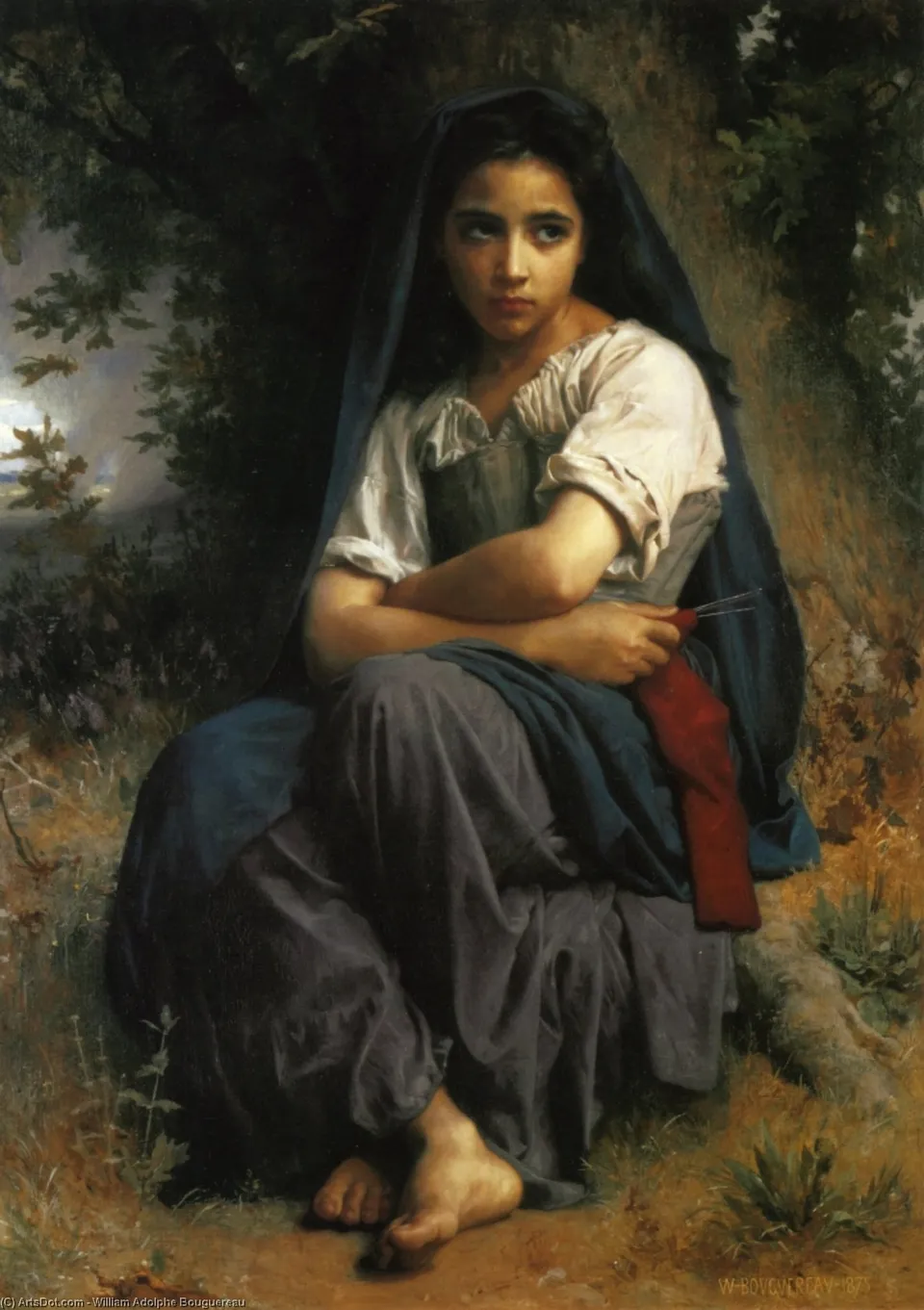
The Little Knitter

Captured in Academicism style by William-Adolphe Bouguereau during the Belle Époque, ‘The Little Knitter’ portrays a serene young girl lost in contemplation amidst dappled sunlight and scattered leaves—a timeless masterpiece inviting you to experience its exquisite beauty.

Viljamas Adolfas Bouguereau buvo Prancūzijos akademinis dailininkas. Jo įmantrios žanrinės drobės iškvėpino mitologiją ir įkvepėjo klasikinius principus. Atraskite jo meistriškumą šiandien!

Įsigykite aukštos skiriamosios raiškos, patobulintą skaitmeninį vaizdą, gerokai pranašesnį už internetinę peržiūrą.

Kiekvieną failą mūsų specialistai kruopščiai paruošia naudojant pažangias technologijas ir profesionalų rankinį retušavimą. Užtikriname, kad kiekvienas vaizdas pasižymėtų išskirtiniu aiškumu, tikslia spalvų atspalviu ir smulkiomis detalėmis.

Baigiamas failas el. paštu pristatomas per 72 valandas; jis optimizuotas nedelsiant naudojimui profesionalioje, redakcinėje ir spausdinimo aplinkoje. Tai ta pati kokybė, kuria pasitiki aukščiausios klasės dizaino studijos, leidyklos ir galerijos.

Skaitmeninis vaizdas

Atsisiųskite didelės raiškos failą asmeniniam naudojimui, spausdinimui ir kūrybiniams projektams. ( Perjungti į spausdinimą Pirkti rankomis tapytą reprodukciją)

Bendra kaina

$ 24,90

Kiekvieną skaitinio vaizdo užsakymą papildė

Profesionalus skaitmeninis vaizdų pristatymas, garantuotas

Pasirinkę WahooArt.com, jūs ne tik gaunate paveikslėlį – jūs gaunate profesionaliai patobudintą skaitmeninį kūrinį, sukurtą itin tikniai ir užtikrinantį pasitenkinimą. Štai viską, kas automatiškai pritékia jūsų užsakymui:

shipping_icon
Greitas nuotraukų gavimas el. paštu

Jūsų aukštos raiškos skaitmeninis vaizdo failas bus išsiųstas el. paštu per 72 valandas nuo užsakymo – jis bus paruoštas naudoti be jokių papildomų veiksmų.

canvas_icon
Skaitmeninis failas su dirbtiniu intelektu

Jūsų meno kūrinys profesionaliai optimizuojamas naudojant pažangius dirbtinio intelekto įrankius ir rankinį redagavimą, užtikrinant maksimalią detalę, aiškumą ir spalvų tikslumą.

insurance_icon
Nemokamas visam laikui pakartotinis siuntimas

Atsitiktinai ištrytikote ar praradote savo failą? Nebijokite – bet kuriuo metu atsiųsime jį jums vėl nemokamai.

tax_icon
Jokio importo mokesčio – niekada

Mėgaukitės savo meno kūriniu akimirka – skaitiniai failai visada yra neapmokestinami, todėl nereikės mokėti muitinės, mokesčių ar pristatymo mokesčių.

color_icon
Spalvų tikslumo garantija

Naudodami profesionalią įrangą ir spalvų valdymo sistemas, užtikriname, kad jūsų skaitmeninis vaizdas kuo tiksliau atspindėtų originalias spalvas.

return_icon
100 dienų patikimumo garantija

Jei nebuvosite patenkinti įsigyto skaitmeninio vaizdo, mes jį tališkai koreguosime arba grąžinsime 100% sumą per 100 dienų – be jokių klausimų.

guarantee_icon
100% pinigų grąžinimo garantija

Nesitenkinate? Gaukite visą sumokėtą sumą per 100 dienų nuo skaitmeninio failo gavimo – be jokių papildomų klausimų.

discount_icon
Nuolaidos dideliems užsakymams

Pirkti 3 nuotraukas – 10% nuolaida – Pirkti 5 – 15% nuolaida – Pirkti 10 ir daugiau – 20% nuolaida. Puikiai tinka kūrybiniams projektams, galerijoms bei agentūroms.

Pagrindinė informacija

  • Artist: William-Adolphe Bouguereau
  • Title: The Little Knitter
  • Notable elements: Detailed depiction; Tranquil setting
  • Dimensions: 115 x 81 cm
  • Year: 1875
  • Medium: Oil on canvas

A Moment Frozen in Time: The Essence of Innocence

In the quietude of a sun-dappled afternoon, William-Adolphe Bouguereau’s 1875 masterpiece, "The Little Knitter," invites the viewer into a realm of profound serenity and timeless grace. This exquisite oil on canvas serves as more than just a portrait; it is a window into the soul of the Belle Époque, capturing a fleeting moment of childhood contemplation that feels both deeply personal and universally resonant. The painting depicts a young girl seated gently upon the earth, her focus entirely absorbed in the rhythmic, meditative task of knitting. There is an undeniable tenderness in her posture, a soft vulnerability that immediately establishes an emotional bond between the subject and the observer. As she gaz indeed off-camera, her gaze suggests a rich inner world, perhaps lost in a daydream or observing a distant movement in the natural landscape, leaving the viewer to wonder about the thoughts swirling behind her innocent eyes.

The setting, a lush backdrop of verdant trees and scattered leaves, provides a natural sanctuary for this domestic scene. The interplay of light and shadow within the foliage adds a layer of depth and organic beauty, grounding the subject in a realistic yet idealized pastoral environment. For collectors and interior designers alike, this piece offers a sense of tranquility that can transform any space, bringing an air of classical sophistication and peacefulness to a room. It is a work that does not demand attention through loud colors or jarring compositions, but rather earns it through a subtle, magnetic charm that lingers long after the first glance.

The Mastery of Academic Impressionism

Technically, "The Little Knitter" is a triumph of Academic Impressionism, a sophisticated style where Bouguereau masterfully reconciled the rigorous precision of classical tradition with the soft, luminous atmosphere of modern experimentation. His brushwork is nothing short of miraculous; he employs a smooth, polished technique that almost erases the presence of the artist’s hand, creating an ethereal, porcelain-like finish on the girl's skin. This meticulous attention to detail allows for a palpable sense of texture that engages the senses—one can almost feel the weight and softness of the wool scarf wrapped around her head and the delicate, fine weave of her blue dress.

Bouguereau’s palette is a masterclass in subtlety, utilizing muted blues, soft greens, and earthy tones to evoke a serene and harmonious atmosphere. This careful selection of color avoids the harshness of reality, instead leaning into an idealized beauty that was the hallmark of his celebrated career. By blending the structural integrity of the Old Masters—drawing inspiration from the likes of Raphael and Titian—with a more contemporary approach to light and color, Bouguereau created a visual language that feels both historically significant and eternally fresh. For those seeking a high-quality reproduction, this technical brilliance is what makes the painting such a captivating centerpiece for fine art collections.

Symbolism and the Legacy of Virtue

Beyond its aesthetic splendor, "The Little Knitter" is steeped in symbolic meaning, reflecting the moral and social values of late 19th-century France. The act of knitting serves as a powerful metaphor for domesticity, patience, and the quiet transmission of care and tradition from one generation to the next. It represents a nurturing instinct and the beauty found in simple, virtuous labors. In an era of rapid industrialization, Bouguereau’s focus on such a peaceful, domestic vignette offered a nostalgic retreat into a world defined by innocence and moral clarity.

The painting functions as a poignant reminder of the beauty inherent in stillness. In our modern, fast-paced existence, the image of a child lost in a moment of quiet industry offers a much-needed emotional respite. It is this profound psychological truth—the ability of art to capture the sanctity of a single, unhurried moment—that ensures Bouguereau’s enduring legacy. Whether displayed in a private study, a grand salon, or a contemporary living space, "The Little Knitter" continues to inspire awe, serving as a testament to the power of beauty to soothe the spirit and elevate the human experience.


Autoriaus biografija

William-Adolphe Bouguereau (1825–1905): A Titan of Academic Realism

William-Adolphe Bouguereau, born in La Rochelle, France, in 1825, stands as one of the most recognizable and revered figures within the landscape of French academic art. From his formative years immersed in the pastoral beauty of Vendée – a region profoundly shaped by Impressionist painters like Monet – Bouguereau embarked on an artistic journey characterized by unwavering devotion to classical principles and unparalleled technical prowess. His oeuvre transcends mere visual representation; it embodies a profound belief in the inherent dignity and sublimity of human form, meticulously rendered with breathtaking precision and infused with emotive resonance. He wasn’t merely attempting to depict what he observed; rather, he sought to capture what he considered to be fundamentally beautiful—a pursuit that cemented his place as a cornerstone of 19th-century artistic achievement.

Early Influences and Artistic Training

Bouguereau's formative years were marked by exposure to the artistic traditions of Vendée, where he absorbed the stylistic nuances of Impressionism alongside his burgeoning fascination with the grandeur of antiquity. However, it was his enrollment at the École des Beaux-Arts in Paris—under the tutelage of François-Edouard Picquenot—that truly catalyzed his artistic development. Here, he immersed himself in the teachings of Raphael and Titian, absorbing their mastery of anatomy, perspective, and color theory. These masters served as guiding beacons, shaping Bouguereau’s stylistic vision and instilling within him an unwavering commitment to replicating the luminous beauty and idealized form that defined Renaissance art. The École instilled a discipline and rigor that would permeate his entire artistic practice—a dedication to meticulous draftsmanship and anatomical accuracy that distinguishes his work from its contemporaries.

The Pursuit of Ideal Beauty: Bouguereau’s Artistic Style

Bouguereau's distinctive artistic style is undeniably rooted in academic realism, yet it transcends mere imitation. He possessed an extraordinary aptitude for capturing the subtleties of human anatomy—the delicate curvature of a shoulder, the subtle blush of skin—with astonishing accuracy. Simultaneously, he demonstrated a masterful command of light and composition, skillfully orchestrating visual elements to evoke emotion and narrative depth. Unlike Impressionists who prioritized fleeting impressions of color and atmosphere, Bouguereau painstakingly reconstructed idealized forms with painstaking detail, striving for a perfection that resonated with the aesthetic sensibilities of his era. His canvases are populated by figures rendered with breathtaking realism—yet they possess an ethereal quality that elevates them beyond mere depiction. Consider *The Birth of Venus*, where Bouguereau transforms Botticelli’s mythological allegory into a luminous celebration of feminine grace and beauty—a testament to his ability to infuse classical themes with emotive resonance.

Major Achievements and Recognition

Throughout his illustrious career, Bouguereau achieved unparalleled acclaim within the Parisian Salon—receiving numerous awards and commissions that solidified his reputation as one of France’s foremost artistic luminaries. His paintings graced the homes of royalty and aristocracy alike, demonstrating his enduring popularity among discerning collectors. However, Bouguereau's unwavering adherence to traditional artistic values—a rejection of Impressionism’s radical experimentation—encountered resistance from avant-garde circles in the early 20th century. Despite this initial setback, Bouguereau’s legacy endured—recognized anew by art historians and critics who championed his technical brilliance and artistic integrity. Today, his works are housed in prestigious museums worldwide—including the Musée d’Orsay and The J. Paul Getty Museum—ensuring that his contribution to French art history will continue to inspire awe and admiration for generations to come. His influence can be discerned in contemporary figurative painting—where artists strive to emulate Bouguereau's mastery of form and light—a testament to the enduring power of classical ideals.

A Lasting Impression: Bouguereau’s Enduring Appeal

William-Adolphe Bouguereau’s artistic vision transcended mere stylistic convention; it embodied a profound belief in the inherent beauty and dignity of human form—a conviction that continues to captivate audiences today. His meticulous draftsmanship, anatomical accuracy, and emotive expression—combined with his unwavering devotion to classical principles—established him as a titan of academic realism—a figure whose influence reverberates throughout the annals of art history. He remains a pivotal artist of the 19th century—representing the zenith of artistic achievement and offering an enduring testament to the transformative power of beauty.
Viljamas Adolfas Bogušėjus

Viljamas Adolfas Bogušėjus

1825 - 1905 , Prancūzija

Pagrindinė informacija

  • Artistic Movement Or Style: Akademinis Realizmas
  • Artists Or Movements Influenced By This Artist: ['Žanras']
  • Artists Who Influenced This Artist:
    • Rafaelas
    • Titas
  • Date Of Birth: 1825
  • Date Of Death: 1905
  • Full Name: William-Adolphe Bouguereau
  • Nationality: Prancūzijoje
  • Notable Artworks:
    • Šešėlių Šuo
    • Mielasis Už Basą
  • Place Of Birth: La Rochelle, Prancūzija