


Muziejų lygio „giclée“ arba drobos spausdinimas: greita gamyba ir lankstios apdailos parinktys. ( Pirkti rankomis tapytą paveikslą Pirkti vaizdą)





























Pasirinkite iš mūsų nustatytų dydžių, atitinkančių originalaus meno kūrinio proporcijas.

Galite nurodyti savo matmenis, kad vaizdas atitiktų konkretų rėmą ar erdvę. Jei pasirinktas dydis nesutaps su originalaus paveikslėlio proporcijomis, mes arba apkirpsime kūrinį, arba išplėsime vaizdą naudojant veideliu atspindėtą arba vientisą šoną. Skaitmeninis maketas bus išsiųstas jums patvirtinti prieš pradedant gamybą.
Atkreipkite dėmesį, kad ekrane matomas vaizdinys neatspindi tikrojo apkirpimo ar išplėtimo. Tik maketas tiksliai parodytų galutinę kompoziciją.
Nors galima rinktis ir individualius dydžius, rekomenduojame pasirinkti vieną iš išanksti nustatytų matmenų, kad būtų išlaikytos originalios proporcijos.
Pristatymas visame pasaulyje () per 2 weeks, o ne įprastas 4/5 savaičių laikotarpis. (7 rugsėjis)


Composition with Red And Blue
Reprodukcijos matmenys
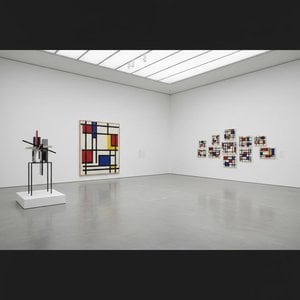
Piet Mondrian’s “Composition with Red and Blue” stands as a monumental achievement in abstract art, encapsulating the very essence of De Stijl – a movement that sought to liberate painting from representational constraints and forge a new visual language rooted in pure geometric form. Painted sometime between 1920 and 1925, this artwork isn’t merely aesthetically pleasing; it's a deliberate manifesto of philosophical ideals concerning order, harmony, and the fundamental building blocks of existence.
Immediately striking is the composition’s dominance by a grid – a network of thick black horizontal and vertical lines meticulously intersecting to divide the canvas into rectangular sections. This grid isn't accidental; it represents Mondrian’s belief in mathematical precision as a pathway to spiritual truth. The lines are unwavering, conveying an undeniable sense of stability and control—a stark contrast to the organic forms prevalent in preceding artistic movements like Impressionism.
Against this austere grid backdrop reside two rectangular blocks filled with solid color – a vibrant red and a deep blue. These hues are chosen from Mondrian’s palette of primary colors (red, yellow, and blue) without any blending or shading. This uncompromising approach reflects De Stijl's rejection of illusionistic techniques; instead, it aims to communicate directly through the inherent qualities of color itself. The placement of these blocks is carefully considered, creating a balanced visual equilibrium.
The painting’s surface possesses remarkable flatness—a characteristic that aligns seamlessly with the principles championed by Bauhaus, the influential German art school where Mondrian taught. The technique involves applying paint with meticulous accuracy using a brush or similar tool, resulting in clean edges and solid color blocks. This deliberate flatness emphasizes the two-dimensional nature of the artwork while simultaneously conveying a feeling of timelessness.
"Composition with Red and Blue" transcends mere visual beauty; it operates on a symbolic level. The grid represents universal order, mirroring the underlying structure of the cosmos—a concept deeply ingrained in Mondrian’s intellectual pursuits. Similarly, the primary colors symbolize elemental forces – fire (red) and water (blue)—suggesting an aspiration to achieve harmony between opposing energies. Ultimately, this artwork invites contemplation on fundamental questions about perception and reality.
More than just a painting, “Composition with Red and Blue” is a testament to Mondrian’s unwavering commitment to abstraction and his profound belief in the transformative power of geometric form. Its enduring appeal lies not only in its visual elegance but also in its intellectual depth—a legacy that continues to inspire artists and designers worldwide.


1872 - 1944 , Nyderlandai

Explore the profound elegance of De Stijl. Discover how Piet Mondrian and the masters of Neoplasticism utilized geometric harmony and primary colors to redefine modern abstraction. An authoritative guide for the discerning collector seeking timeless, structured beauty.
Explore the profound essence of Neoplasticism. Discover how Piet Mondrian and De Stijl masters used pure color and geometric form to redefine modern art. An essential guide for collectors seeking to understand the enduring power of abstract harmony and universal order.

 Peržiūrėti realybėje
 Pasidalinti
 Dalintis
 Išsamiau

 Atsisiųsti
 Panašūs eksponatai
 Rentgeno nuotrauka
 Automatinė diorama
 Skaityti daugiau







 Stiklo variantas prieinamas tik pasirinkus dydį iki 110 cm


