A Symphony of Abstraction: Exploring Mondrian’s ‘Diagonal Composition’
‘Diagonal Composition’, by Piet Mondrian, is a seminal work embodying the core principles of De Stijl – a Dutch artistic movement that radically reshaped 20th-century art and design. This piece isn't merely an arrangement of colors and lines; it’s a visual manifesto for universal harmony achieved through reductive abstraction. It represents a pivotal moment in the evolution of modern art, marking a decisive break from representational painting and embracing a new aesthetic vision rooted in geometric forms and primary hues.
Deconstructing Form: Style & Technique
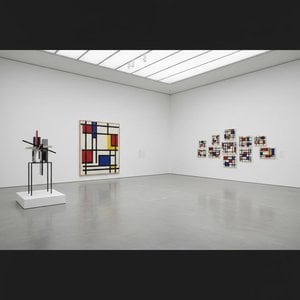
Mondrian meticulously constructed this composition using a limited palette – primary red, blue, and yellow, alongside the neutrality of white and black. The canvas is divided by a dynamic grid of bold, black lines, some vertical, others horizontal, but notably presented on a diagonal orientation - hence the title. This deliberate arrangement eschews representational imagery entirely.
The technique itself is characterized by precise brushwork; Mondrian employed oil paint with meticulous care, applying it in thin layers to achieve flat planes of color that minimized texture and emphasized purity of form. The resulting surface possesses an almost ethereal quality, reflecting the artist’s unwavering commitment to simplifying visual elements while maximizing their expressive potential. This approach aligns perfectly with De Stijl's philosophy of *Neoplasticism*, prioritizing clarity and balance over illusionistic depth.
Historical Context: The Birth of Neoplasticism
Born from a period of intense artistic experimentation, ‘Diagonal Composition’ reflects Mondrian’s evolving philosophical stance. Prior to this groundbreaking piece, Mondrian explored landscapes – as seen in works like *The Red Mill* and *Trees in Moonrise*, demonstrating an early fascination with capturing the beauty of nature. However, profoundly influenced by Theosophy and a fervent desire to communicate spiritual truths through art, he progressively distanced himself from naturalistic representation. By 1917, Mondrian co-founded De Stijl alongside Theo van Doesburg, advocating for *Neoplasticism* – a stylistic movement that sought to distill visual experience into its essential elements. The creation of this artwork coincided with the turbulent socio-political landscape of Europe, prompting artists like Mondrian to grapple with existential questions and forge paths toward universal values beyond immediate sensory impressions.
Symbolism & Meaning: A Quest for Harmony
The seemingly austere geometry of ‘Diagonal Composition’ is imbued with profound symbolic significance.
Mondrian believed that by reducing art to its fundamental components – straight lines, primary colors, and geometric shapes – he could unlock the underlying structure of reality and express a vision of cosmic order. The orthogonal lines represent opposing forces striving for equilibrium, mirroring concepts found in Eastern philosophy. The selection of red, blue, yellow, and white embodies elemental energies—representing fire, water, air, and earth respectively—harmoniously interwoven within the black grid framework. This deliberate juxtaposition underscores Mondrian’s conviction that beauty resides not in imitation but in contemplation, inviting viewers to perceive the world through a lens of intellectual clarity and spiritual insight.
Emotional Impact & Interior Design
Despite its apparent simplicity, ‘Diagonal Composition’ possesses an undeniable emotional resonance. Its restrained palette and balanced grid evoke feelings of serenity, stability, and contemplative reflection—qualities particularly valued in contemporary interior design.
This artwork lends itself exceptionally well to minimalist spaces, complementing sleek lines and neutral tones with a touch of sophisticated color harmony. A high-quality reproduction would transform any room into an oasis of calm, fostering creativity and promoting visual equilibrium. Consider pairing it with textured fabrics or natural materials—such as linen or stone—to create a dialogue between form and substance that captures the essence of Mondrian’s artistic legacy.
问答 (or more naturally for a website heading): Klausimai ir atsakymai
Kur galiu įsigyti „Diagonal Composition“, autorius – Pitas Mondrijanas spausdinį?
„Diagonal Composition“ galima įsigyti kaip aukščiausios kokybės spausdinys ant medžio siuvinėjamų audinių arba archyvinio kanvas tipo popieriaus. Užsakymus galite pateikti ši ši puslapį, pasirinkę jums tinkamą dydį.
Kur galiu rasti statistiką apie „Diagonal Composition“, autorius – Pitas Mondrijanas?
Eksistuoja Statistika puslapis kūriniui „Diagonal Composition“. Jame pateikiama mėnesio apžiūrų diagrama, apimanti šį kūrinį bei kitus šio kūrybinio veikėjo darbus, su skirstymu pagal šalis ir kalbas.
Ar galiu užsisakyti „Diagonal Composition“ aliejinį reprodukciją?
Rankumų „Diagonal Composition“, autorius – Pitas Mondrijanas kopijos yra parduodamos šis internetinis svetainė: rankomis dažyta aliejų reprodukcija ant lininio drobos, užsisakomos per ši ši puslapį.
Kokią vietą Pitas Mondrijanas pasikartojančių temų tarėje užima „Diagonal Composition“?
Dažniausios Pitas Mondrijanas temas apima žygis į geometrinę abstrakciją; kūrinys „Diagonal Composition“ susitelkia į geometrinė abstrakcija, pagrindinės spalvos, lentynos gričių kompozicija.
Kas sukūrė „Diagonal Composition“?
Kūrinį „Diagonal Composition“ sukūrė Pitas Mondrijanas. Darbas katalogizuojamas Pitas Mondrijanas vardu.
Kas sukūrė „Diagonal Composition“ ir kokiu stiliumi tai atlikta?
Pitas Mondrijanas sukūrė „Diagonal Composition“, priklausantį Žygis į geometrinę abstrakciją stiliui.
Kokiam stiliui priklauso „Diagonal Composition“?
„Diagonal Composition“, autorius – Pitas Mondrijanas priklauso Žygis į geometrinę abstrakciją stiliui. Šis dailės kryptys suteikia šiam kūriniui stilistinį kontekstą.