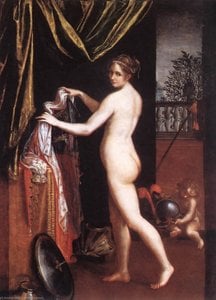
A Renaissance Portrait of Virtue and Tragedy
Lucas Cranach the Elder’s “Lucretia” stands as a cornerstone of German Renaissance art, embodying both exquisite craftsmanship and profound psychological insight. Painted around 1504 for Frederick III, Elector of Saxony—a patron deeply invested in humanist ideals—the artwork transcends mere visual representation to delve into themes of virtue, honor, and the devastating consequences of betrayal. The painting depicts Lucretia, wife of Sextus Tarquinius Superbus, Rome’s tyrannical king. Following a scandalous affair between Sextus and Lucretia's younger sister, Julia, Lucretia bravely took her own life to protect her honor after Sextus attempted to rape Julia.
Cranach meticulously captures the moment of Lucretia’s suicide—a woman draped in white linen, clutching a dagger—creating an image that is simultaneously serene and fraught with sorrow. The artist's masterful technique exemplifies the prevailing artistic sensibilities of his time. Executed on oak panel using oil paint, he employs chiaroscuro – dramatic contrasts between light and dark – to sculpt Lucretia’s form and imbue the scene with palpable emotion. The subtle shading highlights the delicate musculature of her torso and emphasizes the vulnerability conveyed by her gaze. Cranach's meticulous attention to detail extends beyond anatomy; he renders the drapery with remarkable realism, capturing folds and textures that contribute significantly to the painting’s overall atmosphere.
Beyond its technical brilliance, “Lucretia” resonates deeply with mythological symbolism rooted in Roman legend. Lucretia herself is a figure from Virgil's Aeneid, representing chastity and virtue—qualities deemed paramount by Renaissance humanists. The dagger symbolizes sacrifice and defiance against oppression, reflecting the moral dilemma faced by Lucretia as she chose honor over survival. The painting’s emotional impact remains powerfully felt centuries later. Cranach's portrayal of grief is understated yet profound, conveying a sense of tragic beauty that speaks to universal human experiences. “Lucretia” serves not merely as a depiction of an historical event but as a meditation on the enduring importance of moral integrity and the devastating repercussions of injustice.
Artwork Description
Visual Details
The painting depicts a woman holding a sword in her hand. She appears to be wearing a necklace around her neck and is draped in white linen. The artwork is an oil on panel painting.
Provenance and Location
- Artist: Lucas Cranach the Elder
- Year Painted: 1504
- Location: Museo de Bellas Artes de Bilbao (Bilbao, Spain)
问答 (or more naturally for a website heading): Klausimai ir atsakymai
Kodėl „Lucretia“ autoriškos teisės statusas yra toks, koks yra?
„Lucretia“, autorius – Lukaso Kranacho Vyresniojo Vardas yra pripa принадле belongs to the public domain – jo autorinė teisė pasibaigusi. Autorinės teisės galioja nuo mirties metų, kai šis kūrėjas mirė 1553 m.
Kokią nuotaiką ir emociją išreiškia „Lucretia“, autorius – Lukaso Kranacho Vyresniojo Vardas?
„Lucretia“, autorius – Lukaso Kranacho Vyresniojo Vardas perteikia Calm pojūtį bendroje Elegant nuotaikoje.
Kokia „Lucretia“, autorius – Lukaso Kranacho Vyresniojo Vardas emocinė nuotaika?
Emocinis tonas, nurodytas kūriniui „Lucretia“, autorius – Lukaso Kranacho Vyresniojo Vardas, yra Calm. Jis apibūdina jausmą, kurį išreiškia šis darbas.



 Peržiūrėti realaus dydžio版
 Pirkti rankomis tapytą reprodukciją
 Siųsti
 Dalintis
 Išsamiau
 Vadovas

 Atsisiųsti
 Panašūs eksponatai
 Rentgeno spindulių nuotrauka
 Diaporama
 Statistika


 Rodyti daugiau






































 Stiklo variantas prieinamas tik pasirinkus dydį iki 110 cm