A Quiet Vision: The Life and Legacy of Joan Baker
Joan Elizabeth Baker (1922–2017) was a painter whose brushstrokes whispered of the profound beauty found in the overlooked corners of the world. Born in Cardiff, Wales, her artistic soul was deeply rooted in the textures of her homeland—from the bustling energy of the Cardiff docks to the serene, verdant expanses of the Welsh countryside. While she remained a remarkably private figure, choosing to let her prolific body of work—exceeding 3,000 paintings—serve as her true autobiography, her influence on the Welsh art scene was nothing short of monumental. Her life was a delicate balance between the disciplined rigor of a master educator and the sensitive observation of a poet, capturing both the grand scale of nature and the intimate stillness of domesticity.
Her artistic journey began in earnest at the Cardiff School of Art during the pivotal years of 1939 to 1944. Under the mentorship of luminaries such as Evan Charlton and Ceri Richards, Baker was introduced to the burgeoning currents of modernism. This education provided her with more than just technical proficiency; it instilled a lifelong fascination with the interplay of light, color, and form. These early influences allowed her to develop a style that could oscillate between a faithful representation of reality and a dreamlike, impressionistic abstraction. Whether she was working on large-scale mural commissions for institutions like the Cardiff Overseas Club or painting a solitary flower, her work always maintained a signature sense of atmospheric depth.
The Art of Observation: Landscapes and Domesticity
Baker’s oeuvre is characterized by an extraordinary ability to transform the familiar into the extraordinary. Her landscapes, particularly those focusing on gardens and woodlands, are not merely topographical records but emotional sanctuaries. In works such as her Wenallt Woods triptych, she invites the viewer into a realm where reality and memory blur. Through an unconventional use of color—such as ethereal blue tones woven into foliage—she imbant her landscapes with a mythic, almost supernatural quality. Her mastery of the oil medium allowed her to create tactile surfaces where light seems to filter through a canopy or rest upon a damp forest floor, making the viewer feel the very humidity and stillness of the Welsh wilderness.
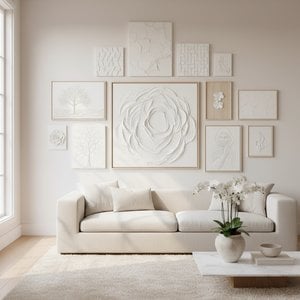
Parallel to her explorations of the wild, Baker possessed a tender eye for the domestic sphere. Her paintings of interior scenes often serve as meditations on time, memory, and the passage of life. In her 1997 masterpiece, The Last Rose, she utilizes a dual perspective—incorporating reflections in mirrors—to explore the ephemeral nature of existence. By placing a single white rose against a backdrop of vibrant blues and soft peaches, she creates a poignant dialogue between vitality and decay. These intimate portraits of everyday life are imbued with a sense of quietude, turning a simple room or a seated figure into a profound stage for human reflection.
A Legacy of Mentorship and Artistic Autonomy
Beyond the canvas, Joan Baker’s historical significance is inextricably linked to her role as a pioneer in art education. For nearly four decades, from 1945 until 1983, she taught at the Cardiff College of Art, eventually becoming the first woman to lead a major art department in Wales. Her pedagogical philosophy was revolutionary in its simplicity: she championed individual expression over rigid imitation. Baker did not seek to create clones of herself; rather, she nurtured the unique voices of her students, famously supporting the early ambitions of artists like Peter Prendergast. This commitment to fostering autonomy ensured that her influence would ripple through generations of British painters.
The true measure of Baker’s contribution to art lies in this duality of achievement:
- Technical Mastery: Her command over oil and watercolor, characterized by deliberate yet fluid brushwork and a sophisticated understanding of light.
- Cultural Impact: Her role as a trailblazing female educator in the Welsh academic landscape.
- Thematic Depth: Her ability to bridge the gap between the external natural world and the internal psychological landscape.
- Enduring Presence: A vast, prolific output that continues to offer a window into the soul of 20th-century Wales.
Through her quiet vision, Joan Baker ensured that the subtle nuances of light, the textures of the earth, and the fleeting moments of human life would be preserved in a timeless, painterly embrace.



 Peržiūrėti realaus dydžio版
 Perjungti į spausdinamus版作品
 Pasidalinti
 Dalintis
 Išsamiau
 Vadovas

 Atsisiųsti
 Panašūs eksponatai
 Rentgeno spindulių nuotrauka
 Automatinė diorama
 Q&A
Q&A Statistika


 Skaityti daugiau






































 Stiklo variantas prieinamas tik pasirinkus dydį iki 110 cm