Egon Schiele’s “Untitled (56)” – A Study in Fragility and Intensity
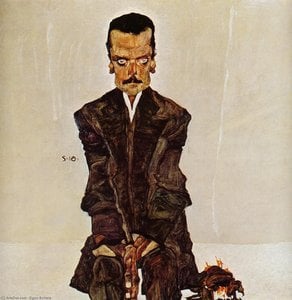
Egon Schiele's "Untitled (56)," a captivating portrait rendered with his signature raw intensity, stands as a poignant testament to the artist’s exploration of human vulnerability and the ever-present specter of mortality. Painted in 1918, just months before his untimely death at the height of World War I, this work embodies the anxieties and psychological complexities that defined Schiele's oeuvre. It’s not merely a depiction of a woman; it’s an embodiment of a moment suspended between life and oblivion, rendered with a startling directness that continues to resonate powerfully today.
The painting immediately draws the eye to its central figure – a young woman whose face is presented with remarkable clarity. Her gaze, direct and unwavering, seems to pierce through the canvas, inviting an intimate confrontation with the viewer. Schiele’s masterful use of line—bold, jagged, and often unsettling—dominates the composition, creating a sense of restless energy that vibrates throughout the image. The woman's elongated limbs and slightly distorted features contribute to this feeling of unease, suggesting a state of heightened awareness or perhaps even distress. Notice how the lines converge towards her face, emphasizing its importance within the overall structure.
The color palette is deliberately restrained, dominated by shades of yellow, blue, and red—a carefully considered combination that amplifies the painting’s emotional impact. The muted yellows create a sense of melancholy and fragility, while the blues evoke feelings of introspection and perhaps even sadness. The strategic placement of the reds – particularly in her dress – introduces an element of dramatic tension, hinting at passion, danger, or even violence. Schiele's use of color isn’t decorative; it’s deeply expressive, serving to amplify the psychological state of the subject.
Expressionist Roots and a Troubled Soul
To fully appreciate “Untitled (56),” one must understand Egon Schiele’s place within the broader context of early 20th-century Expressionism. Emerging from Vienna's vibrant artistic scene, Schiele rejected the prevailing academic traditions in favor of a more subjective and emotionally charged approach to artmaking. Influenced by artists like Edvard Munch and Vincent van Gogh, he sought to capture not just external reality but also the inner turmoil and psychological states of his subjects.
Schiele’s personal life was marked by profound loss and hardship. His father succumbed to syphilis when Egon was only fourteen, a tragedy that deeply affected him and fueled an obsession with themes of death, illness, and sexuality. The early deaths of his sister Elvira and his mother further contributed to the artist's sense of vulnerability and despair. These experiences profoundly shaped his artistic vision, informing his distinctive style characterized by distorted figures, unsettling gazes, and a palpable sense of anxiety.
Symbolism and the Portrait as Psychological Landscape
Beyond its immediate visual impact, “Untitled (56)” is rich in symbolic meaning. The woman’s posture—standing before an undefined wall or building—suggests a state of isolation and contemplation. The lack of specific detail about her surroundings creates a sense of ambiguity, allowing the viewer to project their own interpretations onto the image. Some art historians have suggested that the ‘wall’ represents the boundaries between the self and the external world, highlighting the subject's struggle with identity and belonging.
Schiele frequently employed the portrait as a vehicle for exploring psychological themes. In “Untitled (56),” he doesn’t simply depict a woman; he presents a psychological landscape—a window into her inner thoughts and emotions. The directness of her gaze, combined with the unsettling distortions of her features, invites us to confront our own anxieties about mortality and the fragility of human existence.
A Reproduction for Collectors – Capturing Schiele’s Intensity
WahooArt offers meticulously crafted hand-painted reproductions of “Untitled (56)” that faithfully capture the essence of this iconic work. Our skilled artists utilize traditional oil painting techniques to recreate Schiele's distinctive style, including his bold lines, expressive color palette, and masterful use of light and shadow. We pay close attention to every detail—from the subtle nuances of the woman’s expression to the texture of her dress—to ensure that our reproductions are as authentic as possible.
Whether you're a seasoned art collector or simply seeking a stunning piece of artwork for your home, a hand-painted reproduction of “Untitled (56)” is an exceptional choice. It’s not just a beautiful image; it’s a tangible connection to one of the most important and influential artists of the 20th century—a reminder of Schiele's profound insights into the human condition. Explore our high-resolution images and discover the perfect reproduction to bring this powerful work into your space.



 Peržiūrėti realybėje
 Pirkti rankomis tapytą paveikslą
 Pasidalinti
 Dalintis
 Išsamiau

 Atsisiųsti
 Panašūs eksponatai
 Rentgeno nuotrauka
 Automatinė diorama
 Skaityti daugiau






































 Stiklo variantas prieinamas tik pasirinkus dydį iki 110 cm