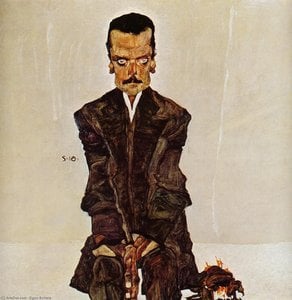
A Descent Into Shadow and Revelation: Egon Schiele’s “The Truth Unveiled”
Egon Schiele's "The Truth Unveiled," painted in 1913, isn’t merely a depiction of figures; it’s an excavation of the human psyche, a raw and unsettling exploration of mortality, duality, and the agonizing process of unveiling hidden realities. Measuring a modest 48 x 32 cm, this work punches far beyond its size, radiating an intensity that demands attention and invites prolonged contemplation. Created during his formative years within the turbulent currents of Expressionism, Schiele’s artistic voice was already forging a path distinct from academic tradition, prioritizing emotional honesty above all else. The painting immediately grips the viewer with its dramatic lighting – a stark contrast between deep shadows and the arresting red of the central figure's robe – creating an atmosphere thick with unspoken tension.
The Anatomy of Emotion: Style and Technique
Schiele’s technique is brutally direct, almost violent in its application. Thick, impasto brushstrokes dominate the canvas, layering color upon color to build a surface that feels both tactile and intensely charged. The figures are rendered with an unsettling realism, yet simultaneously distorted – limbs elongated, faces contorted in expressions of anguish or profound thought. This deliberate manipulation of form isn’t intended to deceive; rather, it serves to amplify the emotional core of the scene. Notice how the red robe itself seems to pulsate with a feverish energy, drawing the eye and anchoring the composition. The background is deliberately muted, almost dissolving into darkness, further emphasizing the central drama and suggesting an abyss of unknown truths.
- Color Palette: Dominated by intense reds, blacks, and browns – colors often associated with passion, death, and introspection.
- Brushwork: Thick, visible brushstrokes create a sense of urgency and movement, reflecting the emotional turmoil depicted.
- Composition: The figures are tightly clustered, creating a claustrophobic atmosphere that mirrors the psychological intensity of the scene.
Decoding the Symbols: Narrative and Interpretation
“The Truth Unveiled” is rich in symbolic weight, inviting multiple interpretations. The central figure, clad in red, is widely understood to represent revelation – a forceful unveiling of something previously concealed. The knife he holds isn’t necessarily an instrument of violence, but rather a tool for cutting away illusions and confronting uncomfortable realities. The two figures flanking him could be seen as embodiments of reason and emotion, locked in a perpetual struggle within the human heart. Some scholars suggest they represent the artist's own internal conflicts, while others interpret them as external forces attempting to restrain or influence his creative process. The shadowy figure in the background hints at the past, perhaps representing unresolved traumas or the weight of inherited burdens – a recurring theme in Schiele’s oeuvre.
A Modernist Echo: Context and Legacy
Painted in 1913, “The Truth Unveiled” stands as a pivotal work within the Expressionist movement. It reflects the broader modernist preoccupation with subjective experience, psychological depth, and the fragmentation of traditional values. Schiele’s unflinching portrayal of human vulnerability and his rejection of idealized beauty paved the way for subsequent movements like Surrealism, demonstrating a profound influence on 20th-century art. His exploration of themes such as death, sexuality, and mental instability was remarkably daring for its time, pushing the boundaries of artistic expression and challenging societal norms. The painting’s raw emotional power continues to resonate with viewers today, reminding us of the enduring complexities of the human condition.
At WahooArt.com, we are proud to offer meticulously crafted hand-painted reproductions of “The Truth Unveiled,” allowing you to bring this extraordinary work into your own space and experience its profound impact firsthand. Each reproduction is created by skilled artisans using traditional oil painting techniques, ensuring a faithful representation of Schiele’s original vision while retaining the vibrancy and emotional intensity that define this iconic masterpiece.
问答 (or more naturally for a website heading): Klausimai ir atsakymai
Kur galiu įsigyti „The truth unveiled - -“, autorius – Egon Šylė skaitmeninį vaizdą?
Skaitmeninį „The truth unveiled - -“, autorius – Egon Šylė vaizdą galima įsigyti šio kūrinio puslapio Skaitmeninis vaizdas skiltyje: aukštos raiškos skaitmeninio vaizdo atsisiuntimas.
Kokią nuotaiką ir emociją išreiškia „The truth unveiled - -“, autorius – Egon Šylė?
„The truth unveiled - -“, autorius – Egon Šylė perteikia Melancholic pojūtį bendroje Dramatic nuotaikoje.
Kokio Egon Šylė kūrybos etapo priklauso „The truth unveiled - -“ (1913)?
1913 m. data įtraugia "The truth unveiled - -" į Egon Šylė kūrybinio plėtojimo Early Period laikotarpį.



 Peržiūrėti realaus dydžio版
 Pirkti rankomis tapytą reprodukciją
 Siųsti
 Dalintis
 Išsamiau
 Vadovas

 Atsisiųsti
 Panašūs eksponatai
 Rentgeno spindulių nuotrauka
 Diaporama
 Statistika


 Rodyti daugiau






































 Stiklo variantas prieinamas tik pasirinkus dydį iki 110 cm