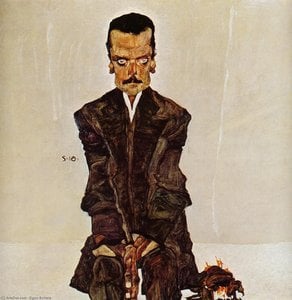
A Moment of Unbridled Joy: Egon Schiele’s “Boy in a Sailor Suit”
Egon Schiele's "Boy in a Sailor Suit," painted in 1913, is more than just a depiction of a young boy; it’s a raw and intensely felt exploration of youth, vitality, and the looming specter of mortality – hallmarks of the artist’s tragically short career. This watercolor captures a fleeting moment of exuberant movement, a boy seemingly suspended in mid-air as he executes a joyous jump or dance. The subject, dressed in the iconic sailor suit, a symbol of childhood innocence and adventure, immediately draws the viewer into his world. The painting's power resides not just in its subject matter but in Schiele’s masterful handling of color and form, techniques honed during a period of intense artistic experimentation.
Technical Brilliance and Watercolor’s Dance
Schiele was a pioneer in the use of watercolor, pushing the medium beyond traditional representational painting. Here, he employs loose washes and layered strokes to create a remarkable sense of movement and dynamism. The vibrant blue of the sailor suit is juxtaposed with the white stripes, creating a visual rhythm that mirrors the boy’s energetic pose. Notice how Schiele doesn't meticulously render every detail; instead, he utilizes broken color and suggestive lines to evoke volume and form. This technique, characteristic of his style, lends the painting an almost ethereal quality, as if the boy is dissolving into the very fabric of the scene. The watercolor medium itself contributes significantly to the work’s emotional impact – its transparency allows for a delicate layering of tones that conveys both fragility and intensity.
Echoes of Vienna and Schiele's Personal Landscape
Created in 1913, “Boy in a Sailor Suit” exists within the context of early Expressionism, a movement characterized by artists’ attempts to convey subjective emotions and experiences rather than objective reality. Schiele’s work was profoundly influenced by his personal struggles – the premature deaths of his father and sister, coupled with his own anxieties about illness and existence. The boy's joyful expression can be interpreted as a defiant assertion of life in the face of these hardships, yet there is also an underlying sense of vulnerability and transience. The painting’s composition subtly echoes Schiele’s fascination with trains, a recurring motif in his oeuvre, suggesting themes of movement, escape, and perhaps even a yearning for something beyond the confines of his immediate surroundings. The setting itself remains ambiguous, adding to the work's dreamlike quality.
Symbolism and Emotional Resonance
The sailor suit, as previously mentioned, represents childhood innocence, but it also carries connotations of performance and spectacle – fitting for a boy captured in this moment of apparent abandon. Schiele’s use of color is particularly significant; the bright blues and whites evoke feelings of joy and optimism, while the darker tones subtly hint at the underlying anxieties that permeate his work. The boy's posture—arms outstretched, face alight with glee—conveys a sense of freedom and unburdened happiness. Ultimately, “Boy in a Sailor Suit” is a poignant meditation on the fleeting nature of youth and the enduring human desire for joy and connection. It’s a testament to Schiele’s ability to capture not just an image, but a profound emotional truth.



 Peržiūrėti realybėje
 Pirkti rankomis tapytą paveikslą
 Pasidalinti
 Dalintis
 Išsamiau

 Atsisiųsti
 Panašūs eksponatai
 Rentgeno nuotrauka
 Automatinė diorama

 Skaityti daugiau






































 Stiklo variantas prieinamas tik pasirinkus dydį iki 110 cm