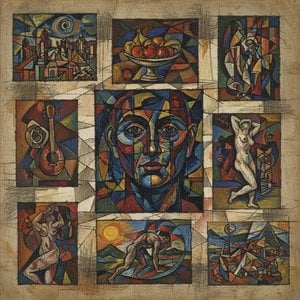
František Foltýn: Bridging Surrealism and Musical Expression
František Foltýn (1891 Královské Stachy – 1976 Brno) stands as a singular figure in Czech art history, embodying both the avant-garde spirit of his time and an unexpected passion for musical performance. Born into modest circumstances in Plzeň, he embarked on a journey that would propel him from Prague’s artistic academies to the Parisian surrealist circles and ultimately establish him as a celebrated double bass virtuoso—a duality that profoundly shaped his artistic vision.
Early Years & Artistic Formation
Foltýn's formative years were marked by a grounding in traditional Czech art education, culminating in studies at the Academy of Arts, Architecture and Design in Prague. However, World War I abruptly interrupted this trajectory, compelling him to enlist in the Austro-Hungarian army where he honed his musical skills as a bassist—a habit that would persist throughout his life. Recognizing the transformative power of artistic exploration beyond Czech borders, Foltýn pursued further studies at the Académie Julian and Grande Chaumière in Paris, immersing himself in the burgeoning modernist landscape of the era. These institutions exposed him to influential figures like Fernand Léger and František Kupka, fostering a fascination with abstraction and its capacity to convey profound emotional truths.
The Surrealist Influence & Geometric Abstraction
Foltýn’s artistic sensibilities were decisively molded by the surrealist movement, aligning him with artists who sought to liberate imagination from rational constraints. He joined groups like Cercle et Carré and Abstraction-Création, experimenting with geometric abstraction—characterized by simplified forms, rhythmic lines, and a deliberate manipulation of color—as a means of expressing inner landscapes and capturing elusive sensations. Critics noted Cassou’s astute observation that Foltýn's paintings demanded prolonged contemplation, urging viewers to “immerse in their sulphurous and stormy haze,” reflecting the movement’s preoccupation with subconscious imagery and emotional intensity. His compositions were imbued with an energetic dynamism—the lines pulsating with life—demonstrating a masterful command of visual language. The influence of Kupka is palpable in Foltýn's exploration of chromatic harmonies and rhythmic patterns, mirroring the Orfismo’s quest for expressive abstraction.
Musical Accomplishments & Recognition
Beyond his artistic endeavors, Foltýn possessed exceptional musical talent, dedicating himself to mastering the double bass as a solo instrument. This passion extended beyond mere performance; he actively engaged in conducting and composing, achieving considerable acclaim internationally through numerous competitions. His musical pursuits mirrored his artistic vision—a commitment to exploring complex textures and conveying nuanced emotions—further cementing his reputation as a multifaceted artist. He performed extensively throughout Europe and America, captivating audiences with his virtuosity and interpretive depth.
Legacy & Continued Relevance
Foltýn’s oeuvre remains an integral part of the National Gallery Prague's permanent exhibition 1918–1938: The First Czechoslovak Republic, serving as a testament to Czech modernist art during a pivotal period in history. His work continues to resonate with contemporary audiences who appreciate its blend of organic abstraction and geometric precision—a stylistic hallmark that distinguishes it from other artists of his time. Foltýn’s artistic legacy transcends national boundaries, demonstrating the enduring power of creativity to grapple with profound questions about human experience and perception. He is remembered not only as a painter but also as a musician who embodied the spirit of innovation and artistic integrity.