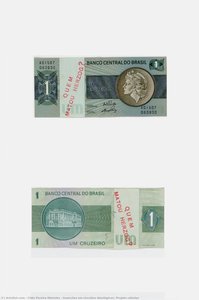
Cildo Pereira Meireles: Exploring Resistance Through Sculpture and Conceptual Installations
Cildo Pereira Meireles (born Rio de Janeiro, Brazil, 1948) stands as a pivotal figure in Brazilian conceptual art, recognized for his uncompromising engagement with political themes and his masterful manipulation of materials to provoke profound phenomenological experiences within the viewer. His work continues to resonate today as a testament to artistic courage and intellectual rigor—a beacon illuminating the intersection of art and social critique.Early Life and Artistic Beginnings
Born into a family steeped in artistic tradition—his father was a sculptor—Meireles’s formative years instilled an early appreciation for visual art. He pursued formal studies at Universidade Estadual Paulista, São Paulo, honing his skills in sculpture and experimenting with diverse mediums before embarking on his groundbreaking conceptual explorations. This familial influence profoundly shaped his artistic trajectory, nurturing a sensitivity to form and materiality that would characterize his entire oeuvre. Initially captivated by Pop Art’s repetition and mass production techniques—particularly Warhol's silkscreen prints—Meireles absorbed the aesthetic principles of reproducibility and questioned the role of the artist in relation to consumer culture. However, he swiftly moved beyond stylistic imitation, prioritizing intellectual rigor and challenging conventional artistic conventions.Conceptual Installations: Challenging Perception
Meireles’s artistic reputation rests primarily on his monumental installations—large-scale projects designed to disrupt viewers' expectations and stimulate critical reflection. These works frequently utilize unconventional materials like steel mesh, spheres of varying sizes, and even banknotes, transforming them into immersive environments that invite sensory engagement. A seminal piece is ‘Glove Trotter’ (1991), which employs a complex geometric structure to symbolize global interconnectedness and the dissemination of ideas. The meticulously crafted mesh creates an illusion of movement, mirroring the flow of information across borders—a deliberate provocation against passive observation. Similarly, ‘Inserções em circuitos ideológicos,’ created in 1976, confronts viewers with Brazilian banknotes—a symbol of national identity—arranged in a pattern that disrupts established visual hierarchies and prompts contemplation on ideological forces shaping society. This project embodies Meireles’s commitment to questioning dominant narratives and exposing hidden assumptions. His installations are not merely objects; they are active agents of perception—forcing audiences to confront uncomfortable realities and reconsider their understanding of the world around them.Influences and Artistic Philosophy
Meireles’s artistic vision draws inspiration from thinkers such as Georges Bataille, Walter Benjamin, and Theodor Adorno, reflecting a preoccupation with concepts of alienation, critique of rationality, and the role of art in confronting social injustices. He champions a phenomenological approach—emphasizing subjective experience—believing that art should transcend mere representation to elicit visceral responses from its audience. Influenced by artists like Hélio Oiticica and Lygia Clark—who similarly blurred the boundaries between art and life—Meireles sought to destabilize traditional artistic conventions, mirroring the spirit of Brazilian neo-conceptualism which emerged in response to Augusto Cesar Cruz Silva’s death in 1973. He argued that “the work is not what we see in a museum exhibition,” emphasizing instead the importance of interaction between artist and viewer—a crucial element in fostering critical engagement with artistic ideas.Major Achievements and Recognition
Meireles’s installations have garnered international acclaim, notably showcased at the Instituto Inhotim Art Museum in Minas Gerais, Brazil. His work has been exhibited extensively throughout Europe and North America, cementing his position as one of Brazil's most influential contemporary artists. He received the Ordway Prize in 2008—a prestigious honor recognizing his contribution to artistic innovation—underscoring the enduring relevance of his conceptual explorations. Cildo Pereira Meireles’s legacy extends beyond individual artworks; it resides in his unwavering dedication to challenging societal norms and advocating for social transformation through creative expression—a testament to the transformative power of art as a tool for intellectual and perceptual liberation.Domande e risposte
Posso ordinare le opere di Cildo Meireles per colore?
Le opere di Cildo Meireles possono essere esplorate per colore nella pagina Indice Spettrale dell'artista.
Quali sono il luogo e l'anno di nascita di Cildo Meireles?
Cildo Meireles è nato a Rio de Janeiro nel 1948.
In quali movimenti ha operato Cildo Meireles?
Le opere di Cildo Meireles possono essere consultate per movimento nella pagina Tutti i movimenti dell'artista.
È disponibile un tour virtuale 3D delle opere di Cildo Meireles?
Le opere di Cildo Meireles sono visibili in una galleria 3D nella pagina Museo 3D dell'artista.
Posso studiare l'uso del colore di Cildo Meireles in tutte le sue opere?
L'uso del colore di Cildo Meireles nelle opere elencate su questo sito può essere approfondito consultando la pagina Genoma della Palette dell'artista.
Dove si trovano le opere di Cildo Meireles raggruppate per parole chiave?
Le opere di Cildo Meireles possono essere esplorate tramite parole chiave nella pagina Per parole chiave dell'artista. Ogni parola chiave raggruppa le opere correlate.
Come posso seguire l'evoluzione dell'opera di Cildo Meireles anno dopo anno?
Le opere di Cildo Meireles possono essere visualizzate in ordine cronologico nella pagina Cronologia opere dell'artista.
Dove si trovano le opere di Cildo Meireles mappate per soggetto?
La pagina Atlante dei soggetti mappa le opere di Cildo Meireles per soggetto.