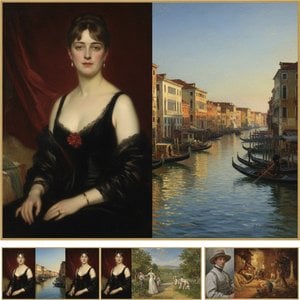
Ambrose Bowden Johns: A Plymouth Painter of Atmospheric Devon
Ambrose Bowden Johns (1776 – 1858) remains a quietly significant figure in the history of British landscape painting, particularly within the artistic circles of Plymouth and the broader Devon region. Often overshadowed by his more celebrated contemporary, Turner, Johns nonetheless cultivated a distinctive style—characterized by rich, dark palettes, evocative atmospheric effects, and a deep connection to the rugged beauty of the Southwest Peninsula. His work offers a compelling glimpse into the Romantic sensibility flourishing in Britain during the early 19th century, blending observation with a potent sense of mood and place.
Born in Plymouth in 1776, little is known of Johns’ formative years beyond his apprenticeship as a printer and publisher for Benjamin Haydon, the father of the future history painter. This early association proved pivotal, providing him with an introduction to the world of art and fostering a close friendship with Haydon himself. It was through this connection that Johns began to develop his artistic skills, encouraged by Haydon’s appreciation for landscape painting and the prevailing trends of the time. His training wasn't solely formal; he benefited from the tutelage of James Northcote, a respected local artist who instilled in him an understanding of Devon’s unique topography and light.
Johns’ artistic journey gained momentum during the 1810s and 1820s. He established himself as a resident artist in Plymouth, actively participating in the burgeoning local art scene. The Plymouth Society of Artists and Amateurs provided a platform for his work, while his home became a hub for artistic activity, attracting fellow artists like Samuel Prout and Benjamin Robert Haydon. A particularly significant period was his summer sojourn with Turner in 1813, an encounter that profoundly influenced his style—as evidenced by the numerous sketches he produced during their shared excursions. These studies demonstrate a clear absorption of Turner’s techniques, particularly his use of light and shadow to create dramatic effects, though Johns always maintained a distinct, darker aesthetic.
Beyond his artistic relationships, Johns was also a practical innovator. In 1807, he secured a patent for an external paint—a significant achievement that showcased his inventive spirit and contributed to the advancement of painting materials. However, a regrettable consequence of this innovation was its inherent instability; the asphaltum used in the formulation proved lightfast, resulting in paintings characterized by their characteristic dark hues – a feature often cited as both a defining trait and a potential drawback of his work. Despite this limitation, Johns’ dedication to capturing the essence of Devon's landscapes remained unwavering.
The Influence of Turner and the Dark Palette
Turner’s presence in Plymouth undoubtedly shaped the trajectory of Johns’ artistic development. Their shared sketching trips provided invaluable opportunities for observation and exchange, while Turner’s innovative use of light and color served as a powerful inspiration. However, it's crucial to recognize that Johns didn’t simply mimic Turner; he adapted these influences to create his own unique vision. His paintings are distinguished by their darker, more somber palette—a deliberate choice that reflects the often-moody conditions of Devon’s coastal landscapes and the Romantic emphasis on melancholy and introspection.
This preference for darkness wasn't merely stylistic; it was deeply rooted in Johns’ artistic sensibility. He sought to capture not just the visual appearance of a scene, but also its emotional atmosphere—the sense of isolation, mystery, and grandeur that characterized the region. His compositions often feature dramatic lighting effects, with pools of shadow contrasting sharply with areas of illumination, creating a powerful sense of depth and perspective.
The influence of other artists – notably Gaspard Dughet and Claude Gellée—is also evident in Johns’ work, particularly in his skillful rendering of atmospheric perspective and the depiction of rugged terrain. These influences combined to produce a style that was both distinctly British and deeply rooted in the traditions of European landscape painting.
Notable Works and Exhibitions
Ambrose Bowden Johns exhibited his paintings at prestigious exhibitions in London, including the Royal Academy, demonstrating his recognition within the established art world. His works frequently garnered attention for their evocative depictions of Devon’s coastline and moorland landscapes. A particularly notable example is “Avonmouth and the Severn from Durdham Down,” a dramatic composition that captures the power and beauty of the Southwest Peninsula. This painting, along with others in his oeuvre, exemplifies his mastery of atmospheric perspective and his ability to convey a sense of mood and place.
Beyond London exhibitions, Johns’ paintings were also showcased at local events and gatherings within Plymouth and Devon. His involvement in the Plymouth Society of Artists and Amateurs ensured that his work remained visible to a wider audience, contributing to his reputation as a leading landscape artist in the region. His dedication to fostering artistic activity within Plymouth cemented his legacy as a key figure in the city’s cultural history.
Legacy and Historical Significance
Despite facing periods of misattribution—most notably when a painting was falsely attributed to Turner—Ambrose Bowden Johns remains an important, though often overlooked, artist. His work offers a valuable insight into the artistic landscape of early 19th-century Britain, particularly within the context of Devon and Cornwall. His distinctive style—characterized by dark palettes, atmospheric effects, and a deep connection to the region’s natural beauty—sets him apart from his contemporaries.
Johns' legacy extends beyond his individual paintings; he played a significant role in fostering artistic activity within Plymouth, encouraging local artists and establishing a vibrant artistic community. His home became a gathering place for fellow artists, contributing to the city’s cultural identity. Today, his works are held in national collections and continue to be appreciated for their beauty, skill, and evocative power.
Domande e risposte
Esiste una linea del tempo delle opere di Ambrose Bowden Johns?
Le opere di Ambrose Bowden Johns possono essere visualizzate in ordine cronologico nella pagina Cronologia opere dell'artista.
Come si è evoluta l'arte di Ambrose Bowden Johns nel tempo?
La carriera di Ambrose Bowden Johns si svela periodo dopo periodo nella pagina Cronologia: una linea temporale orizzontale delle opere, raggruppate in capitoli relativi ai vari periodi della sua carriera.
Posso ordinare le opere di Ambrose Bowden Johns per colore?
L'indice spettrale di Ambrose Bowden Johns, consultabile tramite Indice Spettrale, è una pagina che organizza le opere dell'artista in base ai loro colori.