A Portrait of Melancholy: William Powell Frith’s “Katharina”
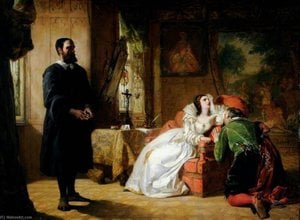
William Powell Frith's "Katharina," painted circa 1851, is more than just a portrait; it’s a carefully constructed tableau of Victorian theatricality and subtle emotional depth. This captivating work, housed within the collections of the University of Cambridge, offers a glimpse into the social fabric of mid-19th century London through the eyes of one enigmatic figure. Frith, a master of genre painting and panoramic narrative scenes, meticulously crafted this image to capture not just likeness but also atmosphere and implied story.
The subject herself is shrouded in an air of quiet contemplation. Dressed in a lavish, yet somewhat faded, theatrical costume—a rich crimson gown adorned with intricate lace and a delicate veil—Katharina appears poised on the cusp of performance or perhaps, simply lost in her own thoughts. Her gaze, directed slightly downward, suggests introspection rather than outward engagement. The lighting, soft and diffused, is crucial to the painting’s effect; it avoids harsh contrasts, instead creating subtle shadows that define the contours of her face and clothing, lending a sense of both vulnerability and dignity.
The Romantic Palette and Precise Technique
Frith's masterful command of oil paint is immediately apparent. He employs a rich, layered technique, building up color gradually to achieve remarkable textural detail. The fabric of the gown appears almost tactile—one can practically feel the weight of the velvet and the delicate rustle of the lace. The artist’s use of line is equally deliberate; precise outlines define the figure's features and drapery, creating a sense of solidity and volume that anchors the composition. Notice how he uses short, broken brushstrokes to capture the shimmer of light on the fabric and the intricate details of the veil.
The background, deliberately blurred and indistinct, serves not as a distraction but as an integral part of the painting’s narrative. It hints at an outdoor setting—perhaps a stage or garden—but ultimately emphasizes the central figure. The atmospheric perspective – the subtle fading of colors in the distance – adds depth without overwhelming the viewer's attention.
A Victorian Stage and Symbolic Resonance
"Katharina" is deeply rooted in the conventions of Victorian theatricality, reflecting Frith’s fascination with public life and social rituals. The costume itself is laden with symbolic meaning; it speaks to the world of performance, role-playing, and the constructed identities that were prevalent within Victorian society. The melancholic expression on Katharina's face suggests a deeper emotional complexity beneath the surface – perhaps a longing for something unattainable or a recognition of the transient nature of beauty and fame.
Considering Frith’s broader artistic output, “Katharina” aligns with his penchant for depicting scenes of social interaction and moral commentary. His meticulous attention to detail and his ability to capture both the outward appearance and the underlying emotions of his subjects make this painting a compelling example of Victorian genre art. It invites us to contemplate not only the beauty of the portrait but also the broader cultural context in which it was created.
Further Exploration & Legacy
For those seeking deeper insights into Frith’s work and “Katharina,” resources such as the Art UK website () offer valuable information, including high-resolution images and scholarly essays. Wikipedia provides a comprehensive biographical overview of Frith's life and career (). These resources, along with the Mercer Art Gallery’s exhibition catalogue, provide a rich context for appreciating this remarkable portrait.
Domande e risposte
Il copyright di "Katharina" di William Powell Frith consente la riproduzione dell'opera?
Lo stato del copyright di "Katharina" di William Powell Frith è chiaro: l'opera è di pubblico dominio - il copyright è scaduto. La sua presenza presso Università di Cambridge non ne cambia lo stato.
Quale soggetto e quale atmosfera si incontrano in "Katharina" di William Powell Frith?
"Katharina" mostra victorian portraiture, theatrical figure, melancholy mood, romantic drama, costume art, detailed painting, 19th century, elegant woman, e l'atmosfera che ne scaturisce è Romantic.
Come viene descritta la tavolozza di "Katharina" di William Powell Frith?
I colori di "Katharina" compongono una tavolozza Earthy. Questa classificazione descrive le famiglie di colori dominanti.



 Anteprima in scala reale
 Acquista il dipinto realizzato a mano
 Invia
Invia Condividi
 Dettagli opera
 Guida
Guida

 Scarica
 Simili
 Radiografia
 Slideshow
 Statistiche

 Espandi i dettagli






































 L'opzione vetro è disponibile solo per dimensioni inferiori a 110 cm