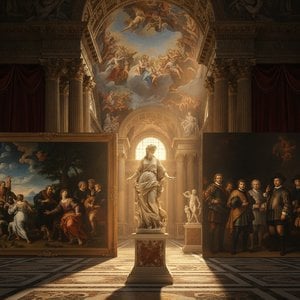
A Window into Georgian Opulence and Satire
In the grand tapestry of eighteenth-century British art, few threads are as vibrant or as biting as those woven by William Hogarth. His masterpiece, "Taste in High Life," serves as a profound window into the gilded age of the Georgian aristocracy, offering much more than a mere glimpse of aristocratic leisure. Etched with masterful precision after his own 1746 painting, this work captures a moment of staged sophistication that is simultaneously beautiful and deeply critical. As one gazes upon the scene, they are transported into a richly decorated chamber where every shadow and every stroke of the engraver's tool whispers tales of social ambition, intellectual pretension, and the subtle chaos lurking beneath a polished veneer.
The composition is a masterclass in narrative arrangement. At the heart of this opulent setting, three figures are gathered in an intimate moment of supposed erudition, their presence anchored by a small, charming dog perched atop a plush cushion. This canine companion, clutching a scroll within its jaws, acts as a silent sentinel of knowledge and learning. Yet, Hogarth cleverly disrupts this image of serene intellect; the eye is drawn away from the scholarly pursuit toward a moment of domestic disruption—a spilled tea tray that serves as a poignant metaphor for the frivolity and misplaced priorities of the upper classes. It is this tension between the high-minded pursuit of culture and the accidental descent into chaos that gives the piece its enduring emotional resonance.
The Mastery of Line and Light
To behold a reproduction of this engraving is to appreciate the breathtaking technical prowess of the Baroque tradition. Hogarth’s technique relies on the meticulous application of fine lines, where cross-hatching and stippling work in harmony to breathe life into the monochromatic palette. The artist utilizes a sophisticated range of grays, from the deepest, velvety blacks to the most delicate, luminous whites, creating a sense of volume and tactile reality. One can almost feel the weight of the heavy drapery, the smoothness of the polished furniture, and the intricate textures of the period clothing through the sheer precision of the etched lines.
For the discerning collector or interior designer, this artwork offers an unparalleled depth of character. The use of linear perspective creates a convincing illusion of space, drawing the viewer deeper into the room’s architectural grandeur. This sense of depth, combined with the soft, diffused lighting that bathes the scene in a calm, almost nostalgic glow, makes the piece an exquisite focal point for any sophisticated interior. Whether placed in a library, a formal study, or a contemporary gallery space, "Taste in High Life" provides a conversation piece that bridges the gap between historical storytelling and timeless aesthetic elegance.
A Legacy of Social Commentary
Beyond its visual splendor, the work remains a vital piece of social history. Produced during an era of intense intellectual ferment, Hogarth’s print functions as a "modern moral subject," a genre he helped pioneer. He invites us to look past the surface of the fine silks and marble sculptures to witness the underlying satire regarding societal pretensions. The way the figures interact—or fail to interact with their surroundings—reflects the anxieties of an age caught between the rigid structures of the past and the burgeoning enlightenment of the future.
Owning a high-quality reproduction of this work is not merely about acquiring a beautiful image; it is about preserving a piece of the human story. It is an invitation to contemplate the complexities of human behavior, the masks we wear in social settings, and the enduring nature of our social ambitions. For those who seek art that challenges the mind while delighting the eye, Hogarth’s "Taste in High Life" remains an incomparable treasure, offering a sophisticated blend of historical insight and masterful artistry.



 Anteprima in scala reale
 Passa alle stampe
 Condividi
 Condividi
 Dettagli

 Scarica
 Articoli simili
 Radiografia
 Slideshow
 Statistiche

 Leggi tutto






































 L'opzione vetro è disponibile solo per dimensioni inferiori a 110 cm