


 CeramicsArts and Crafts
 1897
1897 46.0 x 15.0 cm
 Museo di Los Ángeles County
Acquista un'immagine digitale ad alta risoluzione e ottimizzata, di qualità nettamente superiore all'anteprima online.
Ogni file è meticolosamente preparato dai nostri specialisti interni attraverso l'uso di strumenti avanzati e un sapiente ritocco manuale. Garantiamo che ogni immagine presenti una chiarezza eccezionale, una precisione cromatica impeccabile e dettagli raffinati.
Il file finale viene consegnato via e-mail entro 72 ore, ottimizzato per un uso immediato in contesti professionali, editoriali e di stampa. Si tratta della stessa qualità affidata ai più prestigiosi studi di design, editori e gallerie d'arte.
Scarica un file ad alta risoluzione per uso personale, per la stampa e per progetti creativi. ( Acquista stampa Acquista il dipinto realizzato a mano)
Quando scegli WahooArt.com, non riceverai solo un'immagine: riceverai un'opera d'arte digitale professionalmente ottimizzata, realizzata con la massima precisione e accompagnata da una garanzia di soddisfazione. Ecco tutto ciò che include il tuo ordine, automaticamente:

Riceverai il file dell'immagine digitale ad alta risoluzione via email entro 72 ore dall'ordine, pronto per un uso immediato.

La tua opera d'arte viene ottimizzata professionalmente attraverso l'uso di strumenti avanzati di intelligenza artificiale e una revisione manuale, garantendo il massimo livello di dettaglio, nitidezza e accuratezza cromatica.

Hai eliminato o perso accidentalmente il tuo file? Non preoccuparti: te lo invieremo di nuovo in qualsiasi momento, gratuitamente.

Goditi la tua opera d'arte istantaneamente senza costi doganali, dazi o spese di spedizione: i download digitali sono sempre esenti da tasse.

Garantiamo che la tua immagine digitale rifletta i colori originali con la massima fedeltà, grazie all'uso di strumenti professionali e a una gestione accurata del colore.

Se non sei soddisfatto della tua immagine digitale, la revisioneremo o ti rimborseremo il 100% entro 100 giorni, senza domande.

Non sei soddisfatto? Ricevi un rimborso completo entro 100 giorni dal ricevimento del tuo file digitale, senza alcuna complicazione.

Acquista 3 immagini, risparmia il 10% - Acquista 5, risparmia il 15% - Acquista 10+, risparmia il 20%. Ideale per progetti creativi, gallerie e agenzie.
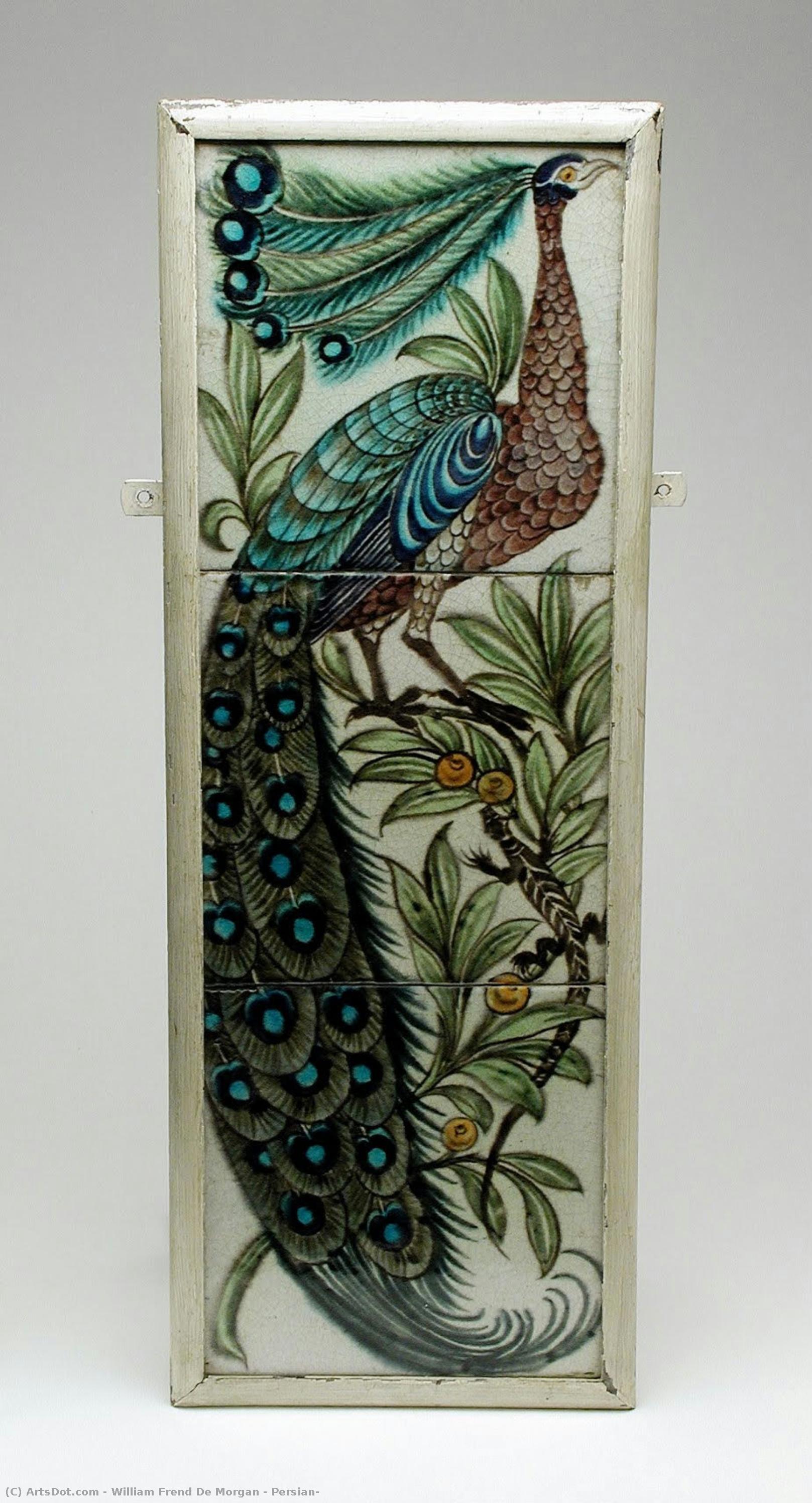
Within the rich tapestry of 19th-century decorative arts, few pieces possess the captivating blend of artistry and exoticism as William Frend De Morgan’s “Persian” tile panel. Created in 1888-1897 during his prolific period at Merton Abbey, this work transcends mere ornamentation; it's a portal to a reimagined East, infused with Victorian sensibilities and a profound understanding of ancient artistic traditions. More than just a decorative object, it’s a testament to De Morgan’s innovative spirit and his ability to synthesize diverse influences into a singularly beautiful whole.
The panel immediately draws the eye with its vibrant palette – deep blues reminiscent of Persian Iznik ware, punctuated by turquoise highlights, manganese purples hinting at ancient dyes, and the warm glow of Indian red. These colors aren’t simply applied; they are meticulously layered to create a luminous depth that seems to shift and shimmer in the light. The intricate design is dominated by stylized peacocks, their tails spread in an explosion of feathers, each feather rendered with painstaking detail. Surrounding these majestic birds are delicate floral motifs – lotus blossoms, irises, and stylized leaves – all arranged within a complex geometric framework. This combination of natural forms and structured patterns speaks to De Morgan’s fascination with both the organic beauty of nature and the order inherent in ancient civilizations.
De Morgan's “Persian” panel is a product of its time, deeply rooted in the artistic currents of the late Victorian era. The Arts and Crafts movement, with its emphasis on handcrafted quality and rejection of mass-produced goods, provided the intellectual framework for his work. However, De Morgan’s inspiration extended far beyond England; he was profoundly influenced by the art and architecture of the Islamic world, particularly the exquisite ceramics of Persia (modern-day Iran). He meticulously studied examples of Iznik tiles – renowned for their vibrant colors and intricate designs – recognizing their potential to create a similar effect on English earthenware.
This fascination with the East wasn’t merely aesthetic; it reflected a broader cultural shift. The Victorian era witnessed a growing interest in Orientalism—a Western fascination with, and often romanticized depiction of, Eastern cultures. De Morgan skillfully navigated this trend, avoiding simplistic stereotypes and instead creating a nuanced representation that celebrated the beauty and sophistication of Persian art while firmly grounding it within his own artistic vision.
The creation of “Persian” involved a complex and demanding process. De Morgan’s studio employed a combination of traditional and innovative techniques. The tiles themselves were typically made from biscuit-fired earthenware, providing a sturdy base for the intricate decoration. The lustrous glaze—the hallmark of this piece—was achieved through a painstaking layering of colored oxides applied to the wet clay before firing. This process required immense skill and control, as even slight variations in temperature or humidity could dramatically affect the final result.
The use of multiple layers of color created an almost three-dimensional effect, with the colors seeming to float above the surface of the tile. The intricate detailing—the feathers of the peacocks, the delicate petals of the flowers—was achieved through a combination of hand-painting and stenciling. De Morgan’s assistants played a crucial role in this process, meticulously applying the pigments and ensuring that each element of the design was executed with precision.
William Frend De Morgan’s “Persian” tile panel stands as a remarkable achievement—a testament to his artistic vision, technical skill, and deep understanding of art history. It embodies the spirit of the Arts and Crafts movement while simultaneously celebrating the beauty and sophistication of Persian art. Today, reproductions of this iconic piece continue to captivate audiences with their vibrant colors, intricate designs, and evocative symbolism. It remains a powerful reminder of the enduring legacy of Victorian decorative arts and the transformative power of artistic inspiration.


1839 - 1917 , Regno Unito

 Invia
Invia Condividi
 Dettagli opera

 Scarica immagine
 Simili
 Slideshow
 Espandi i dettagli


![Vida De Miguel De Cervantes Saavedra (vita Di Miguel De Cervantes Saavedra). Libro V Dell'edizione Di Don Chisciotte (biblioteca Nacional De España) [7] — Martín Fernández De Navarrete, Arte Accademica](/media/artworks/images-thumb/8c/b6/8cb67a4dd450447373a546c8dd039e57.jpg)


