Olio su tela dipinto a mano nelle tue dimensioni e con la tua cornice, realizzato su ordinazione dai nostri artisti. ( Acquista stampa Acquista immagine)





























Scegli tra le nostre dimensioni predefinite, che rispettano le proporzioni originali dell'opera d'arte.

È possibile inserire dimensioni personalizzate per adattare l'opera a una cornice o a uno spazio specifico. Se la dimensione selezionata non corrisponde alle proporzioni dell'immagine originale, provvederemo a ritagliare l'opera o a estendere il dipinto con elementi aggiuntivi dipinti a mano. Un mockup digitale ti sarà inviato per approvazione prima dell'inizio della produzione.
Si prega di notare che l'anteprima a schermo non riflette il ritaglio o l'estensione effettivi. Solo il mockup mostrerà accuratamente la composizione finale.
Sebbene siano disponibili dimensioni personalizzate, consigliamo di selezionare una dimensione dall'elenco predefinito per preservare le proporzioni originali.
Consegna in tutto il mondo () in 3/4 settimane anziché nelle normali 5 settimane. (7 Settembre). Nessun compromesso sulla qualità.


Whose Name Was Writ in Water
Dimensioni riproduzione
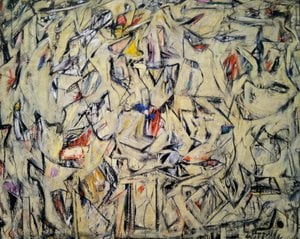
Willem de Kooning's "Whose Name Was Writ in Water," painted in 1975, is a powerfully evocative work that encapsulates the core tenets of Abstract Expressionism – a movement he helped define. This close-up view reveals not just paint on canvas, but a visceral outpouring of emotion and a deliberate disruption of traditional artistic representation. The painting’s dynamism stems from de Kooning's masterful manipulation of color and texture, creating a surface that seems to writhe with energy. Dominating the composition are bold strokes of red and blue, interwoven with strategic accents of green, yellow, and white – colors he frequently employed to convey intense psychological states. The title itself, “Whose Name Was Writ in Water,” adds another layer of complexity, hinting at themes of memory, loss, and perhaps even the elusive nature of identity.
De Kooning's technique is immediately apparent in this piece. The application of paint is anything but smooth; it’s deliberately rough, fragmented, and layered. Thick impasto – built-up areas of heavy paint – creates a tactile surface that demands attention. He employed a vigorous, almost violent brushstroke, often applying the paint with a palette knife as much as with his brushes. This technique wasn't simply about creating an image; it was about imbuing the canvas with feeling. The visible brushstrokes aren’t accidental; they are deliberate marks of energy and struggle, reflecting de Kooning’s own turbulent emotional landscape. The close-up view allows us to appreciate the sheer physicality of his process – a testament to his commitment to expressive abstraction.
"Whose Name Was Writ in Water" was created during a pivotal moment in art history, roughly halfway through de Kooning’s career. Following his early figurative work, particularly his iconic "Woman" series, he increasingly embraced abstraction, though always retaining a raw, almost confrontational quality. This painting reflects the broader trends of Abstract Expressionism – a movement born out of the anxieties and uncertainties of post-World War II America. Artists like de Kooning sought to express fundamental human emotions through non-representational forms, rejecting traditional notions of beauty and harmony. De Kooning’s work stands as a crucial bridge between his earlier explorations of figuration and his later, more purely abstract endeavors, showcasing the evolution of one of art's most influential figures.
The title itself is laden with potential symbolism. "Writ in Water" suggests something fleeting, ephemeral – perhaps a memory fading away or an attempt to capture a moment that’s inherently unstable. The dominant colors—red for passion and violence, blue for melancholy and introspection—contribute to the painting's overall mood of unease and intensity. Ultimately, “Whose Name Was Writ in Water” is not about literal representation; it’s about conveying an emotional state – a feeling of disorientation, struggle, and perhaps even a desperate search for meaning. It invites viewers to confront their own anxieties and grapple with the complexities of human experience.


1904 - 1997 , Paesi Bassi

Esplora i 10 capolavori dell'Espressionismo Astratto con ! Scopri Pollock, Rothko e De Kooning: storia, tecnica e significato di opere iconiche per arredare la tua casa con arte di alta qualità. Esplora la collezione online!

Esplora i 25 capolavori di Wassily Kandinsky, pioniere dell'arte astratta. Scopri la storia, il significato e le tecniche dietro ogni dipinto iconico. Trova riproduzioni d'arte di alta qualità per decorare la tua casa su WahooArt.com.

Esplora i 25 capolavori di Francisco Goya, il genio spagnolo tra Romanticismo e Realismo. Ritratti iconici, 'Los Caprichos' e le toccanti 'Disastri della Guerra'. Trova stampe su tela e riproduzioni artistiche di alta qualità per la tua casa su WahooArt.com.

Esplora i 10 dipinti più iconici dominati dal blu ardesia! Scopri la storia, gli artisti e le tecniche dietro capolavori impressionisti e moderni. Trova riproduzioni artistiche di alta qualità per decorare casa con .

Esplora l'evoluzione dell'espressionismo astratto con Willem de Kooning. Analisi approfondita del suo stile, l'influenza italiana e il suo impatto sull'arte moderna. Scopri perché De Kooning è un investimento prezioso per i collezionisti.

 Anteprima in scala reale
 Invia
Invia Condividi
 Dettagli opera

 Scarica immagine
 Simili
 Radiografia
 Slideshow

 Espandi i dettagli







 L'opzione vetro è disponibile solo per dimensioni inferiori a 110 cm