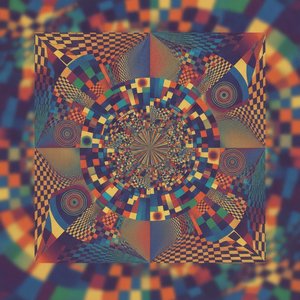
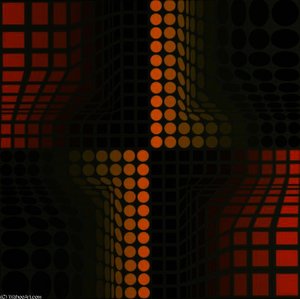
Victor Vasarely’s “Kezdi-All”: A Symphony of Geometric Perception
Victor Vasarely's "Kezdi-All," a captivating exploration of optical illusion and geometric abstraction, stands as a cornerstone of Op Art – a movement that fundamentally challenged our understanding of visual perception. This striking artwork, dominated by concentric circles of vibrant red and blue, invites the viewer into a world where form and color actively engage with the eye, creating an experience far removed from passive observation. Born Károly Vaszary in 1906 in Pécs, Croatia (then part of Austria-Hungary), Vasarely’s artistic trajectory began unexpectedly, initially driven by his medical studies before he was drawn to the expressive potential of painting. His subsequent training within the influential Bauhaus-inspired workshop of Sándor Bortnyik cemented his fascination with geometric abstraction and functional design – principles that would become the very DNA of his groundbreaking work.
The Genesis of Op Art: A Revolution in Sight
"Kezdi-All" exemplifies the core tenets of Op Art, a movement that emerged in the 1960s as artists sought to manipulate visual perception through precise geometric patterns. Vasarely, along with artists like Bridget Riley and Josef Albers, pioneered this approach, utilizing optical illusions to create dynamic and often unsettling effects. The seemingly simple arrangement of circles – a large central form surrounded by smaller iterations – generates an intense sense of movement and depth. This isn't merely a static image; it’s an active engagement with the viewer’s visual system, exploiting the brain’s inherent tendency to interpret patterns and create a perceived three-dimensional space where none truly exists. The deliberate use of contrasting colors—the bold reds and blues—further amplifies this effect, intensifying the illusion and drawing the eye across the composition.
Technique and Materiality: Precision and Illusion
Vasarely’s meticulous technique is central to the impact of “Kezdi-All.” Executed with a precision that borders on scientific, each circle is rendered with exacting accuracy. This deliberate control over form and color is not simply about aesthetic appeal; it's fundamentally about manipulating perception. The artwork was likely created using acrylic paint on canvas, a medium Vasarely favored for its ability to achieve sharp lines and vibrant colors – crucial elements in his optical experiments. The layering of these circles creates an illusion of depth and movement, further emphasizing the artwork’s dynamic qualities. The hand-painted reproduction offered by WahooArt.com faithfully captures this meticulous attention to detail, ensuring that the full impact of Vasarely's vision is realized.
Symbolism and Emotional Resonance
While ostensibly abstract, “Kezdi-All” can be interpreted as a meditation on order and chaos, structure and dynamism. The concentric circles evoke a sense of containment and expansion, mirroring the fundamental principles of geometry. The vibrant colors – red often associated with energy and passion, blue with tranquility and intellect – contribute to the artwork’s emotional resonance. More than just an aesthetic exercise, Vasarely's work invites contemplation on how we perceive reality, questioning our assumptions about space, time, and visual experience. The piece evokes a sense of wonder and intrigue, prompting viewers to actively participate in its creation.



 Anteprima in scala reale
 Ordina la riproduzione dipinta a mano
 Condividi
 Condividi
 Dettagli
 Guida stampabile

 Scarica
 Articoli simili
 Radiografia
 Slideshow
 Statistiche

 Leggi tutto






































 L'opzione vetro è disponibile solo per dimensioni inferiori a 110 cm