A Symphony of Perceptual Motion
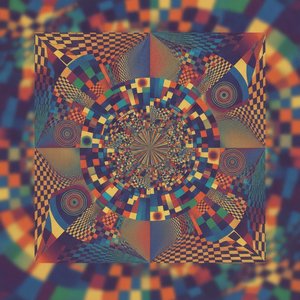
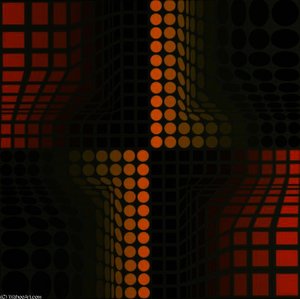
To encounter Victor Vasarely's 'Folklore' is to step away from the stillness of traditional viewing and enter a realm where the canvas begins to breathe, pulse, and vibrate with an engineered energy. Created in 1963, this masterpiece stands as a cornerstone of the Op Art movement—a period that revolutionized visual perception by turning the act of looking into a kinetic experience. The artwork does not merely sit upon a wall; it interacts with the eye, challenging our very understanding of depth, stability, and motion. Through a mesmerizing grid of squares, circles, and triangles, Vasarely orchestrates a rhythmic dance of geometry that invites the viewer to become an active participant in the creation of its illusion.
The composition is anchored by a powerful central square that draws the eye inward, only to find itself swept outward by a radiating expansion of smaller shapes. This deliberate arrangement creates a profound sense of spatial depth without ever relying on traditional perspective techniques. As your gaze wanders across the surface, the varying sizes and positions of these geometric elements generate a restless, undulating rhythm. It is a sophisticated play of mathematics and magic, where the rigid structure of a grid is disrupted by subtle asymmetries, ensuring that the eye can never truly rest, but must instead continue to navigate the shifting landscape of the canvas.
The Vibrancy of Color and Light
Vasarely’s mastery extends far beyond mere shape; he utilizes a vibrant, saturated color palette to amplify the artwork's inherent dynamism. The strategic juxtaposition of complementary colors—such as the striking tension between reds and greens or the energetic interplay of blues and oranges—maximates visual contrast and heightens the sensation of movement. These bold hues, set against stark blacks and whites, contribute to an atmosphere of intense energy that captures the experimental spirit of the mid-20th century. The lighting within the piece feels even and diffused, eschewing heavy shadows to emphasize the flatness of the geometric forms while simultaneously using color shifts to suggest a three-dimensional relief.
For the collector or interior designer, 'Folklore' offers an unparalleled opportunity to introduce a focal point of intellectual and aesthetic stimulation. The smooth, precise execution—likely achieved through meticulous planning and perhaps the use of stencils—results in a surface that feels modern, clean, and structurally sound. It is a work that embodies the influence of the Bauhaus movement, blending functional geometric discipline with an emotive, almost hypnotic power. Whether placed in a contemporary gallery setting or as a bold statement piece in a sophisticated living space, this reproduction brings the revolutionary spirit of Op Art into the modern home, offering a window into a world where art is not just seen, but felt.



 Anteprima in scala reale
 Passa alle stampe
 Condividi
 Condividi
 Dettagli
 Guida
Guida

 Scarica
 Articoli simili
 Radiografia
 Slideshow
 Statistiche

 Leggi tutto






































 L'opzione vetro è disponibile solo per dimensioni inferiori a 110 cm