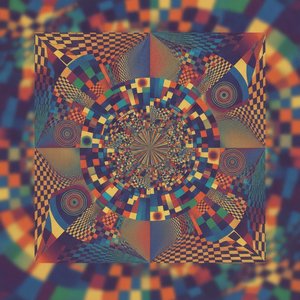
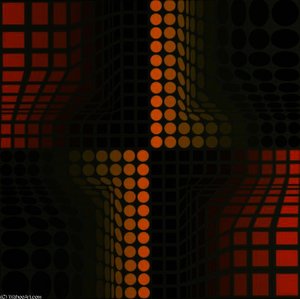
A Symphony in Geometric Harmony: Exploring Victor Vasarely’s “Cheyt Mc. 3”
Victor Vasarely's "Cheyt Mc. 3" is not merely a depiction of a sphere; it’s an invitation to experience the world through a radically altered lens. This vibrant artwork, born from the fertile ground of Op Art and kinetic principles, captures the essence of geometric abstraction with breathtaking precision and emotional resonance. The painting explodes with a meticulously constructed mosaic of hexagons – each one a carefully considered element within a larger, dynamic composition. The sheer density of color, ranging from deep blues and emerald greens to fiery reds, sunny yellows, and warm oranges, creates an immediate visual impact, drawing the viewer into its intricate depths.
The Genesis of Op Art: Vasarely’s Bauhaus Legacy
Understanding “Cheyt Mc. 3” requires a glimpse into the artistic landscape that birthed it. Victor Vasarely emerged as a key figure in the development of Op Art – Optical Art – during the mid-20th century. His journey began with a pragmatic, almost scientific approach to artmaking, heavily influenced by his formative years within Sándor Bortnyik’s “Műhely” workshop, directly connected to the revolutionary principles of the Bauhaus movement. The Bauhaus emphasized functional design and geometric abstraction, seeking to understand how our visual perception is constructed. Vasarely translated this theoretical framework into a powerfully expressive style, utilizing precise lines, contrasting colors, and repetitive patterns to create illusions of movement and depth – effects that challenged traditional notions of representation.
Technique and the Illusion of Movement
The creation of “Cheyt Mc. 3” exemplifies Vasarely’s meticulous technique. He employed a layering method, building up the composition through multiple thin washes of acrylic paint, allowing each layer to partially dry before applying the next. This process created subtle shifts in color and tone, contributing significantly to the artwork's shimmering effect. The precise arrangement of the hexagonal shapes isn't simply decorative; it’s carefully calibrated to manipulate our perception of space and create a dynamic sense of movement. Vasarely was fascinated by how the eye perceives patterns and how these perceptions can be deliberately manipulated to evoke specific emotional responses. This is evident in the artwork's almost hypnotic quality, inviting prolonged contemplation.
Symbolism and Emotional Impact
"Cheyt Mc. 3" transcends a purely visual experience; it speaks to fundamental questions about perception and reality. The geometric forms, repeated and varied, can be interpreted as representing the building blocks of our understanding – the basic elements that construct our world. The vibrant color palette isn't just aesthetically pleasing; it’s deliberately chosen to stimulate the senses and evoke feelings of energy, excitement, and perhaps even a sense of disorientation, mirroring the way our visual system processes complex patterns. This artwork is a testament to Vasarely's belief that art could be both intellectually stimulating and profoundly moving.



 Anteprima in scala reale
 Ordina la riproduzione dipinta a mano
 Condividi
 Condividi
 Dettagli
 Guida stampabile

 Scarica
 Articoli simili
 Radiografia
 Slideshow
 Statistiche

 Leggi tutto






































 L'opzione vetro è disponibile solo per dimensioni inferiori a 110 cm