Olio su tela dipinto a mano nelle tue dimensioni e con la tua cornice, realizzato su ordinazione dai nostri artisti. ( Acquista stampa Acquista immagine)





























Scegli tra le nostre dimensioni predefinite, che rispettano le proporzioni originali dell'opera d'arte.

È possibile inserire dimensioni personalizzate per adattare l'opera a una cornice o a uno spazio specifico. Se la dimensione selezionata non corrisponde alle proporzioni dell'immagine originale, provvederemo a ritagliare l'opera o a estendere il dipinto con elementi aggiuntivi dipinti a mano. Un mockup digitale ti sarà inviato per approvazione prima dell'inizio della produzione.
Si prega di notare che l'anteprima a schermo non riflette il ritaglio o l'estensione effettivi. Solo il mockup mostrerà accuratamente la composizione finale.
Sebbene siano disponibili dimensioni personalizzate, consigliamo di selezionare una dimensione dall'elenco predefinito per preservare le proporzioni originali.
Consegna in tutto il mondo () in 3/4 settimane anziché nelle normali 5 settimane. (7 Settembre). Nessun compromesso sulla qualità.


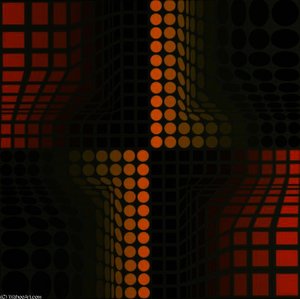
Axo-11
Dimensioni riproduzione
Victor Vasarely's Axo-11 is not merely a painting; it’s an invitation to contemplate the very nature of perception. Created by one of the foremost figures in Op Art, this striking black and white composition immediately commands attention with its deceptively simple arrangement: a meticulously checkered square punctuated by a startlingly vibrant blue void. The image, a photographic representation of Vasarely's original work, captures the essence of his groundbreaking approach – a systematic exploration of optical illusions and the dynamic effects created through geometric abstraction.
Born in 1906 in Pécs, Croatia (then part of Austria-Hungary), Károly Vaszary, as he was initially known, embarked on a remarkable artistic journey. Initially drawn to medicine, his passion shifted dramatically upon enrolling at the Podolini-Volkmann Academy and later Sándor Bortnyik’s influential “Műhely” workshop – a direct descendant of the Bauhaus movement. This immersion in functional design and geometric abstraction proved transformative. Vasarely wasn't simply painting; he was meticulously constructing visual experiences, anticipating the rise of Op Art with his focus on manipulating perception through controlled patterns and color variations. His work reflects a deep engagement with the theories of Gestalt psychology, particularly the principles of figure-ground relationships – the inherent human tendency to organize visual elements into meaningful wholes.
The creation of Axo-11 exemplifies Vasarely’s precise technique. The black and white checkered pattern, achieved through meticulous layering and control of pigment density, generates a subtle but powerful sense of movement. This is not accidental; it's the deliberate orchestration of visual elements designed to trick the eye. The blue void, strategically placed at the center, acts as a focal point, intensifying the illusion of depth and creating an unsettling yet captivating dynamic. Vasarely’s process involved painstaking hand-painting, ensuring each element contributed to the overall effect – a testament to his dedication to precision and control. The seemingly static image is, in fact, a carefully constructed illusion, demanding active engagement from the viewer.
Beyond its purely optical properties, Axo-11 carries symbolic weight. The square, a fundamental geometric form, represents stability and order – yet this is immediately disrupted by the void, suggesting emptiness, uncertainty, or perhaps even the subconscious. The blue color itself, often associated with tranquility and spirituality, introduces an element of contrast and intrigue. Vasarely’s work isn't about depicting reality; it’s about exploring the subjective experience of seeing. The piece evokes a sense of both fascination and unease, prompting viewers to question their own perceptions and the way they interpret visual information. It’s a powerful reminder that our understanding of the world is inherently constructed.
Victor Vasarely (nato Károly Vaszary) è stato una figura fondamentale nello sviluppo dell'Op Art e dell'arte cinetica. La sua opera mirava a trascendere la pittura tradizionale esplorando illusioni ottiche e creando esperienze visive dinamiche. Nato a Pécs, all'epoca parte dell'Austria-Ungheria (ora Croazia), la sua prima vita vide lo studio della medicina presso l'Università Eötvös Loránd di Budapest prima di dedicarsi completamente all'arte.
Il contributo di Vasarely alla storia dell'arte è multiforme. Ha superato le tecniche pittoriche tradizionali per creare opere che coinvolgono attivamente la percezione dello spettatore. Il suo approccio sistematico ha sfidato le nozioni convenzionali di creatività artistica e ha aperto la strada all'arte generata al computer e al design digitale. Abbracciando la riproducibilità e le applicazioni commerciali, Vasarely ha offuscato i confini tra arte figurativa e cultura popolare, lasciando un segno duraturo in entrambi.

1906 - 1997 , Croazia

Explore the profound spiritual depth of geometric abstraction. From Malevich's Suprematism to modern masters, our expert guide reveals how pure form and color command presence in fine art collections.

 Anteprima in scala reale
 Invia
Invia Condividi
 Dettagli opera

 Scarica immagine
 Simili
 Radiografia
 Slideshow

 Espandi i dettagli







 L'opzione vetro è disponibile solo per dimensioni inferiori a 110 cm