

Ottieni un file pronto per la stampa che supera di gran lunga l'anteprima web. Ogni immagine digitale in vendita proviene da un master ad alta risoluzione del nostro archivio — con una larghezza solitamente compresa tra 5.000 e 15.000 pixel — permettendoti di stampare in grande formato, ritagliare con precisione o riprodurre dettagli minuziosi in totale sicurezza.
Nessun file lascia il nostro studio senza essere stato elaborato. Un esperto digitale verifica la corrispondenza dei colori con il dipinto originale e li corregge se necessario, per poi migliorarne la nitidezza e i dettagli attraverso strumenti di fotoritocco professionale — mantenendo sempre fedeltà alla pennellata e allo stile dell'artista. Il risultato è un'immagine che appare come il dipinto stesso, e non come una scansione filtrata.
L'approvazione avviene prima della conclusione dell'ordine: il nostro esperto invierà l'immagine via e-mail entro 72 ore per la tua revisione. Non sei soddisfatto? Puoi richiedere modifiche o correzioni, oppure un rimborso qualora la qualità non dovesse soddisfare le tue aspettative.
Questa è la qualità su cui fanno affidamento editori, studi di design, gallerie e stamperie.
Scarica un file ad alta risoluzione per uso personale, per la stampa e per progetti creativi. ( Passa alle stampe Acquista il dipinto realizzato a mano)
Quando scegli WahooArt.com, non riceverai solo un'immagine: riceverai un'opera d'arte digitale professionalmente ottimizzata, realizzata con la massima precisione e accompagnata da una garanzia di soddisfazione. Ecco tutto ciò che include il tuo ordine, automaticamente:
Riceverai il file dell'immagine digitale ad alta risoluzione via email entro 72 ore dall'ordine, pronto per un uso immediato.
La tua opera d'arte viene ottimizzata professionalmente attraverso l'uso di strumenti avanzati di intelligenza artificiale e una revisione manuale, garantendo il massimo livello di dettaglio, nitidezza e accuratezza cromatica.
Hai eliminato o perso accidentalmente il tuo file? Non preoccuparti: te lo invieremo di nuovo in qualsiasi momento, gratuitamente.
Goditi la tua opera d'arte istantaneamente senza costi doganali, dazi o spese di spedizione: i download digitali sono sempre esenti da tasse.
Garantiamo che la tua immagine digitale rifletta i colori originali con la massima fedeltà, grazie all'uso di strumenti professionali e a una gestione accurata del colore.
Se non sei soddisfatto della tua immagine digitale, la revisioneremo o ti rimborseremo il 100% entro 100 giorni, senza domande.
Non sei soddisfatto? Ricevi un rimborso completo entro 100 giorni dal ricevimento del tuo file digitale, senza dover fornire spiegazioni.
Acquista 3 immagini, risparmia il 10% - Acquista 5, risparmia il 15% - Acquista 10+, risparmia il 20%. Ideale per progetti creativi, gallerie e agenzie.
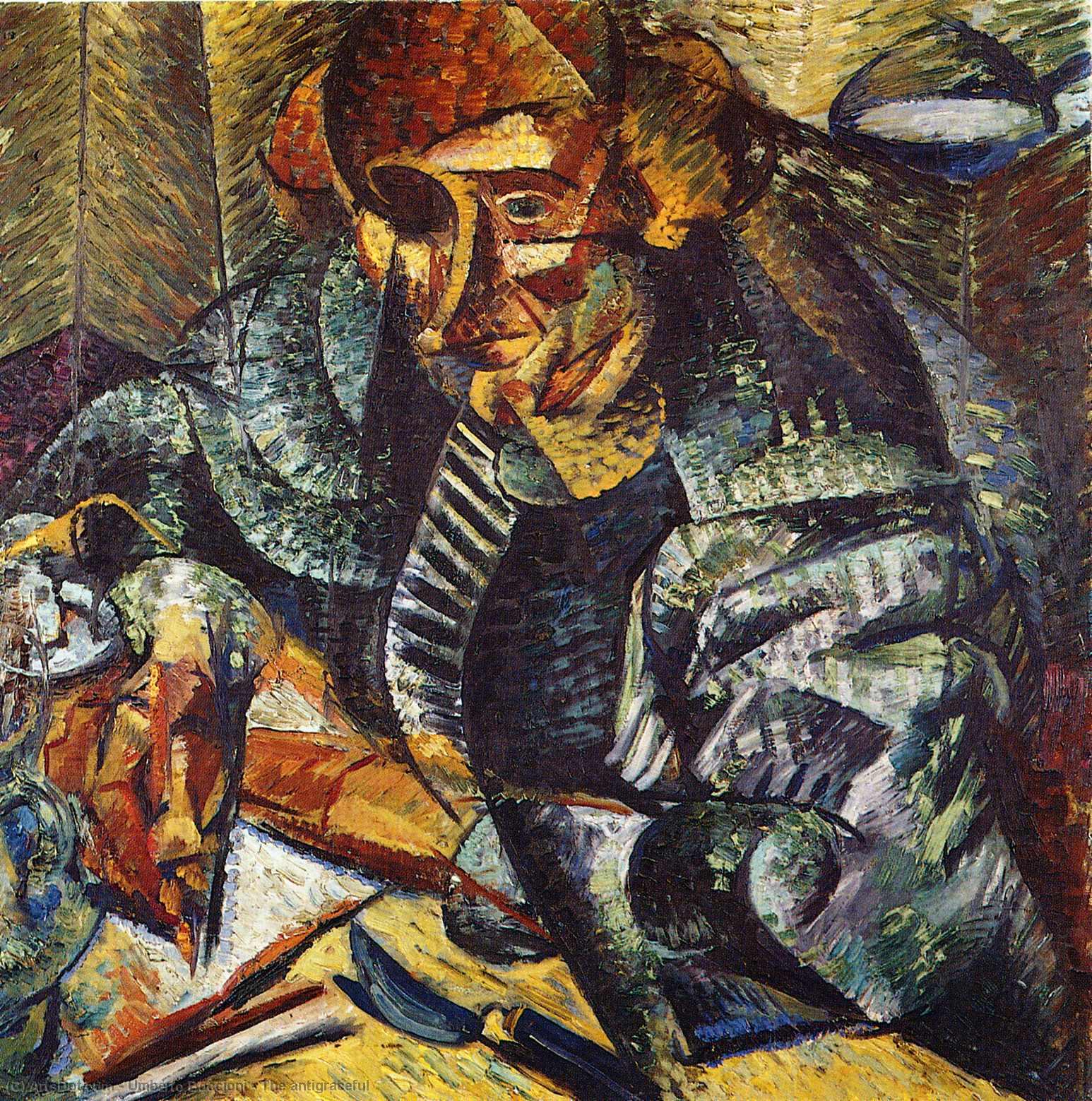
Umberto Boccioni's 1912 work, *The antigraceful*, is not merely a portrait; it’s a manifesto rendered in paint. A defiant gesture against the established artistic conventions of its time, this piece embodies the core tenets of Futurism – a movement obsessed with dynamism, technology, and the rejection of the past. Rather than seeking to capture conventional beauty, Boccioni aimed to dissect and reconstruct form, presenting a vision that was deliberately unsettling yet profoundly modern. The painting depicts his mother, Cecilia Forlani, but it’s not a sentimental tribute; instead, it's an intellectual exploration of how perception itself can be fragmented and reassembled.
To understand *The antigraceful*, one must consider the artistic climate of early 20th-century Italy. Boccioni, alongside artists like Giacomo Balla and Carlo Carrà, felt stifled by the academic traditions that dominated the art world. They sought to break free from these constraints, embracing a new aesthetic inspired by the speed and energy of modern life – the automobile, the factory, the bustling city streets. This fascination with motion is subtly present even in this seemingly static portrait; the fractured planes and angular forms suggest an underlying sense of restlessness, as if Cecilia Forlani herself is caught within a whirlwind of change. The influence of Paul Cézanne and, notably, Pablo Picasso’s early Cubist experiments are visible here, but Boccioni wasn't simply imitating these artists. He was adapting their techniques to express the unique spirit of Italian Futurism – a desire not just to depict reality, but to *dynamize* it.
The technique employed in *The antigraceful* is crucial to its impact. Boccioni abandons traditional modeling and shading, opting instead for a fractured composition built from intersecting planes of color. This deliberate distortion isn’t arbitrary; it's intended to convey the subject’s inner life – her thoughts, emotions, and experiences – as a complex interplay of forces. The painting doesn’t offer a single, fixed perspective; rather, it presents multiple viewpoints simultaneously, challenging the viewer to actively participate in constructing meaning. The muted palette, dominated by earthy tones with subtle accents of blue and yellow, further enhances the sense of introspection and psychological depth. It's a far cry from the idealized portraits of previous generations, offering instead a raw and honest portrayal of human experience. The title itself – *Antigraceful* – is a deliberate provocation, signaling Boccioni’s rejection of conventional notions of beauty and harmony.
Though his life was tragically cut short by war in 1916, Umberto Boccioni left an indelible mark on the history of art. *The antigraceful* remains a powerful testament to his artistic vision – a bold declaration of independence from tradition and a pioneering exploration of new ways of seeing and representing the world. Today, this work continues to resonate with audiences, inspiring artists and captivating collectors alike. A reproduction of *The antigraceful* isn’t just an acquisition; it's an invitation to engage with a pivotal moment in art history – a moment when the very foundations of artistic expression were being challenged and redefined.
Title: The antigraceful
Description:
Umberto Boccioni's 1912 work, *The antigraceful*, is not merely a portrait; it’s a manifesto rendered in paint. A defiant gesture against the established artistic conventions of its time, this piece embodies the core tenets of Futurism – a movement obsessed with dynamism, technology, and the rejection of the past. Rather than seeking to capture conventional beauty, Boccioni aimed to dissect and reconstruct form, presenting a vision that was deliberately unsettling yet profoundly modern. The painting depicts his mother, Cecilia Forlani, but it’s not a sentimental tribute; instead, it's an intellectual exploration of how perception itself can be fragmented and reassembled.
To understand *The antigraceful*, one must consider the artistic climate of early 20th-century Italy. Boccioni, alongside artists like Giacomo Balla and Carlo Carrà, felt stifled by the academic traditions that dominated the art world. They sought to break free from these constraints, embracing a new aesthetic inspired by the speed and energy of modern life – the automobile, the factory, the bustling city streets. This fascination with motion is subtly present even in this seemingly static portrait; the fractured planes and angular forms suggest an underlying sense of restlessness, as if Cecilia Forlani herself is caught within a whirlwind of change. The influence of Paul Cézanne and, notably, Pablo Picasso’s early Cubist experiments are visible here, but Boccioni wasn't simply imitating these artists. He was adapting their techniques to express the unique spirit of Italian Futurism – a desire not just to depict reality, but to *dynamize* it.
The technique employed in *The antigraceful* is crucial to its impact. Boccioni abandons traditional modeling and shading, opting instead for a fractured composition built from intersecting planes of color. This deliberate distortion isn’t arbitrary; it's intended to convey the subject’s inner life – her thoughts, emotions, and experiences – as a complex interplay of forces. The painting doesn’t offer a single, fixed perspective; rather, it presents multiple viewpoints simultaneously, challenging the viewer to actively participate in constructing meaning. The muted palette, dominated by earthy tones with subtle accents of blue and yellow, further enhances the sense of introspection and psychological depth. It's a far cry from the idealized portraits of previous generations, offering instead a raw and honest portrayal of human experience.
Though his life was tragically cut short by war in 1916, Umberto Boccioni left an indelible mark on the history of art. *The antigraceful* remains a powerful testament to his artistic vision – a bold declaration of independence from tradition and a pioneering exploration of new ways of seeing and representing the world.
80 x 80 cm
1912
"La antigraziosa" è stata realizzata nel 1912 con la tecnica Acrilico su tela. Il materiale e la data descrivono come e quando l'opera originale è stata creata.
La composizione cromatica di "La antigraziosa" di Umberto Boccioni coniuga un Deciso contrasto con una Tavolozza dai toni sfumati armonia.
Una tonalità Gamma di gialli dorati attraversa l'opera "La antigraziosa" di Umberto Boccioni.


1882 - 1916 , Italia
 Anteprima in scala reale
 Invia
Invia Condividi
 Dettagli opera
 Guida
Guida

 Scarica
 Simili
 Radiografia
 Slideshow
 Domande e risposte
 Statistiche

 Espandi i dettagli


