A Vision of Rural Tranquility: The Genesis of "Giverny"
Theodore Robinson's “Giverny,” painted in 1888, isn’t merely a landscape; it’s a distilled moment of profound serenity captured with the delicate brushstrokes characteristic of American Impressionism. Born in Vermont and deeply influenced by European artistic traditions – particularly the luminist painters who championed the effects of light – Robinson sought to translate his observations of nature into a uniquely American visual language. This particular canvas, rendered in oil on canvas, transports us to a quiet corner of rural France, a place where the boundaries between reality and dream seem to blur. The scene unfolds within a verdant valley, dominated by a modest farmhouse nestled amongst rolling hills, its simple form offering a grounding presence amidst the ethereal light.
Robinson’s artistic journey was marked by a pivotal relocation to Giverny in 1887, a village already renowned for its connection to Claude Monet. This immersion into the heart of Impressionism profoundly shaped Robinson's style. He wasn’t simply copying Monet; he was absorbing and reinterpreting his mentor’s techniques, adapting them to his own sensibility and incorporating elements of his native American landscape. The painting reflects this synthesis – a harmonious blend of French luminosity and distinctly American spatial awareness.
The Language of Light: Technique and Impressionistic Detail
Close examination reveals Robinson's masterful command of light and color. He employs broken brushstrokes, layering thin washes of paint to create an atmospheric effect that mimics the shifting qualities of sunlight filtering through foliage. The dappled shadows dance across the fields and hillsides, while highlights shimmer on the weathered stone walls of the farmhouse. Notice how he captures the fleeting effects of time – a subtle sense of warmth suggesting late afternoon, hinting at the promise of twilight. The composition is carefully balanced, drawing the eye towards the distant horizon where the sky merges seamlessly with the landscape.
- Color Palette: Dominated by muted greens, blues, and browns, punctuated by flashes of warm ochre and lavender.
- Brushwork: Loose, expressive strokes that convey movement and atmosphere rather than precise detail.
- Value Contrast: Subtle gradations of light and shadow create a sense of depth and volume.
Symbolism and the American Soul
Beyond its purely aesthetic qualities, “Giverny” resonates with deeper symbolic meaning. The humble farmhouse represents the virtues of simplicity and connection to the land – values deeply rooted in the American ethos. Robinson’s choice to depict a rural scene speaks to his desire to capture the essence of the American experience, translating the beauty of nature into a visual language that reflects his own identity. The painting can be interpreted as an ode to the restorative power of nature and the quiet dignity of rural life.
Furthermore, the painting’s connection to Giverny—a place already associated with artistic innovation—underscores Robinson's role as a pioneer in American Impressionism. He wasn’t merely replicating European trends; he was forging his own path, establishing a distinct voice within the burgeoning American art scene.
A Legacy of Light: Reproduction and Artistic Inspiration
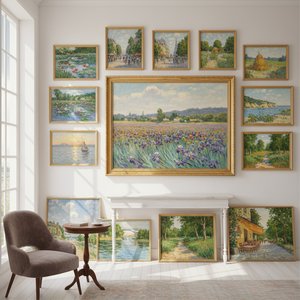
Reproductions of “Giverny” offer a remarkable opportunity to experience Robinson's luminous vision firsthand. Whether displayed in a grand salon or a cozy study, this painting evokes feelings of tranquility, nostalgia, and connection to the natural world. Its timeless appeal lies not only in its technical brilliance but also in its ability to transport us to a place of profound beauty and serenity. Consider framing your reproduction within a warm, neutral color palette to best complement the painting’s delicate hues, allowing Robinson's masterful use of light to truly shine.
Domande e risposte
Qual è la luminosità di "Giverny" di Teodoro Robinson?
I colori di "Giverny" mostrano una luminanza Bright Balance.
"Giverny" dispone di un'anteprima in realtà aumentata?
"Giverny" dispone di un'anteprima in realtà aumentata: la pagina Anteprima AR dell'opera ti permette di visualizzarla nel tuo spazio tramite un dispositivo compatibile.
Per quale motivo lo stato del copyright di "Giverny" è questo?
"Giverny" di Teodoro Robinson è di di pubblico dominio - il suo copyright è scaduto. I termini del copyright si calcolano a partire dalla morte dell'artista, e Teodoro Robinson è deceduto nel 1896.



 Anteprima in scala reale
 Passa alle stampe
 Condividi
 Condividi
 Dettagli
 Guida stampabile

 Scarica
 Articoli simili
 Radiografia
 Slideshow
 Statistiche


 Leggi tutto






































 L'opzione vetro è disponibile solo per dimensioni inferiori a 110 cm