A Dreamscape of Brazilian Serenity
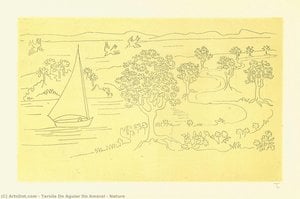
In the quiet corners of art history, few works capture the essence of pastoral tranquility as tenderly as Tarsila do Amaral’s Landscape VII. Created in 1971, toward the twilight of the artist's illustrious career, this piece serves as a window into a world where time seems to slow down. The painting presents a breathtakingly serene landscape, depicting a small, nestled village cradled by rolling hills and the gentle presence of water. It is an invitation to step away from the chaos of modernity and enter a realm of soft light and rhythmic simplicity. Through her masterful use of pastel shades—delicate pinks, ethereal blues, and lush greens—Amaral crafts a dreamlike atmosphere that feels both intimately familiar and otherworldly.
The composition is a masterclass in balanced, horizontal layering. The viewer’s eye is led through a series of soft bands: a verdant foreground suggesting cool water or thick vegetation, a central stage featuring quaint architecture and a striking rock formation, and finally, a background of pink-hued hills that melt into the horizon. There is a charming, almost naive quality to the perspective; by eschewing harsh linear recession in favor of a flatter, more two-dimensional arrangement, the artist emphasizes the decorative beauty of the scene. This approach allows the shapes—the rounded contours of the hills and the organic forms of the trees—to dance across the canvas with a rhythmic, folk-art grace.
Technique and the Texture of Memory
To behold Landscape VII is to witness the tactile power of oil on canvas. Amaral employs a technique characterized by visible, expressive brushstrokes that lend the work a vibrant, living energy. The application of paint is particularly noteworthy in the central rock formation and the surfaces of the buildings, where thick impasto creates a physical texture you can almost feel with your eyes. This ruggedness provides a beautiful counterpoint to the soft, diffused lighting that permeates the scene, suggesting the gentle glow of an overcast afternoon. Every stroke feels intentional, contributing to a surface that is as much about the physical presence of the medium as it is about the subject matter itself.
For the discerning collector or interior designer, this piece offers a unique opportunity to introduce a sense of calm and sophisticated nostalgia into a space. The artwork does not merely decorate a wall; it transforms an environment. Its soft palette and organic shapes make it an ideal centerpiece for rooms designed for relaxation, such as a master suite or a quiet reading nook. Because the style leans toward the Antropofagia movement's roots while embracing a more mature, simplified aesthetic, it bridges the gap between avant-garde history and timeless decorative elegance.
A Legacy of Peace and Identity
Beyond its visual splendor, Landscape VII carries a profound symbolic weight. As a pivotal figure in Brazilian Modernism, Tarsila do Amaral spent her life distilling the soul of her nation into bold, innovative forms. In this later work, that mission evolves into an exploration of harmony and peace. The village scene acts as a symbol of a life lived in equilibrium with nature, where human habitation and the earth exist in a seamless, unconflicted embrace. It evokes a sense of nostalgia for a simpler era, making it deeply resonant for anyone seeking to surround themselves with art that promotes emotional well-being.
Owning a high-quality reproduction of this masterpiece allows one to possess a fragment of Brazilian cultural identity. Whether you are an art historian captivated by her evolution from Cubist influences to folk-inspired simplicity, or a decorator looking for a piece that breathes tranquility into a contemporary setting, Landscape VII stands as a testament to the enduring power of the landscape to soothe the human spirit. It is more than a painting; it is a quiet sanctuary captured in pigment.



 Anteprima in scala reale
 Passa alle stampe
 Condividi
 Condividi
 Dettagli
 Guida
Guida

 Scarica
 Articoli simili
 Radiografia
 Slideshow
 Statistiche


 Leggi tutto






































 L'opzione vetro è disponibile solo per dimensioni inferiori a 110 cm