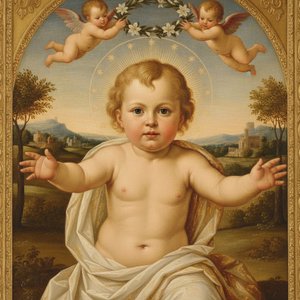
A Vision of Divine Motherhood: Botticelli’s *The Virgin and Child with Saint John and Two Angels*
Sandro Botticelli, a name synonymous with the grace and ethereal beauty of the Early Renaissance, invites us into a realm of serene devotion with his painting, The Virgin and Child with Saint John and Two Angels. This exquisite work, likely created within the bustling artistic environment of Florence during the late 15th century, is not merely a religious depiction but a testament to Botticelli’s mastery of line, color, and emotional resonance. The scene unfolds with a gentle intimacy, centering on the Virgin Mary tenderly cradling the Christ Child. Surrounding them are two delicate angels, their gazes fixed upon the divine pair, while in the background, the youthful figure of Saint John the Baptist observes with quiet reverence.
The Florentine Renaissance and Botticelli’s Unique Style
To understand this painting fully, one must consider the artistic climate of Florence during Botticelli’s lifetime. The city was a crucible of innovation, witnessing a revival of classical ideals alongside deeply held religious beliefs. Botticelli, born Alessandro di Mariano Filipepi in 1445, absorbed these influences and forged a style uniquely his own. He moved beyond the strict realism championed by some contemporaries, embracing instead an elegant linearity and a delicate use of color that evokes a sense of otherworldly grace. His figures are not defined by muscular anatomy or dramatic perspective, but rather by flowing contours and expressive gestures. This is particularly evident in the way Mary’s drapery seems to float around her, and how the angels’ wings appear almost translucent. Botticelli’s training as a goldsmith – as recounted by Giorgio Vasari – instilled in him a meticulous attention to detail, visible in the intricate rendering of the floral elements scattered throughout the composition.
Symbolism Woven into Every Detail
Beyond its aesthetic appeal, The Virgin and Child with Saint John and Two Angels is rich in symbolic meaning. The flowers adorning the scene are not merely decorative; they carry specific religious connotations. Lilies, often associated with purity and the Virgin Mary herself, intertwine with other blossoms representing divine love and grace. Saint John the Baptist’s presence foreshadows Christ's future role as savior, while the angels symbolize heavenly messengers and divine protection. The composition itself is carefully balanced, creating a harmonious visual experience that reflects the spiritual harmony it represents. Botticelli often employed circular formats – tondos – for his depictions of the Madonna and Child, further emphasizing the sense of wholeness and eternity inherent in the subject matter. The tender interaction between Mary and Jesus speaks to the core tenets of Christian faith: love, sacrifice, and redemption.
A Vision of Serenity and Grace
What truly sets this painting apart is its ability to evoke a profound sense of peace and devotion. The soft color palette, dominated by blues, pinks, and golds, creates a calming atmosphere. The figures’ gentle expressions and graceful poses invite contemplation and reverence. Botticelli doesn't present a dramatic or theatrical scene; instead, he offers an intimate glimpse into a moment of quiet sanctity. This quality makes the work particularly appealing for private devotion, as it was likely intended to be displayed in a domestic setting. For those seeking to bring a touch of Renaissance serenity into their own homes, a hand-painted reproduction of The Virgin and Child with Saint John and Two Angels offers not only a beautiful artwork but also a powerful symbol of faith, hope, and enduring beauty.
Technical Considerations
Botticelli’s masterful technique—tempera on wood—contributes significantly to the painting's luminous quality. The meticulous layering of pigments ensures that every detail is rendered with exceptional precision. Furthermore, Botticelli’s use of delicate hatching lines creates a subtle textural effect, enhancing the sense of depth and realism despite his stylized approach. Careful observation reveals the artist’s painstaking attention to capturing the nuances of light and shadow, resulting in an image that radiates warmth and tranquility.



 Anteprima in scala reale
 Ordina la riproduzione dipinta a mano
 Condividi
 Condividi
 Dettagli
 Guida
Guida

 Scarica
 Articoli simili
 Radiografia
 Slideshow
 Statistiche

 Leggi tutto






































 L'opzione vetro è disponibile solo per dimensioni inferiori a 110 cm